

A Toronto homeowner often notices the problem the same way. The house goes quiet, the lights are off, and then there's a faint scratching behind the drywall, a quick scurry above the ceiling, or a rustle near the kitchen at night. That sound is unsettling because it usually means the issue started before it was noticed.
Toronto homes give rodents plenty of ways in. The city had about 2.79 million residents living in 1,160,892 private dwellings in the 2021 Census, a level of housing density that creates many opportunities for rodents to move between buildings, find shelter, and exploit small structural gaps, especially in older neighbourhoods and multi-unit properties, according to Toronto housing and census context. For Toronto residents searching for rodent control near me, that matters because the problem usually isn't just bad luck. It's tied to how dense urban housing works.
The good news is that a rodent problem can be brought under control. It takes the right sequence, a realistic view of what DIY can and can't do, and a company that treats the building as a system instead of dropping bait and leaving.
Table of Contents
- That Scratching in the Walls Is Not Your Imagination
- First Signs of Rodents in Your Toronto Home
- Immediate DIY Safety Measures You Can Take Tonight
- How to Choose the Right Rodent Control Company in the GTA
- The Professional Process and Toronto Service Costs
- Preparing Your Home for and After Rodent Removal
- Your Questions Answered Why Trust Vanish for Toronto Rodent Control
That Scratching in the Walls Is Not Your Imagination
A small sound at night is easy to dismiss once. It's harder to ignore when it happens again near the pantry, behind the bathroom wall, or in the attic over a bedroom. For many Toronto residents, that's the moment worry turns into a search for rodent control near me.
In dense parts of Toronto, rodents don't need a dramatic opening to get established. A narrow gap where pipes enter the wall, an unsealed utility line, a worn door sweep, or a shared void between semi-detached homes can be enough. In condos, the route may be through service penetrations, garbage areas, or connected utility chases rather than a visible hole in the living space.
Why the stress feels so immediate
Rodents make people uneasy for good reason. They contaminate food areas, create odours, leave droppings, and often stay hidden long enough for activity to spread beyond one room. A family may first hear movement in the ceiling, then find signs in the basement, then notice gnawing under the kitchen sink.
Rodent problems feel personal, but in Toronto they're often structural. The home is where the signs appear, yet the pressure usually comes from the surrounding building conditions.
That's why quick reassurance matters. A rodent issue in Toronto doesn't mean a home is dirty or neglected. It usually means rodents found a route, a hiding spot, and a reason to stay. Once those three things are identified, the problem becomes manageable.
First Signs of Rodents in Your Toronto Home
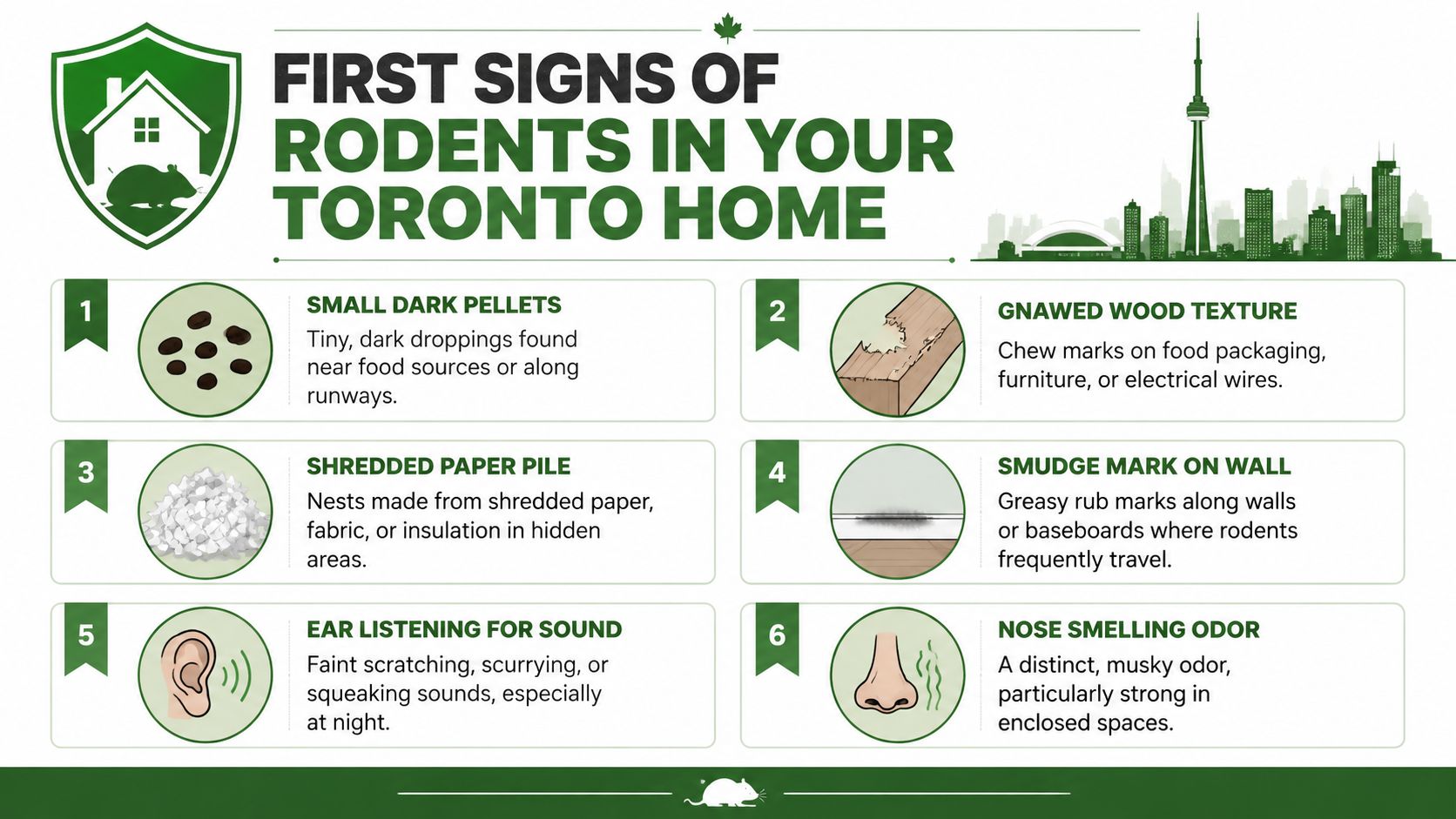
The first useful question isn't “How bad is it?” It's “What evidence is present?” Proper rodent control starts with signs, patterns, and location.
What professionals look for first
The most reliable clues are usually subtle.
- Droppings near activity routes. These are often found under sinks, behind appliances, inside pantry corners, along basement ledges, or near stored pet food.
- Grease marks and runways. Rodents tend to follow walls and repeat the same travel routes. Over time, they can leave dark rub marks along baseboards, utility edges, or framing.
- Gnawing damage. Food packaging, soft wood, cardboard, and wiring insulation may show chewing.
- Nest material. Shredded paper, fabric, insulation, or soft debris in a warm hidden space often points to an active harbourage area.
- Noise and odour. Scratching, squeaking, or a musky smell in enclosed spaces can help narrow down where activity is concentrated.
A condo resident in CityPlace might notice signs in a service closet or under the kitchen sink. Someone in a Cabbagetown house may find activity behind a radiator cover, in a cellar corner, or where old plumbing penetrations were never fully sealed.
Where Toronto rodents tend to show up
A major challenge in the GTA is multi-unit housing. Rodents can travel through shared walls, voids, and utility chases in condos and apartment buildings, so a problem in one unit can affect others unless the building is addressed as a system, not just as one isolated suite, as noted in guidance on multi-unit rodent issues.
That building-wide mindset matters in older Toronto semis too. Shared masonry walls, patched renovations, rear additions, crawlspaces, detached garages, and laneway waste storage all create pathways that don't show up in a quick visual scan.
For buyers and owners who want to think preventively, Royal LePage home buyer advice is a useful reminder that hidden structural issues often reveal themselves around utility entries, moisture-prone areas, and neglected storage spaces. Those are the same places rodent evidence is often found first.
Practical rule: If signs appear in one room, the nesting site may be somewhere else. The visible evidence is often the travel route, not the source.
Immediate DIY Safety Measures You Can Take Tonight
When rodents are active, the goal for the first night is containment, not amateur extermination. Fast, simple changes reduce access to food and shelter and make professional treatment more effective later.
Contain food and reduce access
Start in the kitchen and any place food is stored.
- Move dry goods into sealed containers. Cereals, rice, flour, pet food, and snacks shouldn't stay in thin bags or cardboard once activity is suspected.
- Clean grease and crumbs thoroughly. Focus on under the stove, around the fridge, under the toaster, and inside lower cabinets.
- Secure waste indoors and out. Toronto homes with green bins, recycling, and bagged garbage near side entrances should make sure lids fit tightly and overflow is removed.
- Reduce clutter where rodents can hide. Basements, furnace rooms, garages, and storage lockers often give rodents protected resting areas close to pipes and wiring.
A homeowner doesn't need to empty the entire house. It's more useful to clear access around likely travel routes and eliminate easy food rewards.
What not to do before help arrives
Some DIY habits make the problem harder to solve.
- Don't scatter poison loosely. That creates safety risks and can lead to rodents dying in inaccessible voids.
- Don't seal holes while active rodents are still moving freely inside without a plan. Wrong timing can trap activity in wall voids and push rodents into new rooms.
- Don't rely on mothballs. Many Toronto residents ask about them, but why mothballs don't solve mouse problems is worth understanding before using them as a shortcut.
- Don't ignore pet food overnight. Bowls left out in kitchens and laundry rooms often sustain activity.
A calm cleanup beats a panic purchase. Sanitation and access reduction help immediately. Random products usually don't.
How to Choose the Right Rodent Control Company in the GTA
Typing rodent control near me into a search bar is easy. Choosing the right company is where most homeowners either save themselves weeks of frustration or end up paying for repeat visits that don't fix the source.
Toronto rodent work should be systematic. Rodent activity is a recognised municipal issue, not just an occasional nuisance, and the City's complaint tracking and prevention guidance reflect the need for inspection, prevention, and structured follow-up rather than repeated one-off extermination, as described in municipal rodent management context.
Questions worth asking on the first call
A good company should be comfortable answering direct questions in plain language.
Ask whether the service includes a full inspection of entry points, not just trap placement. Ask whether the technician looks at exterior gaps, pipe penetrations, garage edges, attic access points, and signs along wall lines. If the answer stays vague, that's a warning.
Ask how they handle condos, semi-detached homes, and multi-unit buildings. Toronto pest problems often cross boundaries. A company that only talks about “spraying” or “putting down something strong” may not be thinking about structural movement routes at all.
A few other useful questions:
- What is the treatment sequence? A serious provider should describe inspection, control, sanitation recommendations, exclusion, and follow-up.
- What kind of documentation is provided? Homeowners and property managers should know what was found and what needs repair.
- What happens if activity continues? The answer should explain next steps, not just promise that everything will be gone instantly.
- Are safety measures explained clearly? Homes with children, pets, tenants, or shared common areas need clear instructions.
Red flags that should make Toronto residents pause
Some warning signs show up before the appointment is even booked.
- Pressure to commit immediately. Good operators explain the process. They don't rush a frightened homeowner into a decision.
- No interest in building conditions. If nobody asks about the type of property, age of the home, garbage setup, or where signs were found, the approach may be too generic.
- Promises of a one-visit cure without inspection. Rodent control rarely works that way in Toronto housing.
- Vague answers about proofing. If the company can't discuss sealing work, they may be offering a short-term kill service instead of actual management.
- Cash-only or unclear paperwork. That usually points to weak accountability.
The right hire should sound methodical, not dramatic. Rodent control works best when the company explains the building, the access points, and the follow-up in simple terms.
Vetting your Toronto rodent control pro questions to ask
| Question Category | What to Ask | Why It Matters |
|---|---|---|
| Licensing and insurance | Ask whether the company is properly licensed for pest control work in Ontario and carries liability insurance | Rodent service involves treatment decisions, safety procedures, and work around occupied homes |
| Inspection scope | Ask what areas are included in the inspection | A real assessment should go beyond the room where droppings were found |
| Method | Ask whether they use an IPM-based process | Rodent issues return when companies skip exclusion and sanitation |
| Multi-unit experience | Ask how they handle condos, apartments, and semi-detached homes | Toronto rodent problems often move through shared walls and utility routes |
| Follow-up | Ask what happens after the first visit if activity continues | Monitoring is often part of successful control |
| Proofing | Ask whether sealing recommendations or exclusion work are available | Killing rodents without closing entry points invites reinfestation |
| Safety | Ask how treatment is handled around pets, children, and food areas | The answer should be specific and practical, not generic |
One practical option in the GTA is Vanish Pest Control Inc., a licensed Toronto-based company that provides rodent services, inspections, and proofing work across Toronto and nearby Ontario communities. What matters most, though, is that any company hired can explain its process clearly and apply it to the specific property type involved.
The Professional Process and Toronto Service Costs
Most homeowners feel better once they know what the visit will look like. Rodent control is far less mysterious when it's broken into steps.
What a proper IPM visit looks like
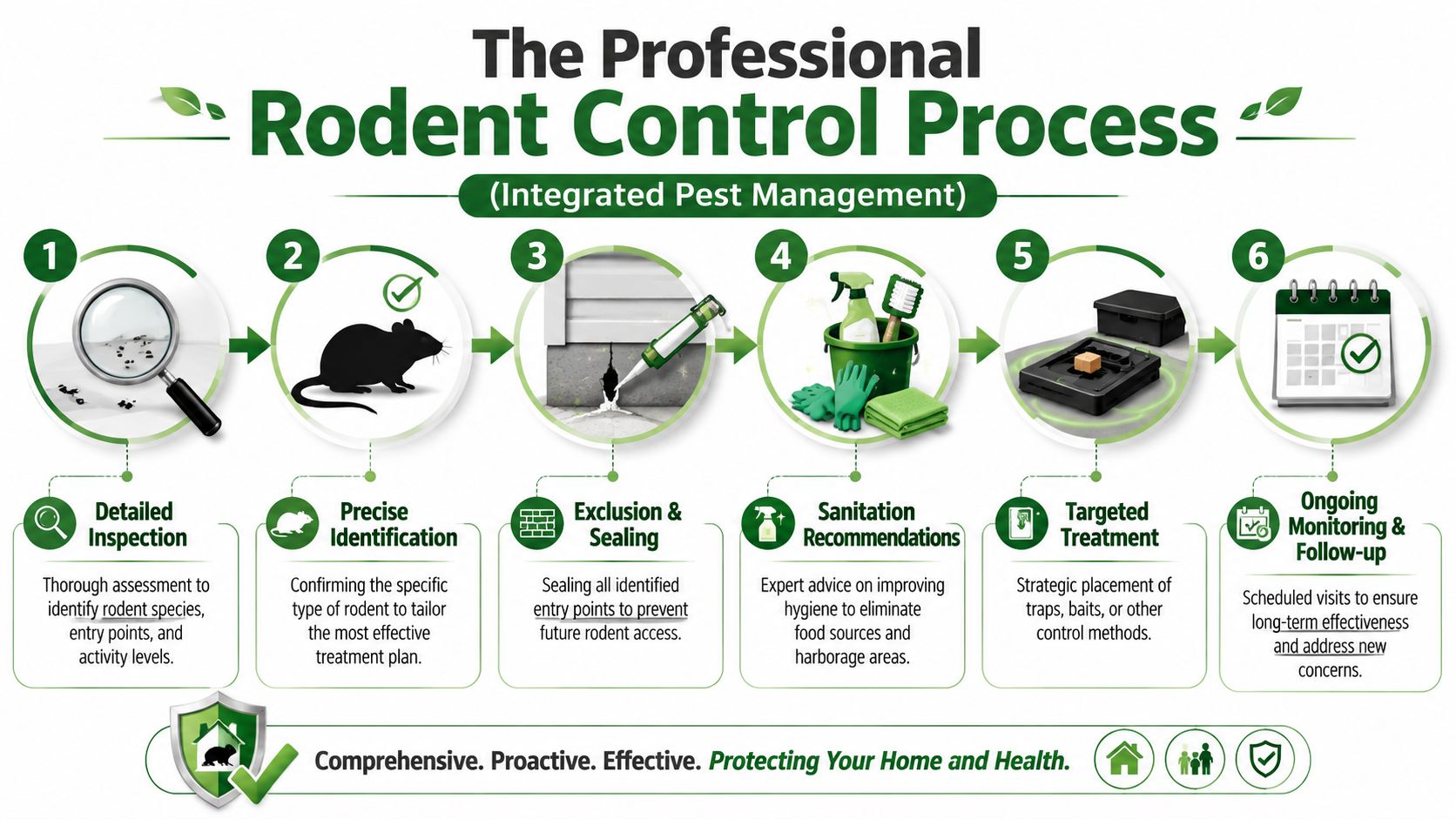
The most effective professional method is an Integrated Pest Management, or IPM, sequence. That means inspection comes first, then exclusion, then targeted control. Guidance for rodent IPM specifies sealing openings larger than 1/4 inch, placing traps along walls and runways, and using bait in tamper-resistant stations only where it's necessary and safe, according to rodent IPM action plan guidance.
In practical terms, that usually means a technician will:
- Inspect the structure carefully. Kitchens, basements, utility rooms, attics, garages, and exterior foundations are checked for signs and openings.
- Identify movement routes. Rodents prefer edges, corners, and concealed travel paths.
- Place control devices strategically. Traps belong where rodents already travel, not randomly in the middle of a room.
- Recommend or perform exclusion work. This may involve sealing gaps around pipes, vents, doors, and wall penetrations.
- Set a follow-up plan. Re-checks matter because activity can shift after the first intervention.
Some buildings need more than one service phase. Shared walls, food-service adjacency, cluttered storage, and poor waste handling can all extend the timeline.
What affects the final service cost
Toronto residents often want local pricing before they book, which is understandable. But service cost depends on what's being purchased. A simple inspection is different from active treatment. Active treatment is different from detailed proofing. A detached home with basement access and exterior entry points is different from a condo unit where management cooperation is needed.
Typical pricing variables include:
- Property type. Condo units, semis, detached homes, restaurants, and mixed-use buildings all require different labour.
- Severity and spread. One active area is simpler than multiple floors or a whole building issue.
- Whether exclusion is included. Sealing and proofing often determine whether the result lasts.
- Follow-up requirements. Monitoring visits may be necessary where reinvasion pressure is high.
For Toronto homeowners comparing quotes, this guide to rat pest control service costs is helpful because it separates inspection, treatment, and proofing instead of treating everything as one flat service. That's the fairest way to evaluate value.
Cheap rodent control often means one thing was sold while three things were needed. Inspection, control, and exclusion are different jobs.
Preparing Your Home for and After Rodent Removal
Rodent control works better when the technician can access the places rodents use. Homeowners don't need to perform a full renovation before the appointment, but they do need to make the work possible.

Before the technician arrives
A short preparation list goes a long way.
- Clear access along baseboards. Move boxes, shoes, and loose storage away from likely travel edges.
- Open up sink cabinets and utility areas. These are common points for pipe-entry gaps and droppings.
- Make basement and garage corners reachable. Technicians need to inspect edges, not just open floor space.
- Store food properly. Dry goods and pet food should already be sealed before treatment begins.
- Share the pattern of activity. Homeowners should note where sounds were heard and where signs were found.
This doesn't just save time. It improves accuracy. When access is blocked, signs get missed and traps can't be placed where they'll perform best.
After treatment and exclusion work
The follow-up phase matters as much as the first visit.
Keep sanitation standards high. Don't slide back into leaving food out overnight, allowing clutter to rebuild, or overfilling storage rooms against walls. If exclusion materials were installed, watch those repaired areas and report any new gnawing or movement quickly.
For households that want a fuller checklist, this guide on controlling rodent activity at home and preventing future infestations helps reinforce what should stay in place after removal.
Your Questions Answered Why Trust Vanish for Toronto Rodent Control
Toronto residents usually ask the same practical questions once they're ready to book. The answers matter because rodent service affects the whole household.
Common questions from Toronto homeowners
Are treatments safe around children and pets?
They should be planned that way. Safe rodent service relies on inspection, targeted trapping, careful placement, and tamper-resistant bait stations where appropriate, not casual product use in living areas.
How quickly should a homeowner act?
As soon as signs are confirmed. Waiting gives rodents more time to expand movement routes, establish nests, and keep feeding in hidden spaces.
Can a condo resident solve the problem alone?
Sometimes only partly. In many Toronto condos, the unit can be treated, but lasting control may also depend on building conditions, shared service areas, and management response.
Will the smell or noise stop right away?
Not always. Once treatment begins, activity can shift before it declines. What matters is whether the program addresses access points and travel routes, not just the symptoms.
What if the home has other pest problems too?
That's common in Toronto properties. A building with rodent pressure may also have sanitation or structural conditions that attract ants, cockroaches, wasps, or wildlife around the exterior. The solution should fit the whole property, not a single isolated complaint.
Why do Toronto homeowners choose a local provider?
Because local housing types matter. A downtown condo, an East York bungalow, a Scarborough rental, and a North Toronto semi all present different access patterns. A company serving Toronto, Newmarket, Woodstock, London, and nearby Ontario communities should be able to adapt the plan to the building rather than forcing the same treatment onto every job.
Rodent problems create stress fast. They also respond well to calm, structured action. When the inspection is thorough, the treatment is targeted, and the proofing is done properly, a worried homeowner can get their home back under control.
If a Toronto homeowner is hearing scratching at night, finding droppings in the kitchen, or dealing with repeat rodent activity in a condo, semi, or detached house, Vanish Pest Control Inc. can help assess the property and recommend a practical next step. The company provides licensed rodent control, proofing, and wildlife removal services across Toronto and nearby Ontario communities, with support for residential, commercial, and multi-unit properties.




