

A Toronto homeowner usually starts the same way. A few ants in the kitchen, droppings in the basement, scratching in the attic, then a search for a pest control company near me that turns into a wall of generic listings with almost no way to tell who can solve the problem.
That rush is where people waste money. The right call is to slow down long enough to verify the company's licence, match the treatment to the pest, and understand what happens after the technicians leave, because a fast visit with the wrong scope is still a bad result for Toronto homes, Toronto residents, and property managers who need the job done once and done properly.
Table of Contents
- Why Your Toronto Home Needs the Right Pest Control Partner
- Verifying Ontario Licences and Technician Certifications
- Comparing Treatment Methods for Common GTA Pests
- Understanding Pest Control Pricing and Recurring Service Value
- What to Expect After Treatment and How to Prevent Recurrence
- Red Flags to Avoid and Why Vanish Pest Control Stands Out
Why Your Toronto Home Needs the Right Pest Control Partner
A lot of Toronto calls start in a place that feels minor. A tenant notices ants along a baseboard in a basement suite. A homeowner hears movement in the attic after dark. A restaurant manager finds cockroach activity under a prep sink and needs the issue handled before service begins.
Toronto housing makes that worse, not better. Older semis, low-rise rentals, condo corridors, and tight utility chases all create different entry points, different hiding spots, and different risks. A company that only talks about “spray and go” treatments is usually not thinking about route density, repeat visits, or the realities of shared walls and stacked plumbing.

What local experience actually looks like
Local experience is not a slogan. It means the technician knows that a basement mouse issue in a Toronto semi usually needs different follow-up than a wasp problem at a detached home or a cockroach complaint in a multi-unit building. It also means they ask about building type, access points, occupancy, and whether children, pets, or tenants need time to stay away from treated areas.
Practical rule: proximity matters only after competence is confirmed. Fast arrival is useful, but only if the company can match the treatment to the pest and the property.
That is why the search should not stop at the first ad. The better question is whether the provider can prove they are licensed for the exact work, can explain how the treatment will affect re-entry and cleanup, and can show a plan for recurrence instead of just a one-time visit. For homes in Toronto and surrounding neighbourhoods, that mindset saves time, avoids repeat visits, and protects the property from sloppy short-term fixes.
Verifying Ontario Licences and Technician Certifications
A quick search for a pest control company near me means nothing if the crew showing up cannot legally handle the problem. In Ontario, pest control work tied to restricted-class pesticides sits under the Ontario Pesticides Act, and the technician needs the right provincial exterminator certification for the exact job, not just a business name and a van. Ontario's certification framework is the standard to use before anyone treats a home, kitchen, basement, or multi-unit space.
What paperwork matters
Ask for the documents directly and check each one against the work being offered:
- Ontario business registration: Confirms the company is a real operating business, not just a listing.
- Provincial exterminator or applicator certification: Required when restricted-class pesticide use is part of the job.
- Proof of insurance: Covers damage to floors, walls, or fixtures if something goes wrong.
- Written scope of service: Should state the pest, the treatment area, and the follow-up plan.
- Service-specific qualifications: Structural pest control is a different skill set from wildlife exclusion or termite inspection work.
A legal registration on its own does not prove the company is right for the problem in front of you. Bed bugs, rodents, and wildlife access points each demand different training, different products, and different follow-up. The safe move is to ask for the certification tied to the exact treatment class, then make sure the written scope matches the issue in your building.
Why scope matters more than a generic listing
A nearby company is not automatically qualified for every pest. Some providers focus on structural pests, others on wildlife exclusion, and some only handle a narrow treatment range. In Toronto, that difference matters because a condo cockroach complaint, a raccoon entry in an attic, and a suspected termite issue are three separate jobs.
Keep this simple: if the company cannot say, in plain language, what it is certified to do, keep searching.
The filter is straightforward. If a company hesitates on licensing, avoids written details, or hides behind broad claims like “we handle everything,” treat that as a warning sign. A professional operator should be able to show authorization, name the treatment class, and explain any limits before you book.
For homeowners who want a humane wildlife option, a useful reference is humane wildlife removal, because wildlife exclusion calls for a different skill set than standard indoor pest treatment. The point is to make sure the person entering the house is legally and practically qualified to solve the right problem.
Comparing the useful documents
| Document | Why it matters |
|---|---|
| Business registration | Confirms the company is operating legally |
| Applicator certification | Shows the technician can apply restricted products |
| Insurance proof | Protects the property if something goes wrong |
| Written scope | Prevents mismatched treatments and surprise extras |
A real pest control company near me search should end with verification, not assumptions.
Comparing Treatment Methods for Common GTA Pests
The worst mistake is letting the method drive the conversation instead of the pest. Bed bugs, carpenter ants, cockroaches, mice, rats, and wildlife all behave differently, so the treatment should be specific, not recycled from the last callout. Toronto property managers know this because one-size-fits-all work usually creates more callbacks.
Match the method to the pest
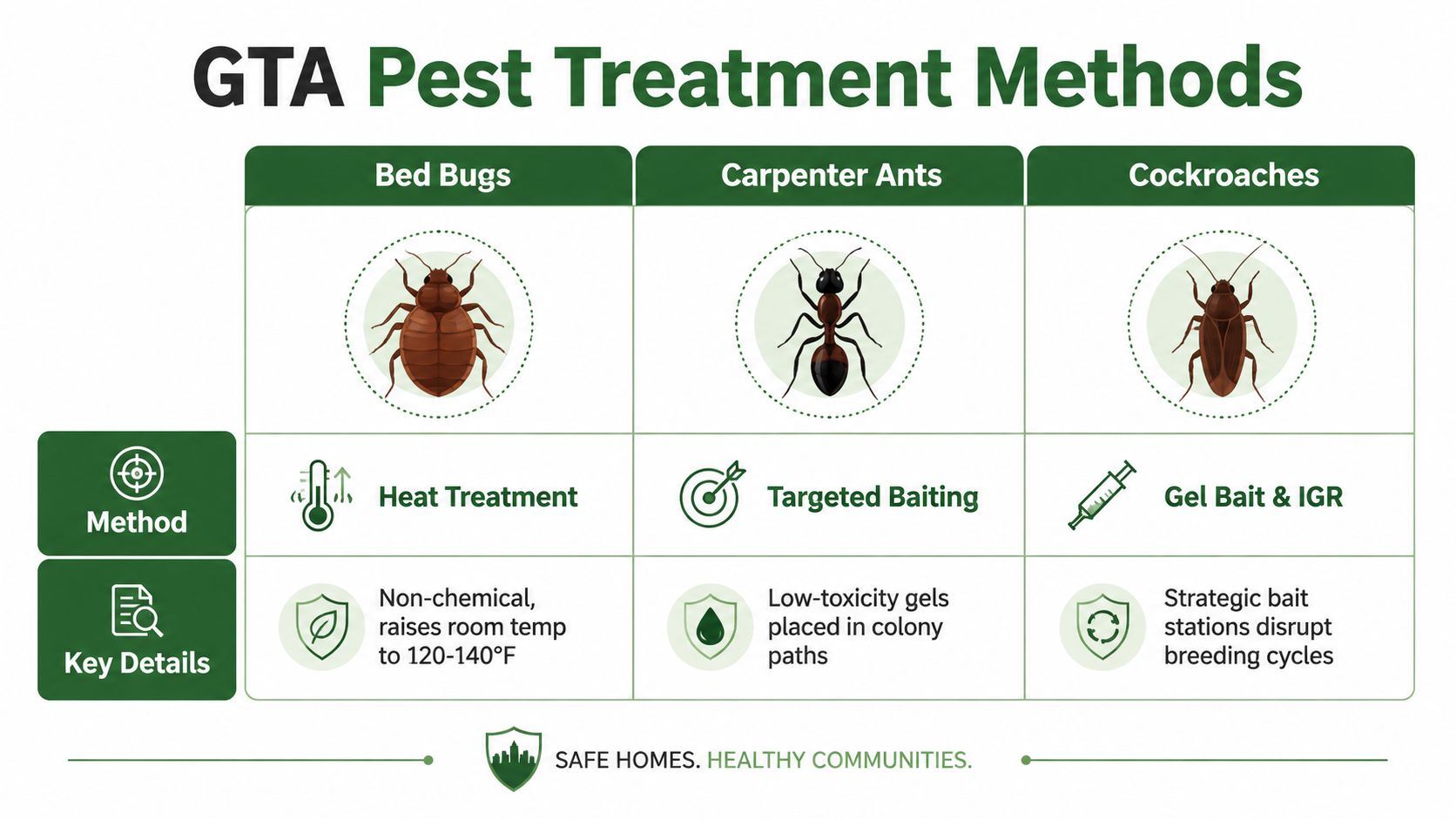
Bed bugs respond well to heat treatment when the infestation and property layout support it. That approach avoids chemical residues and is often chosen when a household wants a non-chemical path through bedrooms, mattresses, and soft furnishings. Carpenter ants and cockroaches, by contrast, usually call for targeted baits and carefully placed gel applications that hit the nest or breeding path rather than saturating the room.
Mice and rats need more than traps. They need rodent-proofing, entry-point sealing, and a sanitation plan that makes the property less inviting after the immediate removal work is finished. Wildlife is different again, because raccoons, squirrels, skunks, and bats are usually handled through humane exclusion, not indoor spray work.
Choose safety and durability over shortcuts
A chemical-heavy plan can feel faster, but speed is not the only metric that matters. If children, pets, tenants, or staff need to re-enter quickly, the company should explain exactly what the treatment means for the space and whether a non-chemical or exclusion-based option makes more sense. That conversation is especially important in kitchens, basements, and common corridors where repeated exposure is a concern.
For bird's-eye clarity, use this kind of comparison:
| Pest | Better-fit approach | Why it usually wins |
|---|---|---|
| Bed bugs | Heat treatment | Non-chemical and thorough when done correctly |
| Carpenter ants | Targeted baiting | Reaches the colony path without broad spraying |
| Cockroaches | Gel bait and growth disruption | Reduces breeding and targets hiding zones |
| Mice and rats | Exclusion and proofing | Stops repeat entry, not just the current activity |
| Wildlife | Humane exclusion | Removes access without turning the building into a chemical zone |
Some operators sell the fastest visible result. The better operators sell the result that lasts after the tenant returns, the kitchen reopens, or the attic cools down.
That is the evaluation test. If a company only talks about “killing bugs,” it is thinking too narrowly for GTA properties where the entry point, nesting site, and aftercare matter as much as the initial treatment.
Understanding Pest Control Pricing and Recurring Service Value
A cheap quote can look fine on paper and still cost more once the problem keeps coming back. A proper pest control price should reflect how often the issue can return, how much monitoring the property needs, and whether the company is setting up prevention instead of just chasing visible activity. The 2025 U.S. structural pest control industry generated $13.416 billion in total service revenue, and 85.4% of residential service revenue came from recurring plans, with 109,384 service technicians working across 16,565 firms and 81.4% of firms operating just one or two locations, which shows how heavily the business leans on repeat service and local route density (National Pest Management Association).
What to look for in a pricing quote
A solid quote breaks the work into parts you can check. Property size, infestation severity, and treatment complexity all affect the final number, but the provider should still spell out what is included, what is excluded, and whether a follow-up visit is part of the plan. If those details are missing, the price is not transparent enough for a landlord, condo board, or homeowner who needs to compare real value.
| Service Type | One-Time Treatment | Recurring Plan (Annual) |
|---|---|---|
| General residential pest control | Varies by property and pest scope | Better for ongoing prevention and monitoring |
| Rodent service | Often includes removal and proofing | Better when entry pressure is ongoing |
| Bed bug treatment | Usually tied to a full-room or unit plan | Repeat visits may be needed for monitoring |
| Wildlife exclusion | Usually priced as a separate scope | Less common as a routine plan, more common as needed |
That table only helps if the company explains the service behind it. A good recurring plan should cut down repeat emergencies, include return visits when the issue reappears, and match the building's actual risk level. A weak plan bills for visits that do not change the conditions that brought the pests in.
Recurring service should earn its keep
Recurring service should feel like maintenance, not a trick to keep billing forever. It makes sense for landlords, restaurants, multi-unit buildings, and older homes where pests can return through tiny openings, shared walls, or active utility runs. If a provider cannot explain why the schedule exists, the plan is probably too thin to justify the cost.
Toronto owners should also ask what the service includes beyond the visit itself. Money-back guarantees, repeat-customer pricing, and clear follow-up terms all show that the operator is willing to stand behind the work. For a practical cost breakdown, Toronto pest control pricing is a useful starting point for understanding how local service structures are usually framed.
What paperwork matters
The quote is only part of the job. Ask for the treatment plan in writing, the product or method being used, the expected re-entry window, and any conditions that would trigger a return visit. If the company says the plan changes by pest type, that is normal. If it refuses to put the terms on paper, walk away.
The best operators are specific about scope. They tell you whether the service covers inspection, treatment, follow-up, exclusion work, or only one of those pieces. That matters in Toronto properties because a low price can hide gaps that leave you paying again for the same problem.
What to Expect After Treatment and How to Prevent Recurrence
Many ask what gets sprayed. Fewer ask when the family can walk back in, when the floors can be cleaned, or how long prevention really takes. That gap causes unnecessary stress, especially in condos, rental units, kitchens, and shared buildings where timing matters as much as the treatment itself.
Re-entry and cleaning
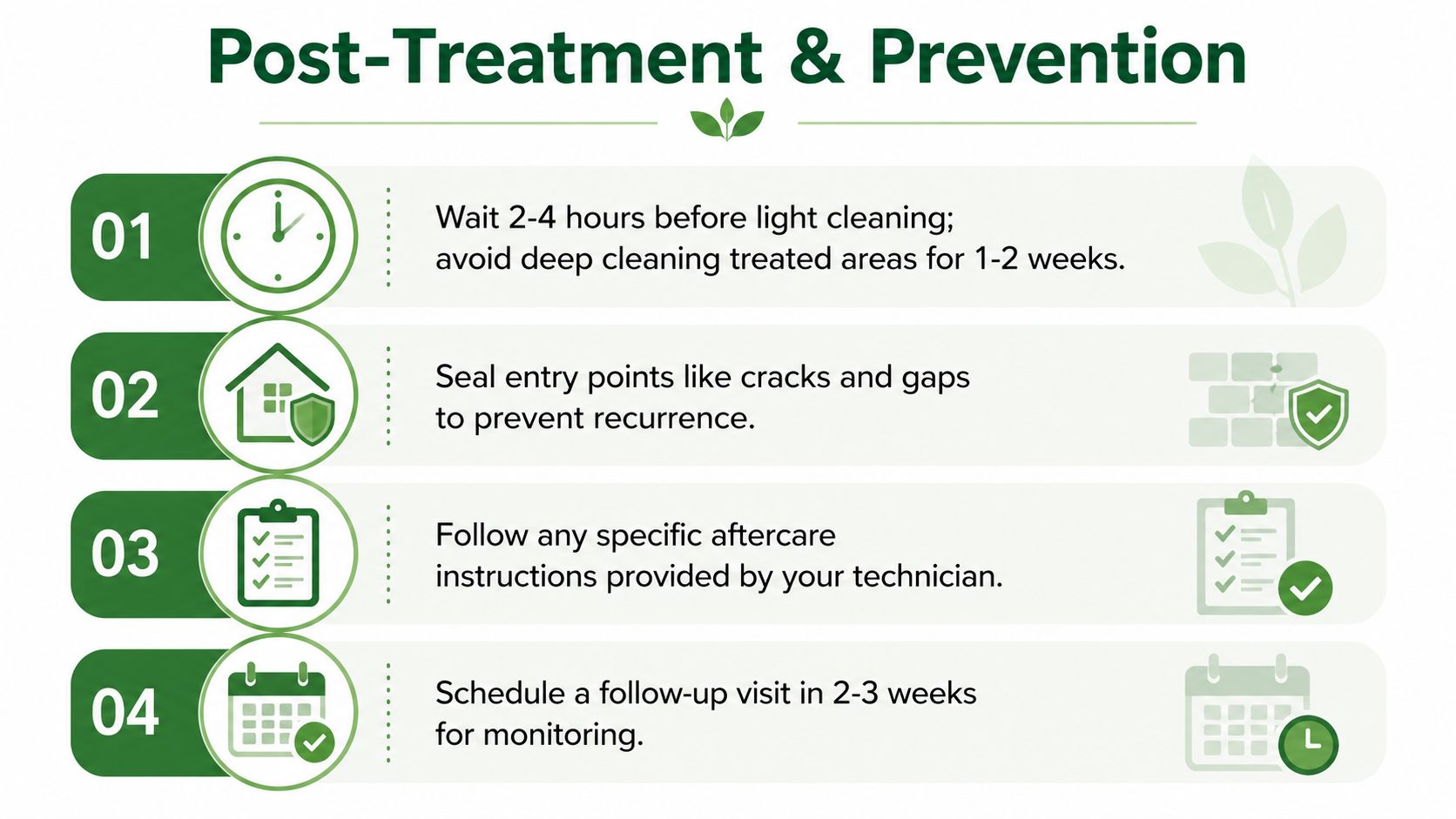
The working rule is simple. Light cleaning usually waits 2 to 4 hours after treatment, and deep cleaning of treated areas should be delayed for 1 to 2 weeks when the technician says the product or method needs that window. Follow the provider's instructions exactly, because treatment type changes the aftercare, and the wrong cleanup can reduce effectiveness. The safe move is to ask for the re-entry window before the technician leaves the site.
Occupants should not guess after a treatment. If a technician does not give clear re-entry and cleaning instructions, the handoff is incomplete.
Multi-unit buildings need even tighter coordination. Hallways, kitchens, shared laundry rooms, and garbage areas often need different rules than private rooms, and property managers should document who was told what, and when. That avoids disputes later and helps staff know whether normal activity or a follow-up call is needed.
Prevention between visits
Prevention is not glamorous, but it works. Seal cracks around utility lines, baseboards, window frames, and foundation gaps. Manage moisture near sinks, laundry rooms, and basements, because damp areas keep pests active longer and make food sources easier to find.
A short list keeps the work focused:
- Store food tightly: Open packaging invites ants, cockroaches, and pantry pests.
- Control waste: Bins should close fully, especially in kitchens and shared corridors.
- Reduce clutter: Cardboard, piles, and unused storage create hiding places.
- Watch moisture: Leaks and condensation need fast repair.
- Keep a follow-up date: A monitoring visit in 2 to 3 weeks is often the right window for checking whether activity has fallen off.
If a pest problem reappears after normal use and the structure has not been protected, that is a reason to call back. If activity appears briefly during the expected aftercare period, that is not automatically failure. The difference matters, and a good company explains it before the job starts.
Red Flags to Avoid and Why Vanish Pest Control Stands Out
The easiest way to lose money is to hire on urgency alone. Vague licensing claims, rushed discounts, no written treatment plan, and pressure to book before questions are answered are all signs that the operator is more interested in closing the job than solving the pest issue. A good company welcomes scrutiny because good work is easy to explain.
Red flags that should stop the booking
Watch for these patterns:
- Unclear credentials: If the company cannot prove certification for the exact treatment class, keep looking.
- No written scope: If the plan is only verbal, there is too much room for confusion.
- One-size-fits-all language: If every pest gets the same answer, the treatment is probably too broad.
- No aftercare explanation: Re-entry and cleaning should never be left to guesswork.
- Pressure tactics: A serious operator does not need to push a same-minute yes on a complex property issue.
A strong local provider should also be able to talk about humane wildlife exclusion, chemical-free bed bug heat treatment, and service coordination for homes, condos, restaurants, and industrial properties without sounding vague. Vanish Pest Control Inc. covers those service categories, along with inspections, targeted treatments, and preventative rodent-proofing, which makes it a practical fit for Toronto and GTA properties that need clear scope and documented follow-through. About Vanish Pest Control Inc.
What a better fit looks like
The better choice is the company that answers hard questions directly. It should explain whether technicians are certified, whether treatment is family- and pet-aware, whether the plan includes cleaning coordination before or after chemical applications, and whether recurring customers get real value instead of padded visits.
A trustworthy pest company leaves the reader with a plan, not a sales pitch.
That is the standard Toronto homeowners should use. If the operator can't prove credentials, can't explain the method, and can't outline the next step after treatment, the search should continue until a clearer option appears.
If a Toronto home has pests, Vanish Pest Control Inc. can handle the inspection, treatment, and follow-up with a service model built for local properties, including bed bugs, rodents, and humane wildlife exclusion. Homeowners and property managers who want a straightforward next step should visit Vanish Pest Control Inc. and ask for a treatment plan that matches the exact pest problem, the building type, and the re-entry timing that comes with it.




