

A Toronto homeowner hears scratching behind the kitchen kickplate at night, then finds a few dark specks under the sink the next morning. The first instinct is usually simple. Kill the pests fast. The second thought lands right behind it. What's being used in the home, and is it safe around children, pets, or food areas?
That tension is exactly why eco pest control matters in Toronto homes. It isn't a softer version of pest control, and it isn't a bottle of “natural” spray from a shelf. It's a modern, science-based way to solve pest problems by finding where pests live, why they're getting in, and what treatment matches the pest instead of spraying everything on sight.
That approach also matches where the market is going. The Canadian pest control industry is projected to reach $2.7 billion in revenue by 2026, with a 4.5% CAGR in the number of businesses, and 84% of Canadians believe home pest control products are necessary and safe when used properly, according to IBISWorld's Canada pest control industry outlook. Toronto residents aren't moving away from professional pest control. They're becoming more selective about how it's done.
Table of Contents
- The Modern Approach to Pest Problems in Toronto
- What Eco Pest Control Really Means for Your Home
- Proven Eco-Friendly Techniques for Common GTA Pests
- Safety and Effectiveness A Comparison
- Your Proactive Eco Pest Prevention Checklist
- How to Choose a Professional Eco Service in Toronto
- Toronto Eco Pest Control FAQs
The Modern Approach to Pest Problems in Toronto
Toronto pest problems rarely start with a dramatic infestation. Most begin subtly. A mouse in the pantry. German cockroach activity around a condo dishwasher. Carpenter ants pushing frass from damp trim. A raccoon using a roof vent as a repeat access point.
The old model of pest control treated all of those problems the same way. Spray first, ask questions later. That approach can knock down visible activity, but it often leaves the root cause untouched.
Why quick sprays often disappoint
A mouse problem in a Toronto basement isn't just a mouse problem. It's usually a gap around a pipe chase, a worn door sweep, food access, shelter, or all four. A cockroach problem in a kitchen often rides on moisture, cluttered voids, and harbourage around warm appliances. If those conditions stay in place, the problem comes back.
Practical rule: If a treatment doesn't change access, shelter, or moisture, it usually doesn't change the long-term outcome.
That's why modern pest work in Toronto homes leans on inspection before treatment. Detached homes, semis, older brick houses, laneway properties, and condo towers all create different pest pathways. The technician has to read the building, not just the bug.
What Toronto pest problems actually require
Mice and rats need exclusion and sanitation.
Bed bugs need a treatment that reaches every life stage where they hide.
Cockroaches need crack-and-crevice work, monitoring, and moisture control.
Wasps need nest-specific treatment and safe removal.
Wildlife such as raccoons, squirrels, skunks, and bats need humane removal paired with entry-point repairs.
Ontario also pushes the industry in this direction. The province's cosmetic pesticide framework requires priority for cultural, mechanical, and biological controls before chemical intervention in lawn and garden settings, as outlined in Toronto pesticide bylaw guidance and organic alternatives.
For Toronto residents, that's good news. The strongest pest plans now focus on fewer broad applications, more precision, and better prevention. That's what makes eco pest control feel less like a compromise and more like an upgrade.
What Eco Pest Control Really Means for Your Home
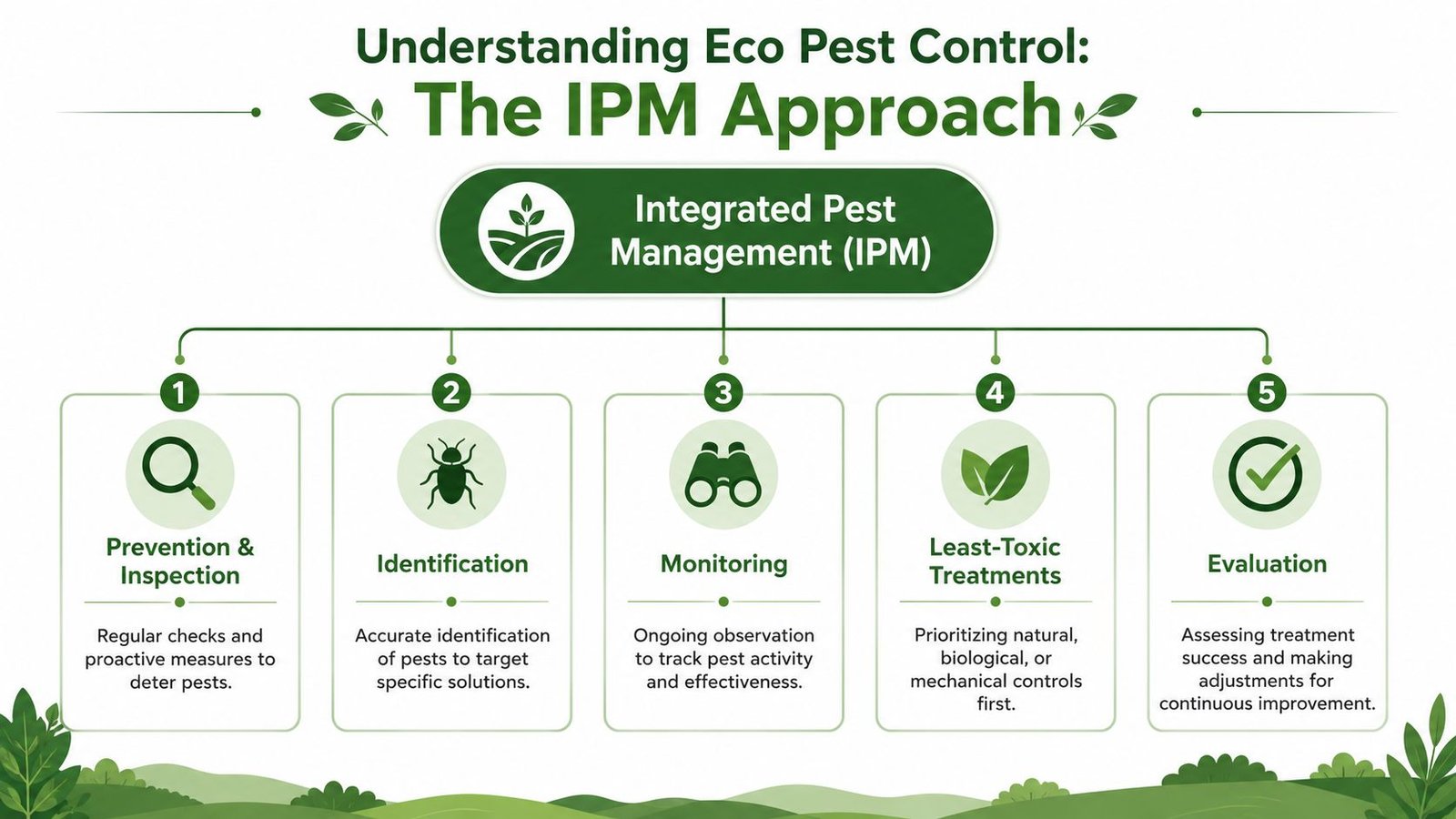
Eco pest control in Toronto homes is best understood through Integrated Pest Management, or IPM. In Ontario, IPM is considered the gold standard and can reduce pesticide use by up to 70% by prioritising prevention, monitoring, and targeted action over routine spraying, according to Ontario-focused guidance on pest control and the environment.
Think of IPM like preventative healthcare for a house
A healthy home doesn't stay healthy because someone reacts late. It stays healthy because problems are caught early, causes are identified correctly, and treatment is used carefully. IPM works the same way.
A Toronto home with repeated ant activity around a back door doesn't automatically need broad pesticide application. It may need vegetation trimmed off the structure, a threshold identified, a nesting area located, and a focused treatment in the right place. The same logic applies to mice, wasps, cockroaches, and even wildlife intrusions.
The five levels that make eco pest control work
The easiest way to picture IPM is as a hierarchy. The lower levels do the heavy lifting. Treatment sits higher up, not at the bottom.
Prevention and inspection
Homes are checked for gaps, water issues, food access, cluttered storage, damaged vents, and other conditions that support pests.Identification
The pest has to be identified properly. Carpenter ants aren't managed the same way as pavement ants. House mice aren't handled the same way as wildlife in an attic.Monitoring
Sticky monitors, visual checks, trap placement, and follow-up tell the technician whether activity is active, declining, or spreading.Least-toxic treatments first
Mechanical control, exclusion, sanitation, vacuuming, traps, heat, and carefully placed low-toxicity products come before indiscriminate broadcast use.Evaluation
The result gets measured. If activity remains, the plan is adjusted based on evidence, not guesswork.
Eco pest control works best when the home itself stops helping the pest.
That's why the term “eco” can be misleading when it's used in marketing without process behind it. One green-labelled spray doesn't make a pest plan responsible. A real eco approach changes the conditions that let pests survive in the first place.
Proven Eco-Friendly Techniques for Common GTA Pests
Toronto residents usually want one honest answer. Does eco pest control work against difficult pests? It does, but only when the method matches the pest. Humane capture, heat, exclusion, trapping, and selective low-toxicity applications are tools. None of them solve every problem on their own.
Structural exclusion for mice rats and wildlife
For rodents, traps matter, but they are only one part of the job. Health Canada guidance makes the missing piece clear. Humane traps can be highly efficient, but they don't provide a long-term barrier, and sustainable eco rodent control in unsealed GTA homes requires a 70%+ investment in structural exclusion work, as noted in Health Canada's pest control tips.
That's why a proper rodent plan in Toronto homes usually includes:
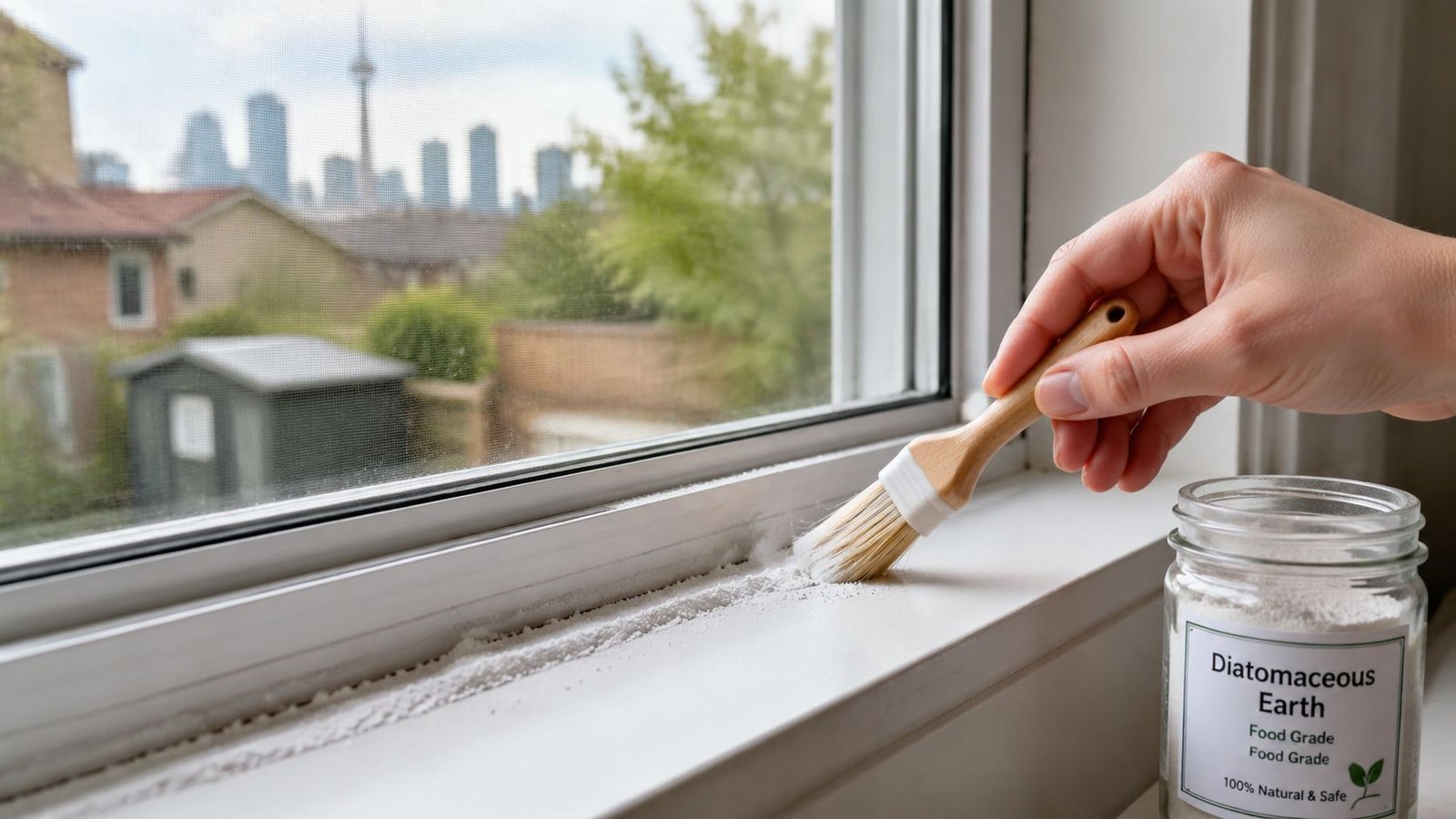
- Gap sealing: Caulking around utility penetrations, repairing broken vents, and screening openings.
- Material upgrades: Metal screening where rodents can chew through softer materials.
- Trap strategy: Placing traps where mice travel, not randomly in open rooms.
- Sanitation fixes: Removing easy food access in kitchens, storage rooms, and garages.
The same principle applies to raccoons and squirrels. Removal without repair only creates a vacancy that another animal can use later. Eco wildlife control means humane removal followed by exclusion and damage repair.
Heat treatment for bed bugs
Bed bugs are where many homeowners assume “eco” will fail. That assumption doesn't hold up when the treatment is heat. For one of Ontario's hardest pest problems, chemical-free heat treatment can achieve up to 100% efficacy in a single application, according to Green Building Canada's pest control discussion.
That matters in Toronto condos and apartment buildings where bed bugs move through shared walls, cluttered bedrooms, and upholstered furnishings. It also explains why DIY botanical sprays disappoint so often. They usually don't reach hidden harbourages, and they rarely solve building-wide pressure.
A homeowner dealing with this issue can also review natural bed bug control guidance for Toronto-area homes, especially for preparation steps and realistic expectations around non-chemical methods.
Heat isn't “natural” in a marketing sense. It's effective because it reaches the places sprays often miss.
Targeted low-toxicity treatment for hidden insect activity
Eco pest control doesn't mean refusing treatment. It means using the right treatment with precision. For carpenter ants, cockroaches, and some ant issues, that can include crack-and-crevice products, dusts in voids, bait placements, and direct nest treatment instead of fogging whole rooms.
This matters in kitchens, basements, and utility spaces where pests hide behind walls, under cabinets, and near plumbing lines. Broad applications in open space often miss those areas. Focused placement works better and leaves less unnecessary product in the living environment.
Indoor environment also affects pest pressure. Dust, moisture, and debris make harbourage more stable for several pests. For homeowners trying to improve the conditions that attract mites and other irritants, Purified Air Duct Cleaning's guide is a useful companion read on reducing buildup inside the home.
Safety and Effectiveness A Comparison
A Toronto homeowner usually asks two questions first. Will this work, and is it safe for the people and pets in the home?
Eco pest control answers both, but only when it is done properly. The modern version is not a weak substitute for conventional pest control. It is a more selective approach that uses inspection, exclusion, monitoring, heat, trapping, and tightly targeted products where they are needed.
Where traditional methods still appeal
Fast knockdown still has appeal. If wasps are active near a doorway before a family barbecue, or cockroaches are crossing the kitchen floor at night, people want the problem to stop now.
That urgency is reasonable.
The trade-off is that visible activity is only part of the infestation. Exposed insects are often a small fraction of the actual problem. If the nest, entry point, moisture source, wall void, or food source stays in place, the pressure usually returns.
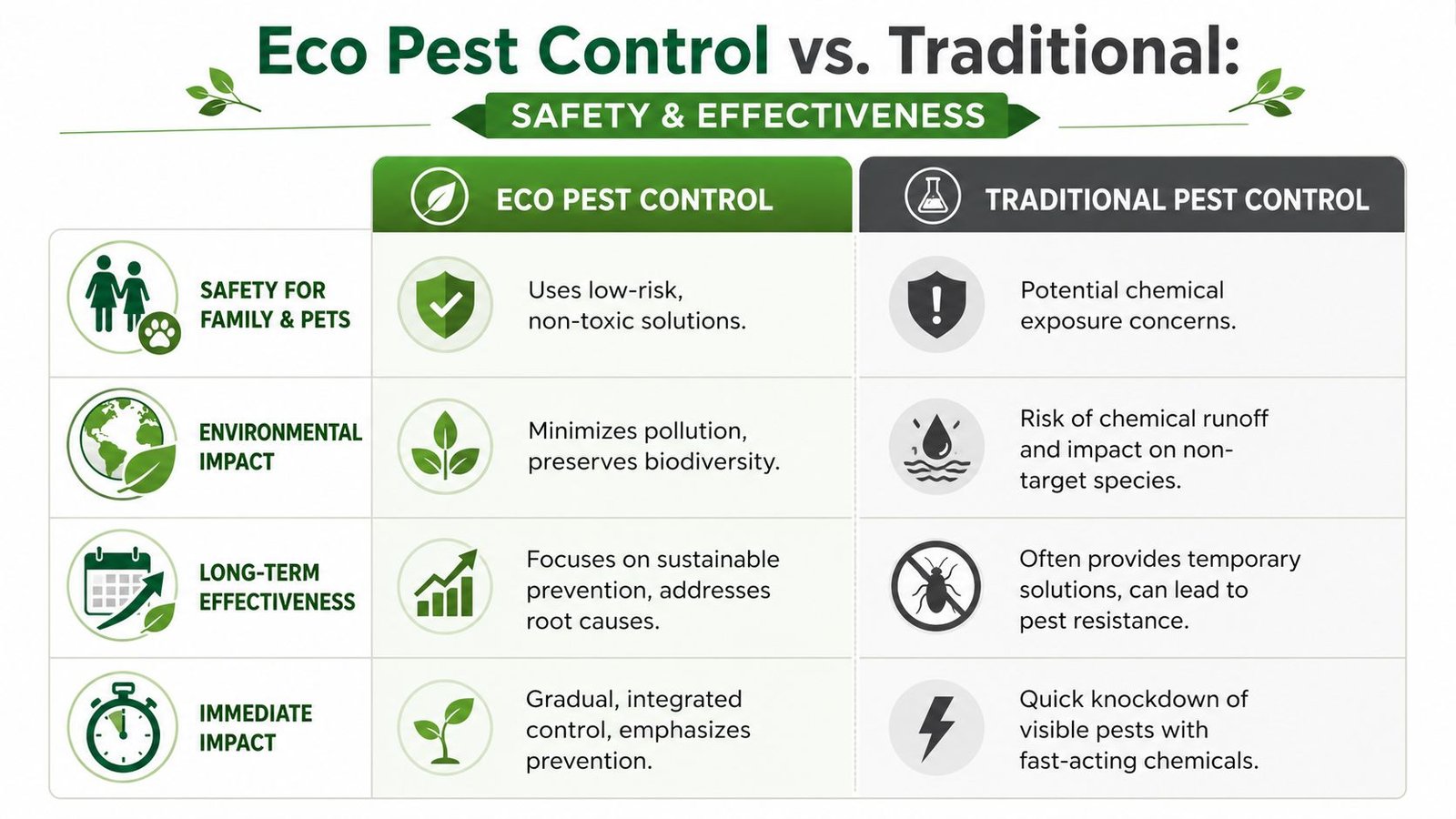
| Comparison point | Eco pest control | Traditional heavy-chemical approach |
|---|---|---|
| Immediate impact | Depends on the method. Heat, exclusion, trapping, and baits may take planning but can solve the core problem | Often faster visible knockdown |
| Long-term control | Focuses on entry points, harbourage, monitoring, and conditions that support pests | Can fall short if the building conditions stay the same |
| Family and pet considerations | Prioritises lower-risk methods and precise placement | Can raise more concern about unnecessary exposure |
| Environmental effect | Aims to limit runoff and non-target exposure | Can involve broader chemical use |
| Best fit | Recurring issues, prevention-focused homes, sensitive indoor environments | Short-term suppression where immediate visible reduction is the main goal |
Why eco pest control often performs better over time
The main advantage is precision. Instead of treating large areas because pests might be there, a good eco program targets where pests live, travel, feed, and enter. In practice, that usually means fewer unnecessary applications and better follow-through on the causes of the infestation.
Bed bugs are a good example. Whole-room heat can reach cracks, seams, furniture joints, and other hiding spots that are easy to miss with surface sprays. Rodent work shows the same pattern. Humane exclusion, proofing, and trap placement usually hold up better than repeated short-term control if gaps around pipes, vents, soffits, or garage edges remain open. Homeowners dealing with repeat activity can review this guide on protecting your GTA home from future pest infestations to see how prevention supports treatment results.
Cockroach jobs in older Toronto housing stock also prove the point. If activity is tied to drain lines, moisture, and hidden voids, broad spraying alone rarely fixes it. Sanitation, drain attention, baiting, and exclusion do more to prevent cockroaches from drains than a quick surface treatment.
The safer plan is not the one that uses nothing. It is the one that uses the least intrusive method that will solve the infestation and keep it from coming back.
That is the comparison. One approach chases the pests you can see. The other addresses the conditions that let them survive in the first place. For many Toronto homes, the second option is the stronger one over time.
Your Proactive Eco Pest Prevention Checklist
Most pest issues in Toronto homes become easier to control when the property stops offering food, water, and access. Prevention sounds basic, but in practice it's where eco pest control becomes most effective. Small building corrections often do more than repeated treatment visits.
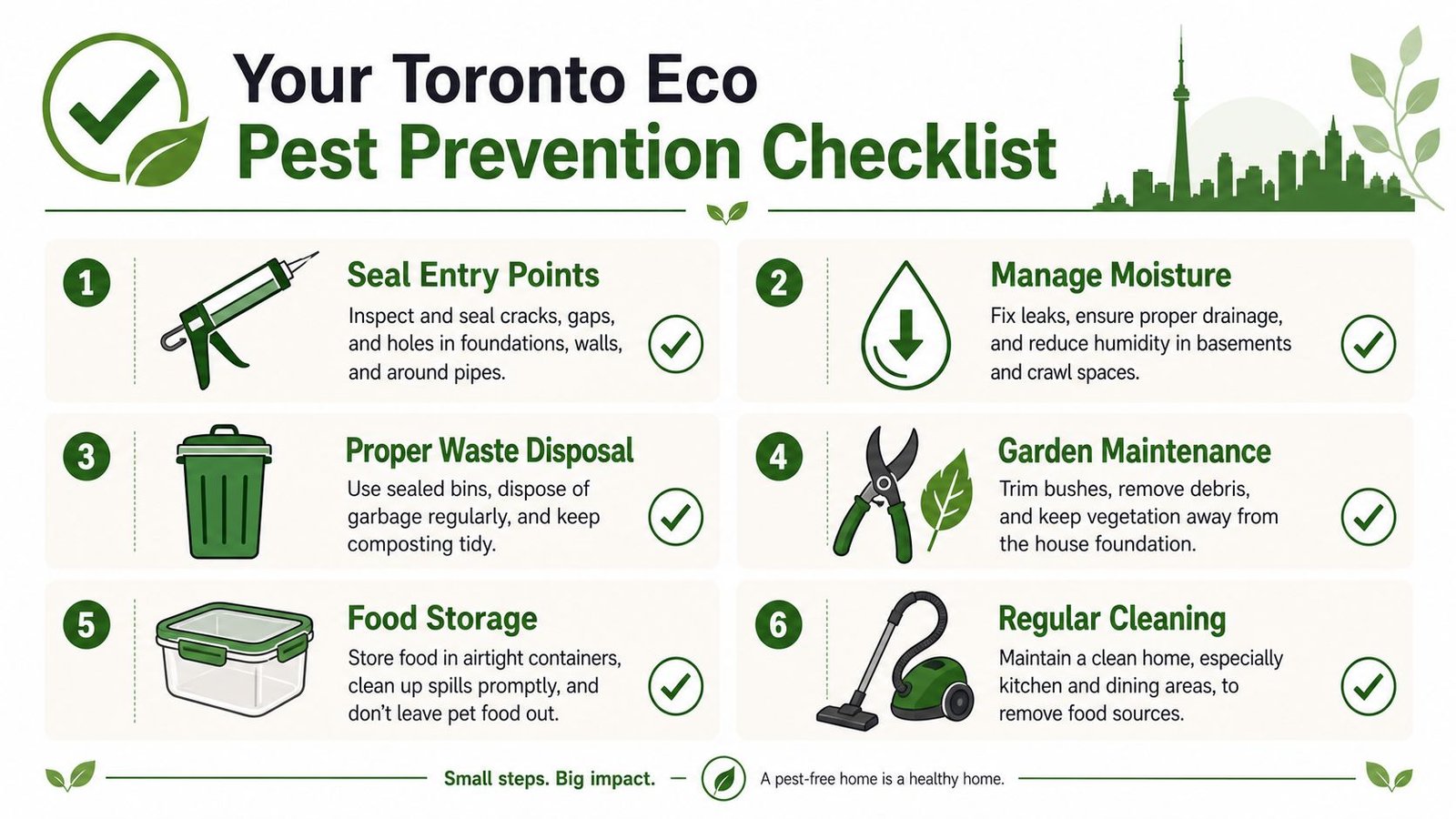
For GTA homes, Ontario guidance includes mowing grass to 2–3 inches, aerating, deep watering, and sealing structural gaps with caulking or metal screening over vents as a first line of defence, according to Ontario's natural pest management guidance for homes and gardens.
Kitchen and bathroom checklist
These are the two zones where Toronto pest problems often begin because they combine moisture, food residue, and warmth.
- Store dry goods properly: Use sealed containers for flour, cereal, rice, pet food, and snacks. Open packaging inside cupboards makes life easy for pantry pests and mice.
- Wipe grease and crumbs daily: The space beside the stove, under the toaster, and around the kickplate matters more than the centre of the floor.
- Keep drains and sink edges dry when possible: Roaches and drain-associated pests thrive where water is reliable. Homeowners dealing with this issue may find practical advice to prevent cockroaches from drains useful alongside professional inspection.
- Fix leaks quickly: Even a slow drip under a sink can support cockroaches, ants, and silverfish.
- Limit overnight pet food exposure: Food bowls left out overnight often feed more than the pet.
A broader home plan also helps. Toronto residents can review practical prevention steps for future GTA infestations to support the same IPM logic at the household level.
Basement attic and exterior checklist
Basements, attics, and the outside envelope decide whether pests can settle in.
- Seal entry points: Check around hose bibs, cable lines, pipe penetrations, foundation cracks, and vent edges.
- Screen vulnerable openings: Dryer vents and similar openings need secure screening that still allows proper function.
- Reduce basement moisture: Use ventilation and address damp corners, especially near stored cardboard and laundry areas.
- Keep insulation and storage tidy: Cluttered attics and packed basement storage create harbourage for mice and insects.
- Trim vegetation away from the structure: Branches and dense shrubs create cover and easier access for ants, rodents, and wildlife.
- Manage standing water outdoors: Toronto homeowners should clean gutters and maintain grading so water doesn't collect near foundations. That helps limit mosquito breeding pressure around the home, as noted in GTA pest prevention guidance that highlights gutters and proper grading.
A clean home can still get pests. An accessible, damp, cluttered home gives them a much better chance to stay.
For lawns and gardens, strong plant health also matters. Ontario's agricultural IPM guidance requires scouting for pests before insecticide use and choosing the lowest effective rate with products less toxic to bees and beneficial insects when treatment is necessary, as outlined in Ontario's agronomy guide for field crop pest management. The same mindset applies around the home. Check first, then act precisely.
How to Choose a Professional Eco Service in Toronto
Not every company using the word “eco” is practising eco pest control in a meaningful way. Toronto residents should look for a service that can explain process, not just product.
Questions that expose greenwashing fast
A useful phone call usually includes questions like these:
- How is the pest identified before treatment begins
- What exclusion or prevention work is part of the plan
- What non-chemical or least-toxic options are available for this specific pest
- How will the service be monitored after treatment
- What preparation is required from the homeowner or tenant
- How are children pets and food areas considered in the treatment plan
If the answer is only about spraying, that's a warning sign. A legitimate provider should be able to describe inspection points, likely harbourage, and what building corrections matter.
What a proper service visit should include
A strong eco service in Toronto should include inspection, written findings, targeted treatment recommendations, and a realistic explanation of trade-offs. For bed bugs, that may mean discussing heat. For rodents, it should mean discussing proofing work. For wildlife, it should mean humane removal plus entry-point repair.
In commercial settings, especially food premises, the standard is even tighter. The Canadian Food Inspection Agency states that only traps are permitted inside food processing areas, while rodenticide bait stations are limited to non-food areas and must be numbered, mapped, and checked on schedule under CFIA preventive control guidance for pest control. That level of discipline is a good benchmark for any Toronto service.
Residents comparing options can also review what to look for in Toronto pest control companies. Vanish Pest Control Inc. is one example of a Toronto-based provider offering chemical-free bed bug heat treatment, rodent-proofing, and humane wildlife exclusion within that broader eco-focused model.
Toronto Eco Pest Control FAQs
Is eco pest control more expensive
Sometimes, yes.
The first visit can cost more because good eco pest control often includes inspection time, exclusion work, monitoring, and minor correction recommendations instead of a quick spray alone. In practice, that usually saves money when the underlying cause is an open gap, a wet crawlspace, food access, or a hidden harbourage that would keep feeding the infestation.
How quickly does eco pest control work
The timeline depends on the pest and the method used.
Bed bug heat treatment can resolve an active problem fast when the prep is done properly. Mouse and wildlife exclusion starts paying off the day entry points are sealed, but activity may continue for a short period while remaining animals are trapped or removed. For cockroaches, the best eco plans rely on targeted products, monitoring, and sanitation, so improvement is often staged rather than instant. That does not make the approach weaker. It means the treatment is built around how the pest is living in the structure.
Are DIY natural products enough
DIY prevention has a place. Sealing pantry goods, reducing clutter, drying out damp areas, and closing small gaps all help.
For an active infestation, store-bought natural sprays and home remedies rarely solve the full problem. Bed bugs hide deep in furniture and wall voids. Rodents travel through pipe penetrations and shared building spaces. In Toronto condos and semis, pests often move unit to unit, so a single resident can do everything right and still see repeat activity if the source is larger than one room.
Is eco pest control safe for children and pets
Usually, that is one of the main reasons homeowners ask for it.
A proper eco plan reduces routine broad application and focuses on inspection, prevention, exclusion, trapping, heat, and tightly targeted treatment where needed. Safe use still depends on the pest, the material selected, and how the service is carried out. A licensed technician should explain what is being used, where it is going, whether you need to leave the area, and how to protect pet items, toys, and food surfaces.
Toronto homes need accurate inspection, practical prevention, and treatment that fits the pest and the building. Homeowners, condo residents, landlords, and businesses looking for that kind of support can explore Vanish Pest Control Inc. for eco-conscious pest control and humane wildlife removal across Toronto and the GTA.
