
A Brampton homeowner usually notices bed bugs at the worst possible time. It's often late at night, after a few unexplained bites, a small stain on the sheet, or a bug spotted near the mattress seam. Stress rises fast because bed bugs feel personal, even though they aren't a sign of poor housekeeping. They're hitchhikers, and once they get inside, they spread subtly through bedrooms, sofas, luggage, and shared walls.
That's why choosing the right Bed Bug Exterminator Brampton residents can trust matters so much. The job isn't just to spray something and hope for the best. It's to confirm the infestation, choose the right treatment for the property, prepare the space properly, and make sure the problem is gone.
Table of Contents
- Why Bed Bug Problems Are on the Rise in Brampton
- Confirming an Infestation Signs and Inspection Tips
- Evaluating Treatment Options Heat vs Chemical
- How to Hire the Right Bed Bug Exterminator in Brampton
- Your Pre-Treatment Checklist for a Successful Extermination
- Life After Extermination and Brampton-Specific FAQs
Why Bed Bug Problems Are on the Rise in Brampton
A typical call starts the same way. Someone in a Brampton condo or townhouse notices bites, checks the mattress, and hopes it's anything else. Then a closer look at the bed frame or box spring changes the situation from suspicion to urgency.
Why Brampton homes face steady pressure
Brampton has become a serious local concern because travel and density make bed bugs easier to move from one place to another. According to this overview of how common bed bugs are in Brampton, Brampton has emerged as a significant hotspot for bed bug infestations, driven by its proximity to Toronto, which had ranked as Canada's worst city for bed bugs for 7 consecutive years before 2025. Frequent movement between the two cities helps infestations spread through apartment buildings, hotels, and private homes.
That local pattern matters. In detached Brampton homes, bed bugs often arrive in luggage, second-hand items, or overnight guests. In apartment buildings and condos, the challenge can be larger because units share walls, hallways, and common movement paths. One untreated unit can keep pressure on nearby units.
Practical rule: Bed bugs don't care whether a property is spotless or cluttered. Clean homes still get infestations. Clutter just gives them more places to hide.
Brampton residents also deal with a wider mix of pest problems through the year, from mice in basements to wasps near soffits and cockroaches in kitchens. But bed bugs create a different kind of disruption because they affect sleep, routines, and peace of mind almost immediately. A homeowner who would monitor ants for a few days usually can't do that with bed bugs.
Why quick action matters
Waiting rarely improves the situation. Bed bugs stay hidden during the day, and delayed treatment gives them more time to spread through bed frames, upholstered furniture, and neighbouring rooms.
A useful starting point is learning how to protect a home from a bed bug infestation in the Toronto GTA. Prevention helps, but once there are visible signs, a professional plan is usually the difference between a short disruption and a lingering problem.
For stressed homeowners, there is good news. Modern treatment options are much better than the old spray-and-wait approach. A properly planned extermination can work quickly, especially when the inspection is thorough and the preparation is done properly.
Confirming an Infestation Signs and Inspection Tips
Before treatment starts, the infestation has to be confirmed properly. Guesswork leads to missed harbourages, and missed harbourages lead to repeat activity.
Where to look first
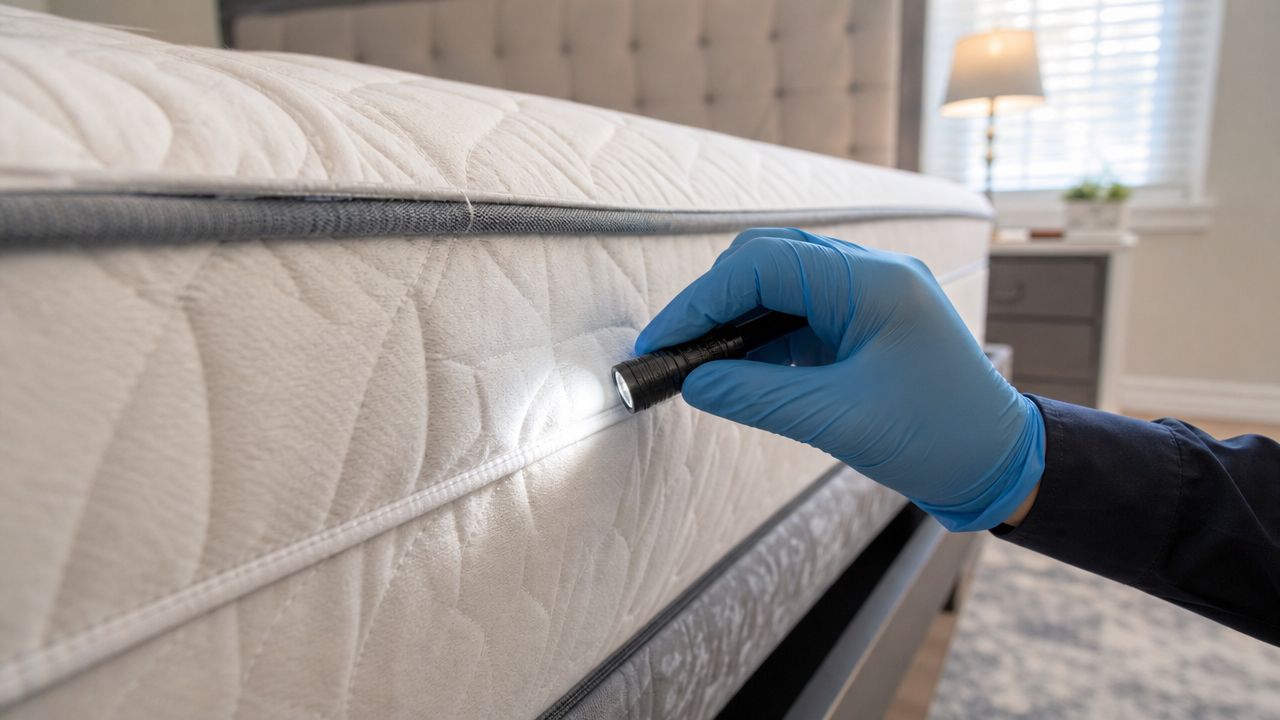
In most Brampton homes, the first inspection zone is the sleeping area. Start with the mattress seams, piping, labels, and tufts. Then move to the box spring, headboard, bed slats, and the joints in the frame. Bed bugs like tight, dark spaces close to a sleeping host.
After that, expand outward:
- Baseboards and trim: Check cracks where carpet edges, flooring, and wall trim meet.
- Nightstands and dressers: Remove drawers and inspect corners, undersides, and screw heads.
- Upholstered furniture: Sofas and accent chairs can hold active infestations, especially if someone naps there.
- Behind wall fixtures: Inspect behind loose outlet covers, picture frames, and mounted headboards.
- Luggage and storage bins: Travel items are a common introduction point.
What signs actually matter
Not every bite means bed bugs. Skin reactions vary, and some people don't react at all. Visual evidence matters more.
Look for these signs:
- Live bed bugs in seams, joints, and folds.
- Shed skins left behind as they grow.
- Tiny white eggs tucked into protected crevices.
- Reddish-brown spotting on bedding, mattresses, or nearby surfaces.
Bed bugs hide in places a quick glance won't catch. The inspection has to be slow, close, and deliberate.
Brampton residents who travel, host guests, or live in multi-unit buildings should also think about where items came from. A child's backpack on the bedroom floor, a suitcase returned from a trip, or a used piece of furniture can all become the starting point.
A simple inspection routine
Pest control authorities recommend a practical inspection routine called S.L.E.E.P. for travellers and homeowners. As outlined in Orkin's post on bed bug inspection steps, the process is to Search for signs, Lift and Look in common hiding spots, Raise luggage off the floor, Examine belongings before bringing them inside, and Place all clothing in a dryer on high heat. That same guidance stresses that professional intervention is essential once signs are detected.
For a homeowner doing an initial check, this routine works well:
| Area | What to inspect | Why it matters |
|---|---|---|
| Bed | Seams, tags, frame joints | Primary hiding zone |
| Furniture | Drawer corners, undersides, fabric folds | Secondary harbourages |
| Room edges | Baseboards, outlet areas, wall cracks | Spread points |
| Travel items | Suitcases, duffel bags, laundry | Common entry route |
A proper inspection should answer two questions. First, are bed bugs present? Second, how far have they spread inside the home? That second question often decides whether a room-based response will work or whether the whole unit needs treatment.
Evaluating Treatment Options Heat vs Chemical
A common Brampton call starts the same way. The bites showed up a week ago, one bedroom is already off limits, and the homeowner wants to know whether to book heat or spray treatment. The right answer depends on how far the bed bugs have spread, how the unit is built, and how quickly the home needs to get back to normal.
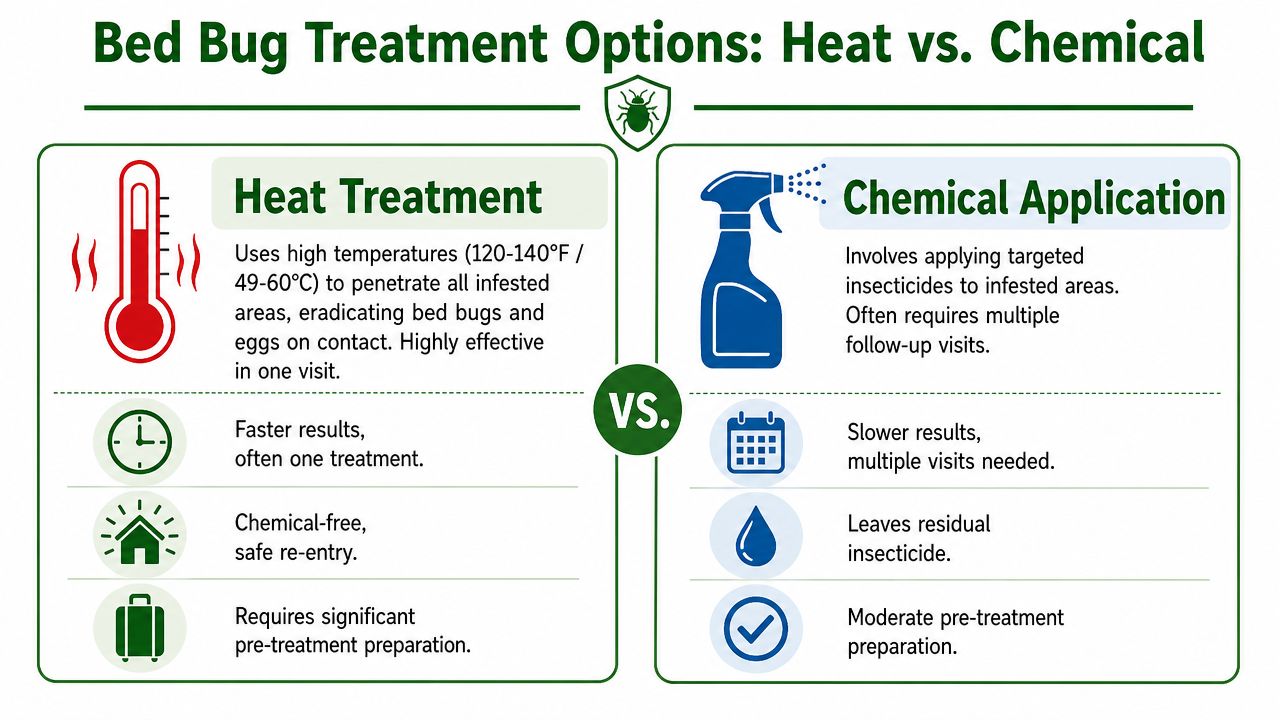
In Brampton, that choice is rarely theoretical. Homes, condos, basement apartments, and multi-unit buildings all create different treatment conditions. Add the steady movement of people and belongings between Brampton and Toronto, and infestations can spread faster than generic online advice suggests. A method that works well in a detached home may need a different plan in a stacked townhouse or apartment building.
How heat treatment works in real homes
Heat treatment is often chosen when speed matters and the infestation has likely reached more than one hiding area. A proper professional heat job raises the treated space to lethal temperatures for bed bugs and holds that heat long enough to kill insects in mattress seams, bed frames, furniture joints, and other hidden spots that are hard to treat by direct application alone.
Done properly, heat can clear an infestation in a single service window. That is why many Brampton homeowners prefer it when children need their rooms back, tenants are waiting to reoccupy a unit, or the problem has already crossed from the bed to nearby furniture. Homeowners comparing methods can review this guide to safe chemical-free bed bug heat treatment.
The trade-off is preparation. Heat-sensitive items must be removed or protected. Clutter has to be reduced so hot air can circulate. In tighter Brampton homes with packed closets, storage beds, or heavy furniture pushed against walls, setup takes work. Heat also has to be managed carefully in attached housing, where layout, airflow, and building materials affect how evenly temperatures move through the space.
Where chemical treatment fits
Chemical treatment still has a valid place in bed bug work. It is often used where the infestation appears more contained, where follow-up monitoring is planned, or where residual product in cracks, crevices, bed frames, and baseboard areas adds staying power after the initial service.
This option usually costs less up front, but it asks more from the household. Preparation still matters. Follow-up visits matter. Missing a second appointment, leaving rooms inaccessible, or skipping laundering and reduction steps can drag out the problem for weeks.
Ontario rules matter here too. Treatment should be done by a licensed exterminator using approved products according to label directions. That is not a paperwork detail. In occupied Brampton homes, especially those with children, seniors, or shared ventilation in multi-unit buildings, product choice and application method have to match the site.
A practical comparison for Brampton properties
For detached homes with widespread activity, heat often makes sense because it treats the whole affected area quickly.
For condos, apartments, and homes where reintroduction is a concern, chemical treatment may be part of a broader plan, especially if adjoining rooms or neighbouring units need monitoring.
For cluttered rooms or homes where preparation will be difficult, neither option performs well without cooperation. Treatment failure usually starts there, not with the machine or the product.
A useful way to judge the options is to ask four direct questions:
- How fast do you need the room back? Heat is often preferred for a faster reset.
- How far has the infestation spread? Wider spread can push the decision toward heat or a combined plan.
- Can the household complete preparation properly? Missed prep weakens both methods.
- Is this a single-family home or a shared building? In Brampton apartments, condos, and basement units, treatment often has to account for adjoining spaces and repeat introduction risk.
The strongest plan is the one that fits the layout, the infestation pattern, and the household's ability to prepare. In practice, many successful jobs use inspection findings to decide whether heat, chemical treatment, or a combination of both gives the best chance of clearing the problem the first time.
How to Hire the Right Bed Bug Exterminator in Brampton
A poor hire can turn one infestation into months of repeat calls. That's why screening the company matters almost as much as the treatment method.

Credentials that should never be skipped
Ontario residents should verify credentials before booking anything. According to this Ontario-focused FAQ on bed bug exterminator verification, homeowners should always ask for proof of a valid exterminator licence issued by the Ministry of the Environment, Conservation and Parks, along with proof of insurance, to avoid unlicensed operators who may use unapproved products or improper techniques.
That's not paperwork for the sake of paperwork. Licensing and insurance affect safety, accountability, and whether the treatment follows legal product-use standards.
Ask for clear answers on:
- Licence proof: The applicator should be able to show valid Ontario credentials.
- Insurance documentation: Liability coverage protects both the company and the homeowner.
- Treatment plan details: The company should explain where treatment will occur and what preparation is required.
- Post-treatment steps: Good operators explain what happens after service, not just before it.
Questions worth asking before booking
Brampton properties vary a lot. A detached house with a finished basement is different from a high-rise unit or a stacked townhouse. The exterminator should speak comfortably about those differences.
Useful questions include:
- What areas will be inspected besides the bed itself?
- Is the plan designed for a house, condo, apartment, or mixed-use building?
- What preparation is required from the resident?
- Will the company provide written instructions before treatment?
- What follow-up or reinspection process is included?
A serious company won't rush these answers. Bed bugs hide in structure, furniture, and belongings. The plan should reflect that.
Red flags during the estimate stage
Some warning signs show up immediately. Be cautious if the company avoids discussing preparation, offers a quote without asking about the layout, or promises an effortless fix without inspection details.
If a company can't explain how it will find bed bugs, it probably can't explain how it will eliminate them.
Another red flag is a price that looks unrealistically low compared with the amount of labour involved. Proper bed bug work takes inspection time, treatment planning, and homeowner coordination. Cheap shortcuts often mean missed harbourages, incomplete application, or no real follow-up.
For homeowners comparing options, this local bed bug exterminator near me page is a useful example of the kind of service category to review while checking whether a provider gives enough practical detail.
Your Pre-Treatment Checklist for a Successful Extermination
Preparation decides whether treatment reaches the insects or leaves protected pockets behind. In Brampton homes, especially crowded bedrooms, shared kids' rooms, and small condo layouts, this part often makes the difference between a clean result and lingering activity.
What to do with clothing bedding and clutter
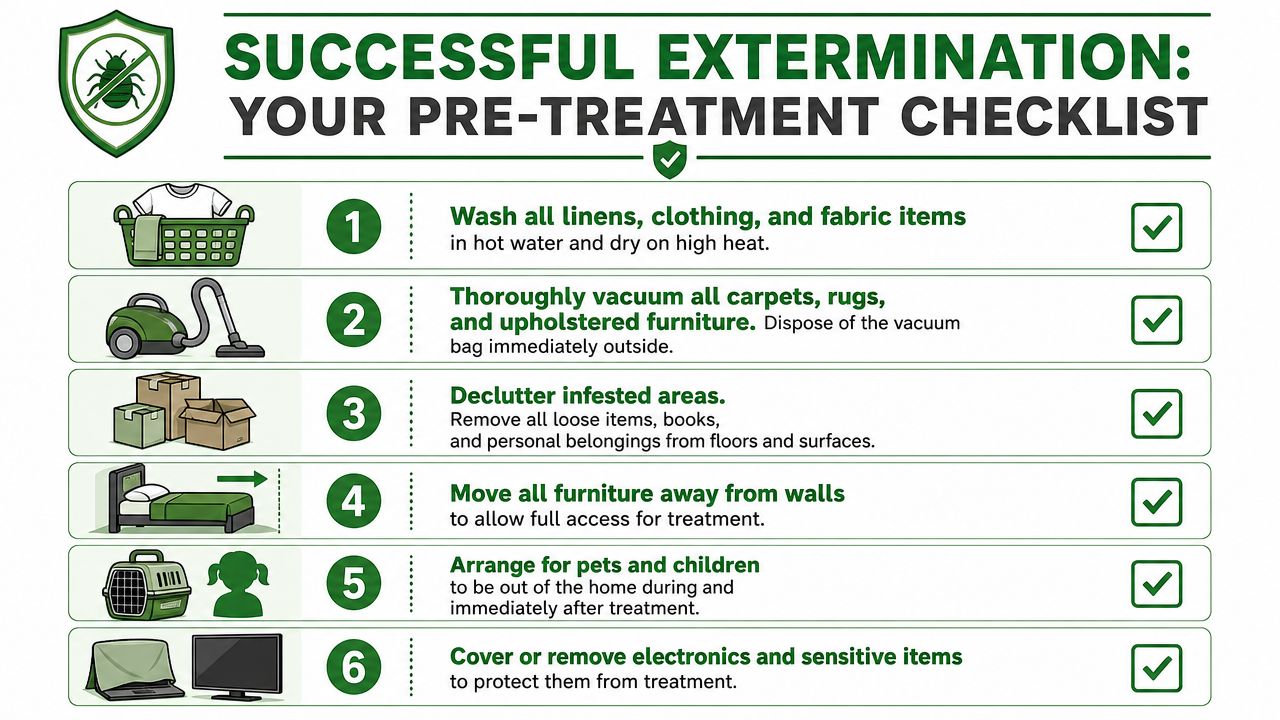
Start with all washable fabric items from the affected rooms. Bedding, pillowcases, blankets, sleepwear, and loose clothing should be bagged, laundered, and dried on high heat according to the exterminator's instructions. The goal is to stop bed bugs from staying hidden in fabric piles and to keep cleaned items separated from untreated ones.
Clutter has to be addressed next. Professional heat work depends on open airflow, and chemical work depends on access to hiding places. Piles of books, loose toys, overfilled under-bed storage, and packed closet floors all create protected spaces where bugs can survive.
A bedroom doesn't need to become empty, but it does need to become accessible. For many homeowners, the toughest part is organising what stays, what gets bagged, and what needs to leave the treatment area. Practical storage ideas can help reduce hiding spots long-term. Critelli's bedroom storage tips are useful for homeowners trying to keep sleeping areas less congested after treatment.
How to prepare furniture electronics and access points
Furniture should be pulled away from walls so technicians can reach baseboards, bed frames, and rear edges. Drawers may need to be emptied or left open, depending on the treatment plan. Nightstands and dressers usually require access to interior corners and undersides.
Heat-sensitive items need special attention. Some electronics, aerosol cans, medicines, candles, vinyl items, and certain personal belongings may need to be removed or protected. This should never be guessed. The treatment provider should give item-specific instructions.
A strong preparation checklist usually includes:
- Laundry handling: Bag infested-room fabrics before moving them through the home.
- Vacuuming: Vacuum carpets, rugs, bed frames, and upholstered furniture if instructed, then dispose of the vacuum contents outside.
- Access creation: Clear under beds, empty floor clutter, and open pathways to all walls.
- Furniture spacing: Move beds, sofas, and storage units away from walls where instructed.
- Family planning: Arrange for children and pets to be out of the home during the treatment window if required by the provider.
- Sensitive item review: Set aside electronics and materials that may react poorly to heat or treatment conditions.
Why preparation changes the outcome
According to this technical explanation of bed bug heat treatment methodology, commercial heat units need to maintain rooms at at least 120°F (49°C) for 90 minutes to guarantee egg mortality, and integrated pest management that combines heat with mattress encasements and interceptors can reduce bed bug numbers by more than 90% in apartment settings with low infestation levels. The same source notes that relying only on non-IPM chemical sprays rarely leads to total eradication in real-world conditions.
That's why preparation can't be treated as optional. If clutter blocks airflow, if furniture stays tight to the wall, or if key items are left packed shut, treatment won't move evenly into all the places bed bugs use.
Preparation matters because bed bugs survive in the gaps. The goal is to remove those gaps before treatment starts.
For Brampton residents in apartments and condos, there's another layer. Shared walls and tighter room layouts make access even more important. A well-prepared unit gives the technician a better chance of reaching bed frames, baseboards, electrical areas, and furniture joints where activity often continues.
Life After Extermination and Brampton-Specific FAQs
The hours after treatment are usually calmer than the days before it. The room is no longer in limbo. There's a plan, the active work is done, and the next step is observation rather than panic.
What to expect after treatment
Homeowners should follow all re-entry and post-treatment instructions from the exterminator. Beds may need to remain positioned a certain way. Cleaned items should stay separated. Mattress encasements, interceptors, and careful monitoring can help confirm that activity has stopped.
A short post-treatment review is also important. Some providers schedule a follow-up inspection window, while others instruct the homeowner on what signs to watch for. The key is not to rearrange everything immediately or bring untreated items back into cleaned rooms too quickly.
FAQ
Who is responsible for bed bug treatment in a Brampton rental
This is one of the biggest points of confusion for renters. As outlined in this discussion of Ontario landlord and tenant obligations for bed bugs, under Ontario's Residential Tenancies Act, landlords are responsible for maintaining a pest-free property. Tenants should notify the landlord in writing and allow access for treatment. Withholding rent without following proper legal procedures isn't advised.
Can bed bugs come back after treatment
Yes, reintroduction is possible. Bed bugs can return through luggage, visitors, used furniture, or neighbouring units in multi-residential buildings. That doesn't always mean the original treatment failed. It can mean a new introduction occurred after the job was completed.
Should furniture be thrown out
Not automatically. Many beds, sofas, and upholstered pieces can be treated successfully. Throwing furniture out too quickly can spread bed bugs through hallways or common areas if the item isn't wrapped and handled properly.
Are other Brampton pest problems treated the same way
No. Bed bugs require a very different approach from mice, rats, cockroaches, ants, wasps, termites, or wildlife issues such as raccoons, squirrels, skunks, and bats. Bedrooms, fabric, furniture joints, and human sleeping patterns make bed bug control its own category of work.
If bed bugs are disrupting sleep in a Brampton home, condo, rental unit, or business, Vanish Pest Control Inc. can inspect the space, explain the treatment options clearly, and provide a practical plan that matches the layout and level of activity. Early action usually means a faster, cleaner result.