

A pallet arrives at a Toronto warehouse, and a worker notices droppings near its base. The useful response isn't to spray the area and carry on. Staff can isolate the pallet, record exactly where the evidence appeared, check nearby stock and the receiving dock, and alert the people responsible for food safety, maintenance, and pest management.
That response turns a sighting into information the warehouse can act on. Effective warehouse pest control connects prevention, monitoring, corrective action, and verification, with records that show what happened and what changed.
Table of Contents
- Why Warehouse Pest Control Starts Before Treatment
- Understanding Integrated Pest Management
- Build a Practical Warehouse IPM Routine
- Recognize Common Warehouse Pests
- Control Sanitation Moisture and Entry Points
- Monitor Trends and Build Audit-Ready Records
- Respond to Urgent Pest Activity
- Choose the Right Commercial Pest-Control Provider
Why Warehouse Pest Control Starts Before Treatment
A single sign near receiving may be connected to the load, the dock, nearby stored goods, or a route through the building. The sign alone doesn't prove where activity started or how far it extends. A measured response preserves the evidence and helps the team decide what to inspect next.
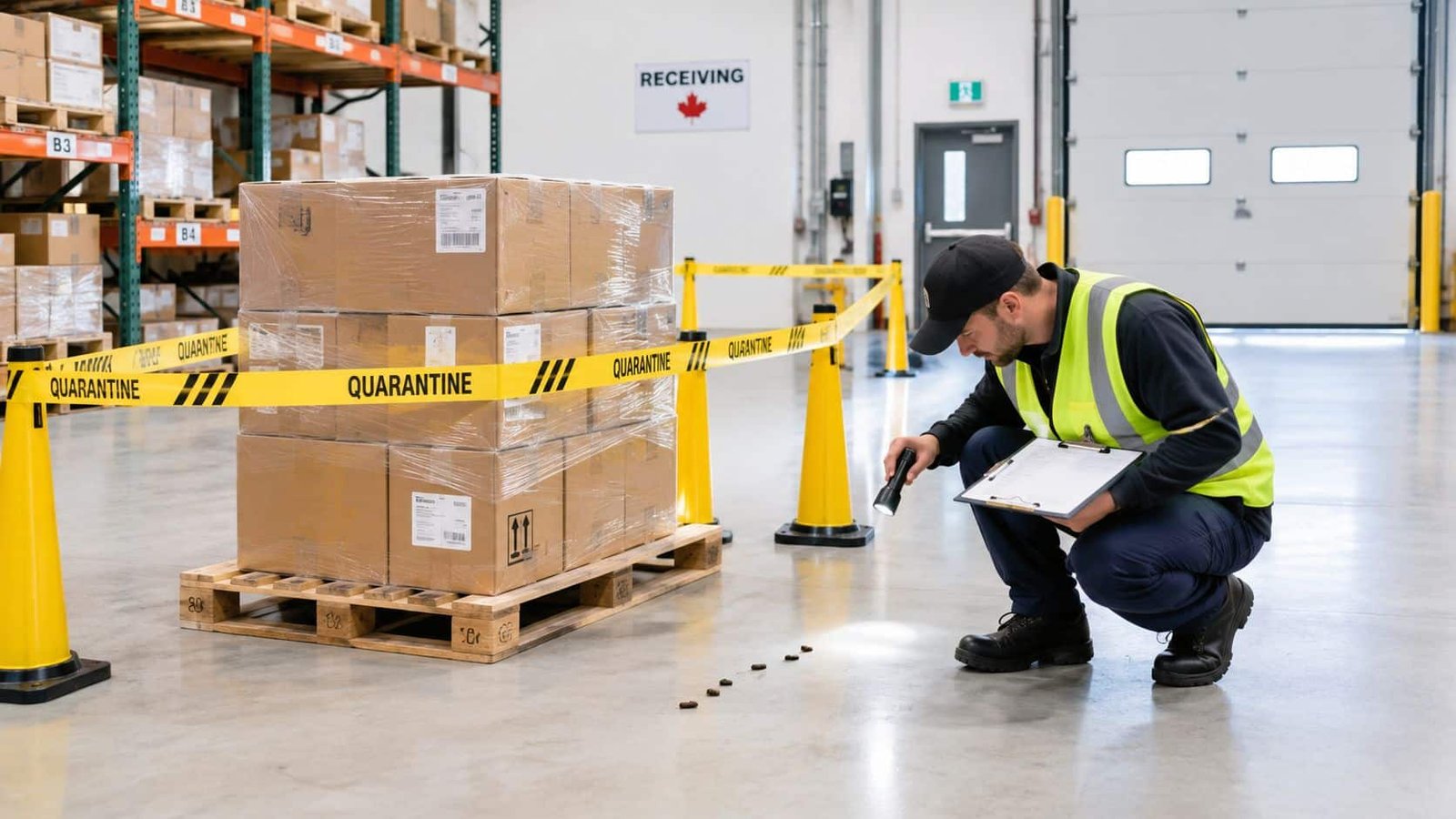
The first task is containment. Staff can keep the affected pallet or area from being moved until the responsible manager determines how to handle it. They should note the time and location, photograph what they found, and check adjacent stock, dock edges, and any visible gaps. Product decisions should follow the facility's food-safety procedures, not guesswork.
Next comes correction and verification. Maintenance may need to assess a door gap or damaged joint; warehouse staff may need to remove residue or reorganise a storage area; and a pest-control professional may need to identify the evidence and recommend a response. The manager should assign each action to someone, set a follow-up date, and record whether the work resolved the concern.
Practical rule: A service visit is one part of the record, not a substitute for the warehouse's own inspection and corrective-action history.
| IPM Element | Warehouse Application | Expected Record |
|---|---|---|
| Prevention | Keep goods organised and address gaps or harbourage | Inspection findings and maintenance requests |
| Detection | Check receiving, storage edges, and monitoring points | Date, location, observer, and evidence |
| Containment | Hold affected stock or limit movement in the area | Product decision and person notified |
| Correction | Remove contributing conditions or repair defects | Action owner and completion date |
| Verification | Recheck the location and document the result | Follow-up finding and status |
The response should match the evidence. A questionable single mark calls for documentation and a careful check; repeated signs, damaged packaging, or evidence across adjacent areas justify prompt escalation and a broader inspection. Staff should share findings with food-safety personnel, maintenance, and the provider so the suspected route doesn't remain open while each group assumes someone else is handling it.
Understanding Integrated Pest Management
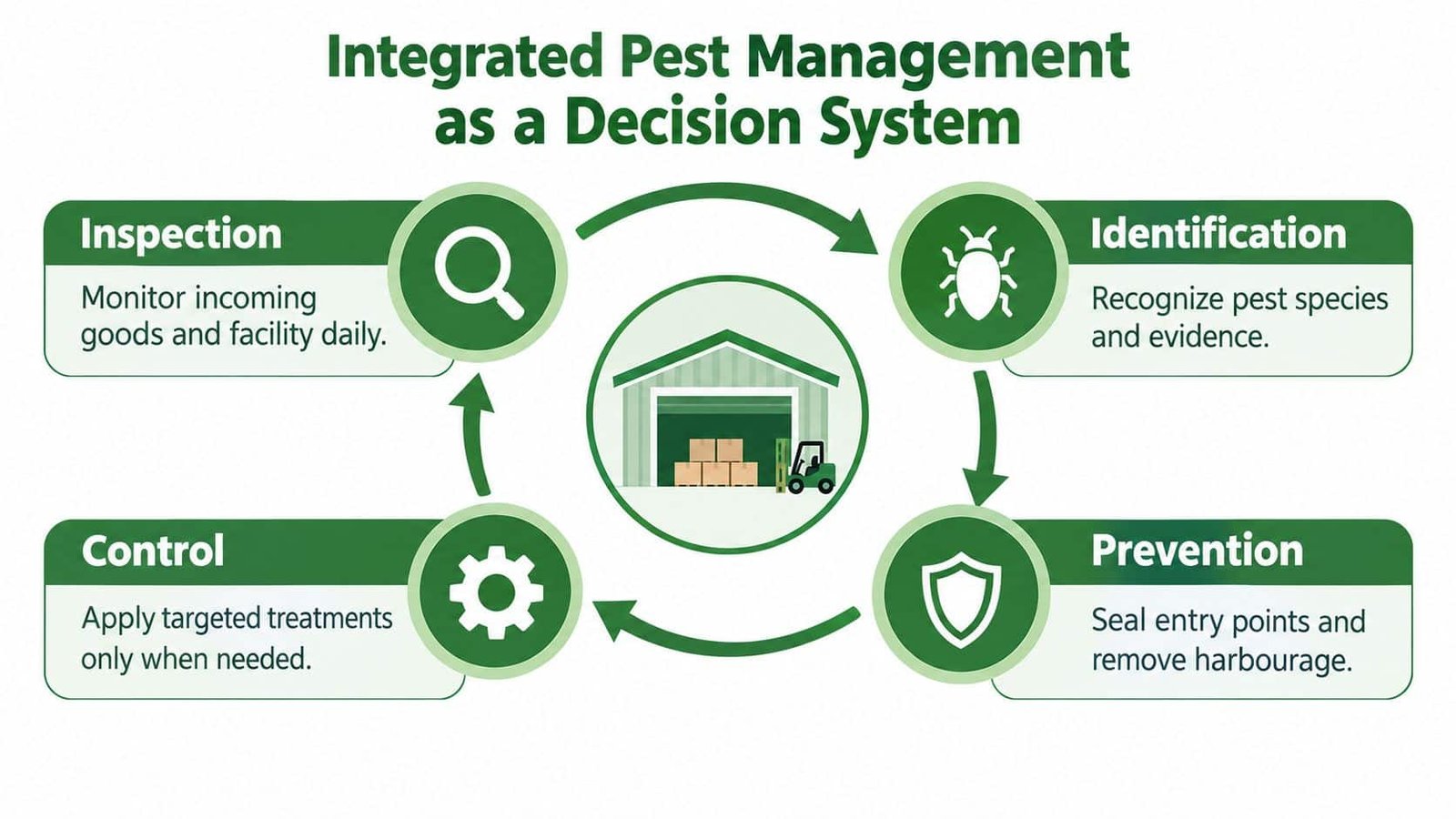
Integrated pest management (IPM) is a coordinated decision system, not another name for pesticide use. A warehouse works as a connected environment: an open dock, a spill, and poorly rotated stock can link receiving, storage, and waste areas. Each control has a specific job, and none replaces the others.
Sanitation removes accessible food and residue. Stock handling limits long-standing, hard-to-inspect areas. Structural exclusion addresses entry points and harbourage. Monitoring helps staff detect activity and understand where it occurs. Environmental controls help operators manage conditions relevant to the stored commodity. Approved treatments are considered when inspection and identification establish a need, with product use following applicable label directions.
A Canadian example shows why pest control belongs alongside food-safety procedures. A federal Health Canada programme planned and delivered 33 inspections of fruit and vegetable warehouses in 2010, including 10 in Ontario. Chemical treatment was reported in 24 warehouses, while rodent-control products were reported in 14 (Health Canada's produce warehouse inspection report). Those figures describe the inspected facilities and period, not a universal treatment prescription. They reinforce the need to document monitoring and ensure that any product used is registered for its application and used according to its label.
A facility can make the decision path visible:
| Stage | Operator Question | Evidence to Retain |
|---|---|---|
| Inspection | What was observed, and where? | Notes, photographs, and location |
| Identification | What can be confirmed, and what remains uncertain? | Specimen details or professional assessment |
| Prevention | Which condition needs correction? | Maintenance or sanitation action |
| Control | Is a targeted measure justified? | Rationale and product-use record, if applicable |
| Verification | Did the activity or contributing condition change? | Follow-up inspection and status |
Teams seeking a prevention-first approach can review Vanish's eco-friendly pest-control information. The central test remains practical: the chosen action should address the evidence and contributing conditions, not add an application to the service record.
Build a Practical Warehouse IPM Routine
A repeatable routine gives staff a clear handoff from first observation to follow-up. The process should cover receiving and returned goods as well as storage aisles, since a concern can arrive with freight or packaging rather than develop inside the warehouse.
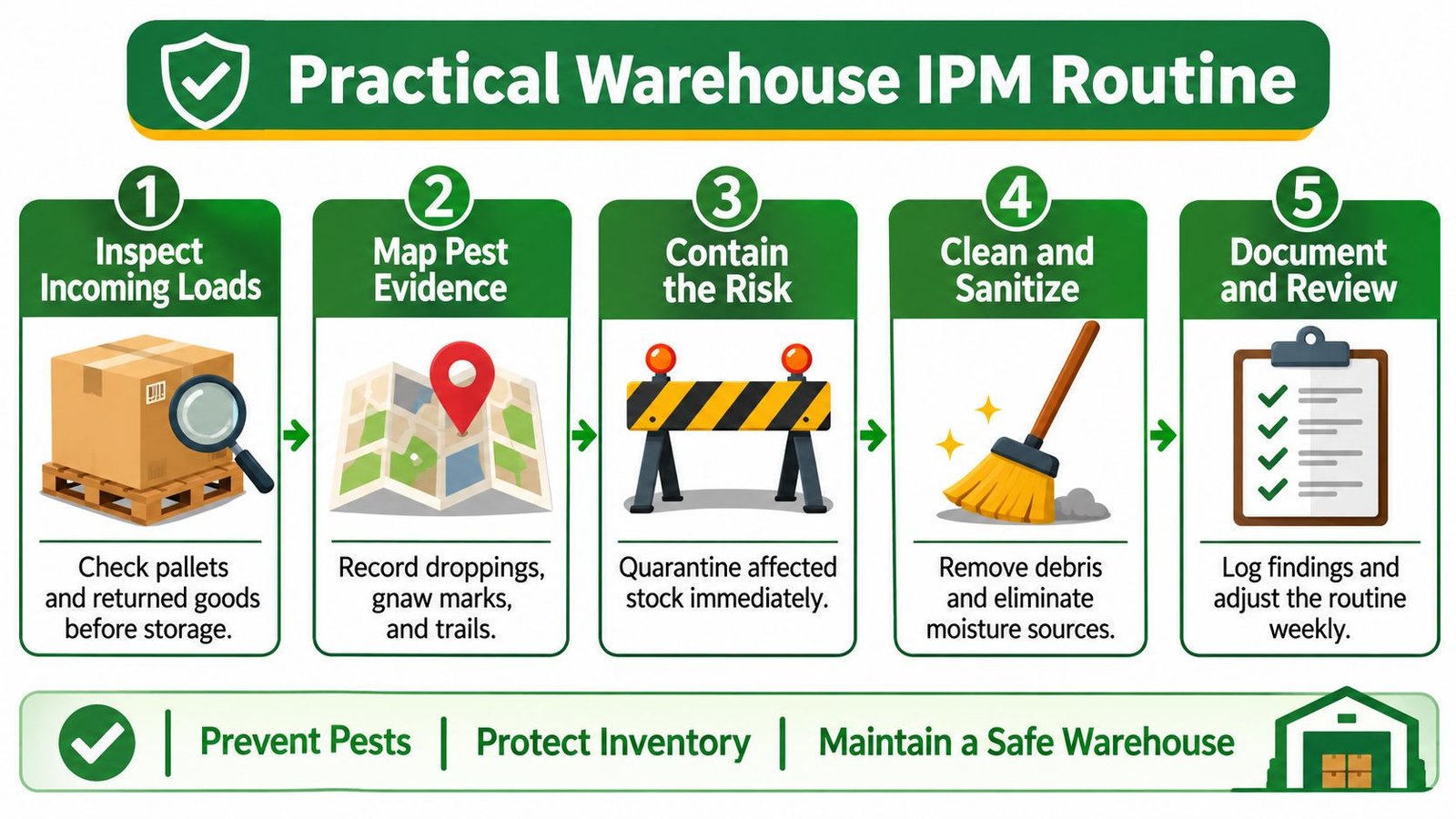
Start at receiving. Staff should inspect incoming materials before storage and note damaged packaging, visible evidence, or conditions that need review. If a concern is found, keep the affected goods identifiable and follow the site's product-hold procedure rather than mixing them into existing stock.
Map the evidence. Record the exact location and type of sign, then check nearby routes and monitoring points. A location map helps distinguish a finding at the dock from one at a wall edge, drain, or storage zone. Avoid naming a pest species based only on an ambiguous mark.
Contain and correct. Restrict unnecessary movement around the affected area, notify the responsible personnel, and remove the contributing condition where appropriate. The corrective action might involve sanitation, stock handling, or a maintenance assessment; the record should identify who is responsible and when the work will be checked.
Verify the response. Set a follow-up date and revisit the same location. A closed work order doesn't establish that pest evidence has stopped; the inspection record should show what was checked and what was found.
The CFIA's preventive-control guidance for food warehouses calls for incoming materials to be inspected, food to be stored off the floor, wall aisles to remain clean and visible, expansion joints to be sealed, and stock rotation to reduce old-product accumulation. These practices make inspection more useful because staff can see key surfaces and access likely routes.
| Location | Check | Action If Concern Is Found |
|---|---|---|
| Receiving dock | Pallet condition, packaging, and visible evidence | Hold or identify affected goods and notify the lead |
| Storage aisle | Clear sightlines and goods off the floor | Reorganise stock and record the corrective action |
| Wall and floor joints | Gaps, residue, or signs of activity | Request maintenance and arrange a recheck |
| Returned goods | Packaging condition and evidence before storage | Keep separate pending the site's product decision |
The routine works only when staff know where to report findings and who owns the next step. A photograph without a location or follow-up date may preserve a moment, but it won't establish whether the risk was corrected.
Recognize Common Warehouse Pests
Different pest groups leave different clues, but a sign's location is often more useful than appearance alone. Droppings, gnaw marks, tracks, trails, damaged packaging, webbing, and sightings should be documented as observations. A qualified assessment may be needed to confirm what caused them.
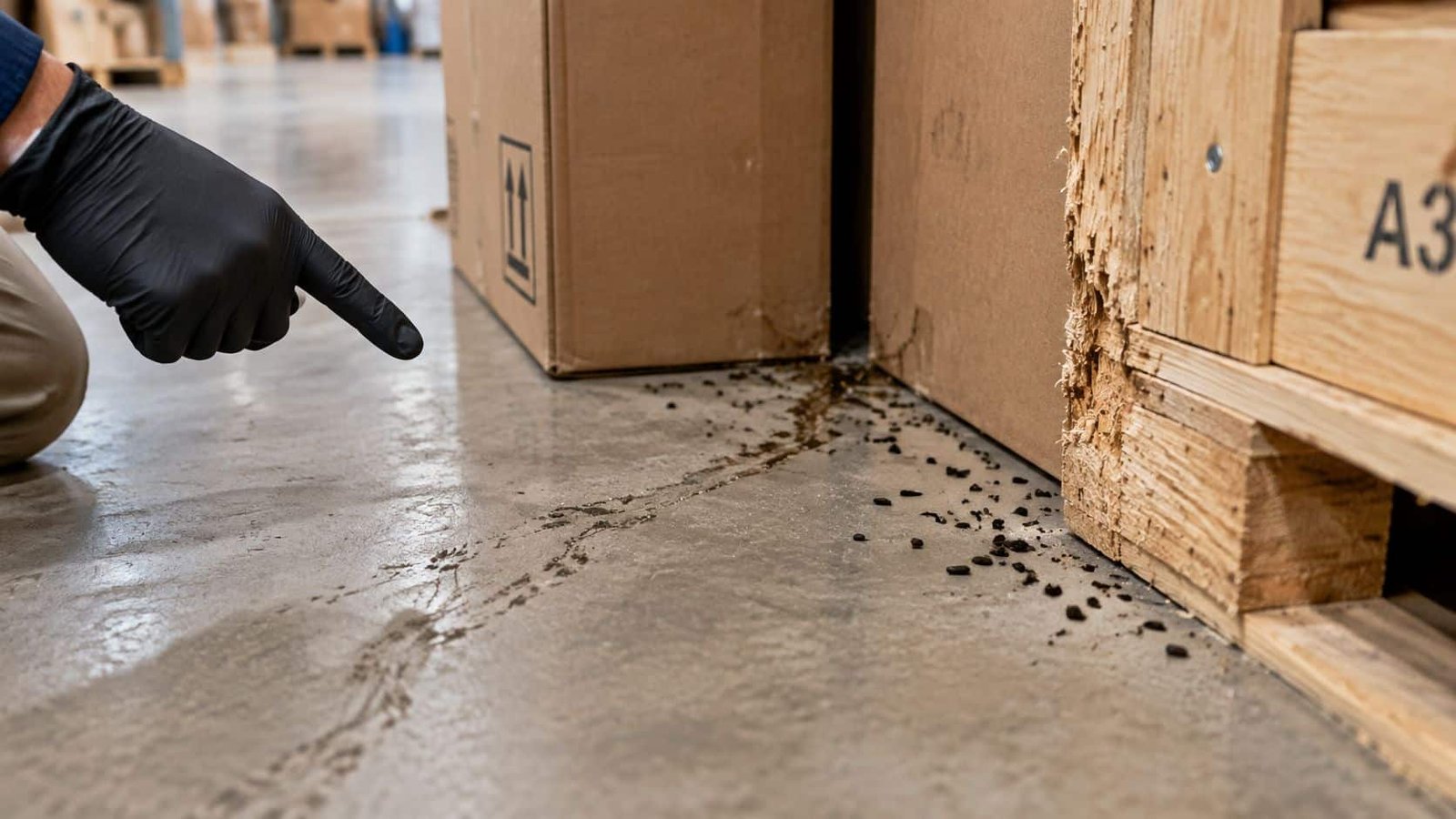
Stored-product insects call for close attention to commodities, packaging, and older stock. Rodent evidence directs inspection toward wall edges, dock doors, utility penetrations, and areas where goods or equipment limit visibility. Cockroach concerns warrant attention to damp, sheltered locations and nearby drains or service penetrations. Occasional nuisance wildlife concerns are more likely to require an exterior and structural review. These are inspection priorities, not diagnoses based on a single clue.
The scale of stored grain in Canada illustrates why commodity protection matters. Agriculture and Agri-Food Canada reports annual average production of 54 million tonnes of cereal grains and oilseeds, while an average of 8.7 million tonnes of wheat remains in farm storage for more than one year (Agriculture and Agri-Food Canada's stored-grain report). For warehouses handling food or agricultural products, the practical lesson is to treat evidence and product condition as operational concerns, not just housekeeping observations.
| Evidence Pattern | Inspect For | Document |
|---|---|---|
| Signs near a delivered pallet | Packaging, adjacent loads, and receiving route | Load details, location, and photographs |
| Repeated evidence along an edge | Gaps, concealed routes, and nearby storage | Exact points checked and findings |
| Damaged packaging or product | Affected stock and surrounding goods | Product identification and disposition |
| Webbing or insect-like material | Stored goods, packaging, and older inventory | Sample or photograph and location |
| A single uncertain mark | Nearby surfaces and relevant monitoring points | Description, date, and follow-up status |
Preserve photographs and location details, and avoid cleaning away evidence before the responsible personnel decide whether it needs assessment. If a specimen can be collected safely under site procedures, keep its location associated with the sample. Report whether the evidence is repeated, whether packaging is affected, and whether nearby stock or structural features also show signs.
Control Sanitation Moisture and Entry Points
Daily controls reduce the conditions that support pest activity. Keep spills and residue from accumulating, make wall and storage interfaces visible, rotate stock, inspect incoming materials, and report gaps in doors, walls, floors, and service penetrations. A clean floor helps, but cleanliness by itself doesn't establish that a building is sealed or that concealed activity is absent.
For food warehouses, the CFIA guidance on receiving, storage, wall aisles, expansion joints, and stock rotation, outlined above, provides a practical basis for inspection. Apply those checks consistently and record defects so maintenance can address them. Roof leaks deserve attention because moisture can affect storage conditions and create areas that need investigation. For general background on roof maintenance, operators can review advice on preventing commercial roof leaks, then have site-specific defects assessed by the appropriate building professional.
Environmental readings are especially useful for bulk grain, but grain thresholds shouldn't be applied indiscriminately to other commodities. Canadian grain guidance recommends stored grain be kept below 14.5% moisture and below 18°C. It also states that maintaining grain at -5°C for 12 weeks can control stored insect pests at all life stages (Canadian Grain Commission guidance on physical control). The temperature and exposure period matter together; a brief cold spell or temporarily open door doesn't establish that the full bulk reached the required conditions for long enough.
| Condition | Preventive Action | Verification Record |
|---|---|---|
| Spills or residue | Clean the affected area and review how material accumulated | Sanitation check and completion |
| Visible structural gap | Refer for repair and inspect the area again | Defect, owner, repair date, and recheck |
| Grain moisture or temperature concern | Assess the relevant storage zone and corrective options | Reading, location, and follow-up |
| Hard-to-access stock | Reorganise to improve inspection access | Stock movement and inspection finding |
| Moisture intrusion | Report the source and assess affected storage | Maintenance action and product review |
For grain storage, trend readings by bin or zone and investigate a sudden change. Record the corrective action, whether that means reviewing aeration, handling, or the affected stock. Control decisions for any commodity should account for its characteristics and the facility's requirements.
Monitor Trends and Build Audit-Ready Records
A monitoring point is useful only when the warehouse can tell where it is, what was checked, and what happened next. Keep a site map of traps or other monitoring points, then record findings by location rather than writing a general note that “the warehouse was checked.” An empty station is one observation, not proof that no pest activity exists elsewhere.
Environmental logs should identify the bin or storage zone, the reading, the date, and any follow-up. A sudden change calls for investigation, not an automatic treatment decision. At receiving, records can connect supplier-load findings with photographs, affected stock, and product disposition. For sanitation and repairs, capture the defect, assigned owner, completion, and verification.
Ontario Regulation 493/17 requires food premises to prevent pest entry and harbourage and to retain records of every pest-control measure for at least one year (Ontario Regulation 493/17). Operators should confirm how the regulation applies to their particular facility and recordkeeping process with the appropriate food-safety or regulatory adviser.
| Field | What to Record | Why It Matters |
|---|---|---|
| Date and observer | When the check occurred and who completed it | Establishes a traceable inspection history |
| Location | Dock, aisle, wall, monitoring point, or storage zone | Helps identify recurring patterns |
| Evidence | Description and photograph where useful | Separates observed facts from assumptions |
| Affected stock | Product or packaging concerned and disposition | Connects pest findings to inventory decisions |
| Corrective action | What changed, who owns it, and when it was completed | Makes responsibility and progress visible |
| Verification | Follow-up date, finding, and open or closed status | Shows whether the response was checked |
A warehouse can have no visible rodents and still be unable to demonstrate a consistent inspection and corrective-action history.
Keep the map and logs accessible to staff who need them, including food-safety personnel, maintenance, and the pest-control provider. Facilities with food-handling procedures may also find the restaurant pest-control resource useful when considering how pest records fit within broader food-safety operations. The warehouse's own records should still reflect its layout, risks, and procedures.
Respond to Urgent Pest Activity
The response should depend on what staff find. A single uncertain mark isn't the same as repeated signs, suspected entry, or affected goods. Managers can start by limiting unnecessary movement in the immediate area, identifying any stock that needs review, and notifying the people responsible for food safety and site operations.
| Situation | Immediate Action | Escalation Trigger |
|---|---|---|
| One questionable sign | Photograph and record the location; check nearby surfaces | Evidence recurs or additional signs appear |
| Repeated signs or active movement | Restrict disturbance and arrange prompt assessment | Activity extends beyond the initial area |
| Suspected structural entry | Record the location and request maintenance review | Gap or route remains open or activity continues |
| Damaged or potentially affected stock | Identify and separate it under site procedures | Product disposition or safety review is needed |
When contacting a qualified provider, share the pest stage if known, exact location, photographs, stock type, recent deliveries, sanitation history, and any structural concern. Those details help the professional assess what needs inspection without treating an unverified assumption as fact. Preserve relevant evidence until the responsible personnel decide whether it should be retained.
Treatment decisions depend on the pest, commodity, site conditions, and applicable requirements. Product treatment, fumigation, cold treatment, and other controls require commodity-specific assessment; any applicable pesticide must be authorised for its intended use and applied according to its label and regulatory requirements. Temporary cooling or a local intervention shouldn't be treated as proof that an entire stored commodity has been controlled.
Choose the Right Commercial Pest-Control Provider
A credible provider should describe what was inspected, what evidence was found, what remains uncertain, and what action is recommended. The service should also explain how the warehouse team can help correct contributing conditions and how the provider will verify whether those actions were completed.
| Evaluation Question | What a Credible Response Covers | Operator Follow-Up |
|---|---|---|
| What does inspection include? | Receiving, storage, likely routes, and reported locations | Confirm access and responsibilities |
| How is evidence assessed? | Clear distinction between observation and identification | Ask how uncertain findings are handled |
| How are recommendations documented? | Location, corrective action, and follow-up status | Confirm who receives the report |
| How are food-site products managed? | Application-specific label and compliance considerations | Review the facility's approval process |
| How is progress verified? | A defined follow-up check tied to the original finding | Agree on communication and timing |
Ask how monitoring points are mapped, how urgent reports are handled, and how findings are shared with food-safety and maintenance staff. Confirm quotations, credentials, service terms, and any treatment claims directly; generic promotional language isn't a substitute for a site-specific explanation. For context on how recurring service arrangements can be structured in commercial settings, operators can browse commercial maintenance agreements, while confirming pest-control terms separately with their chosen provider.
Before signing, managers should know who receives reports, which actions belong to warehouse staff, how open recommendations are tracked, and what counts as a completed follow-up. Further questions about selecting a provider can be informed by this guide to pest-control companies in Toronto.
Vanish Pest Control Inc. offers commercial pest-control support focused on inspection, targeted planning, and prevention for warehouse and business properties. Call 877-611-8855 to discuss a site-specific programme, or visit Vanish Pest Control Inc. to learn more.


