

A Toronto homeowner usually notices the problem at the worst possible time. It's late at night, the house is finally quiet, and then the ceiling starts thumping. Not a light scratch. A heavy, deliberate movement above the bedroom, hallway, or second-floor bathroom.
That sound often means more than “there's a raccoon up there.” In the GTA, raccoon removal is rarely a one-step animal call. It's a property access problem, a seasonal wildlife issue, and in many cases a roofline repair job that needs to be handled in the right order. If the animal is using an attic, soffit, chimney, or vent, the permanent solution depends on inspection, legal handling, baby checks, humane exclusion, and proper sealing after the animal is out.
For Toronto homes, semis, older detached houses, laneway properties, and multi-unit buildings, the difference between a temporary fix and a lasting one comes down to the full project lifecycle. That's what matters in raccoon removal GTA work.
Table of Contents
- Is That a Raccoon in My Attic? Signs of an Infestation
- Why Raccoon Removal Is Not a Weekend DIY Project
- The Professional Raccoon Removal Process Step by Step
- Understanding Raccoon Removal Costs in the GTA
- How to Raccoon-Proof Your Toronto Property for Good
- GTA Raccoon Removal Frequently Asked Questions
Is That a Raccoon in My Attic? Signs of an Infestation
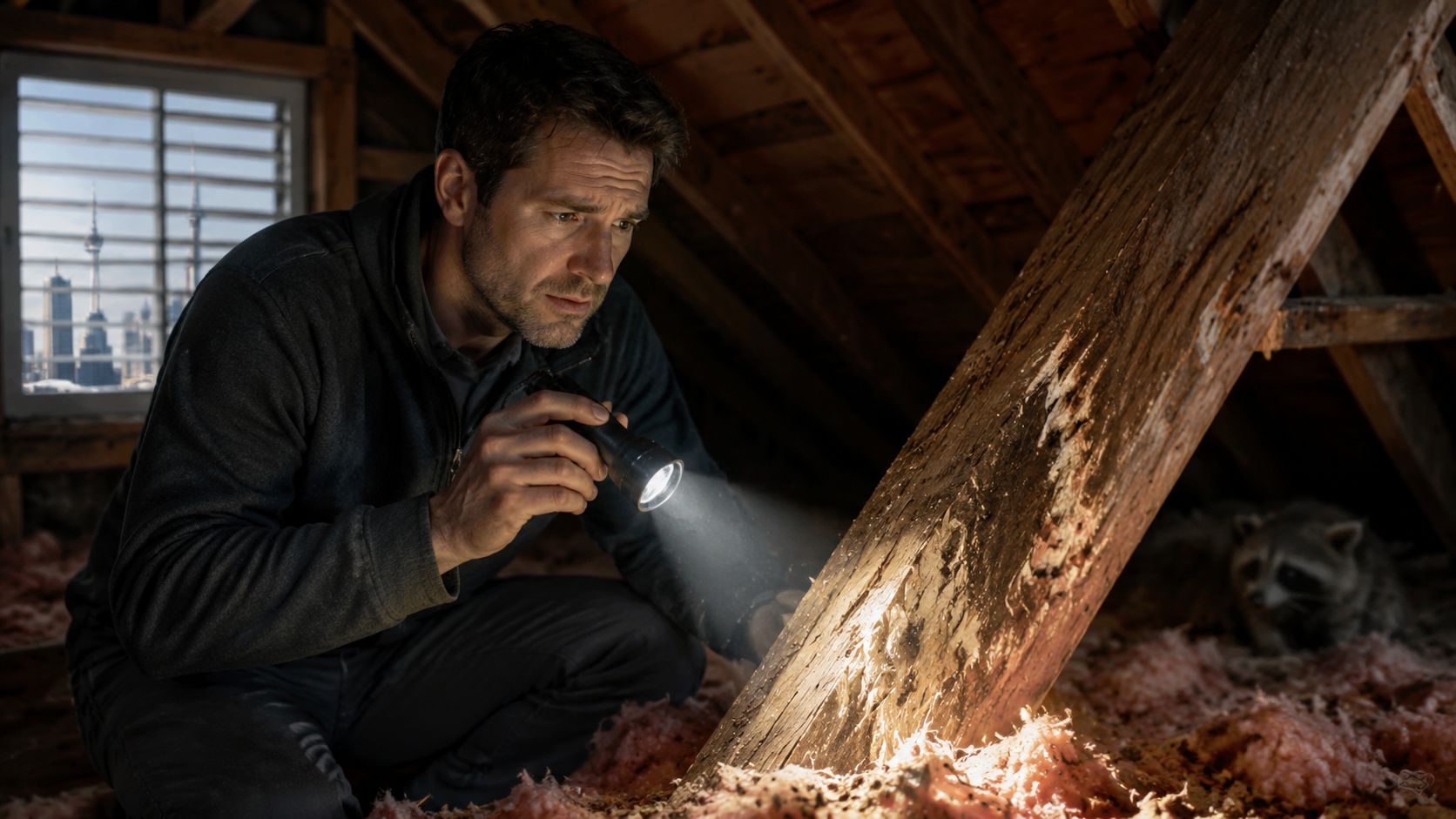
In Toronto homes, raccoon activity rarely stays subtle for long. A squirrel often sounds fast and light. A raccoon usually sounds heavier, slower, and stronger. The difference matters because the kind of damage overhead can change the urgency of the call.
A raccoon can tear at weak soffits, pry at roof vents, bend screening, and widen an opening that started as a small weakness. In older GTA housing stock, that often means one breach becomes several.
Noises to Listen For
The sound profile is one of the best first clues.
- Heavy thumping at night: Raccoons are large enough that their movement often sounds like weight shifting, not just tiny feet.
- Dragging or shuffling above one room: This can happen when an adult is moving through insulation or settling into a den area.
- Vocal sounds: Chittering, growling, or distressed sounds may suggest a nesting situation rather than a brief roof visit.
- Noise near dawn or dusk: Activity near exit and entry times can point to a regular denning pattern.
Practical rule: If the ceiling noise sounds too heavy to be a squirrel and too deliberate to be branches, it should be treated as an active wildlife issue until proven otherwise.
Many Toronto residents first hear this in the attic over a bedroom, but the same problem can start over kitchens, additions, garages, or top-floor closets. In row housing and semis, the noise can also seem like it's coming from a neighbouring roofline when the actual entry is on the same structure.
Visual Damage to Your Home
Exterior clues are often easier to confirm in daylight.
Look closely at the roof edge, especially where the soffit meets fascia, around plumbing stacks, roof vents, chimney areas, and low roof transitions. A raccoon doesn't need a perfect opening. It only needs a weak one.
Common signs include:
- Bent or lifted soffit panels
- Torn vent covers
- Disturbed shingles near an edge
- Black rub marks near a repeated climbing route
- Insulation sticking out from a hole or vent
A strong inspection also checks where the animal likely climbed. Downspouts, fences near garage roofs, stacked materials beside the house, and overhanging branches all matter. For Toronto homes with additions or flat roof sections, those transitions often create easy access paths.
Identifying Raccoon Latrines
A raccoon den often leaves a sanitation problem behind, not just an access problem. Droppings in an attic, on a roof, under a deck, or along a garage ledge should never be brushed off as “just a bit of mess.”
A raccoon latrine is a repeated bathroom area. That repeated use is one reason odour builds so quickly in enclosed spaces. If a homeowner is unsure what they're seeing, this guide to identifying raccoon scat in a Toronto or GTA home helps distinguish wildlife droppings from other pest evidence.
The combination that most strongly points to a raccoon issue is simple: heavy night noise, visible roofline damage, and concentrated droppings or odour near one part of the property. Once those signs line up, the next step isn't trial and error. It's controlled removal and proper exclusion.
Why Raccoon Removal Is Not a Weekend DIY Project
A lot of Toronto homeowners start in the same place. They hear the noise, find the hole, and think the job is to trap the raccoon or seal the opening. That's where many situations get worse.
Raccoon removal in the GTA involves legal limits, breeding-season checks, and structural decisions that have to be made in sequence. The danger isn't just getting scratched. The danger is turning a manageable wildlife entry into trapped animals, hidden baby raccoons, more damage inside the roof, or a repeat infestation.
The Legal Problem Most Homeowners Miss
Ontario handling rules shape what can be done after a raccoon is captured. Guidance used in Southern Ontario wildlife control notes that raccoons have strong homing instincts and animals released no more than 1 kilometre from the capture site often return, which is one reason professionals focus on sealing entry points instead of relying on relocation alone, as outlined in this Southern Ontario raccoon exclusion guidance.
That one detail changes the whole strategy. If the house remains open, trapping the animal doesn't solve the underlying issue. The structure still invites re-entry.
The Health and Safety Risk Inside the Home
A raccoon in an attic or chimney isn't the same as spotting one in a backyard. Inside a structure, the risk profile changes.
A homeowner may be dealing with:
- Contaminated droppings and urine
- Damaged insulation
- Odour inside the living space
- Aggressive behaviour if the animal feels cornered
- A mother defending a den site
This is one reason professionals don't treat raccoon removal GTA calls as simple capture jobs. Once the animal has spent time inside a home, the work often includes sanitation and damage review as part of the solution.
A raccoon that feels trapped in a confined space can tear at drywall, duct paths, soffits, or roof decking while trying to escape.
DIY approaches also push people into unsafe contact points. Homeowners climb ladders, approach attic voids without protective equipment, or reach into dark cavities where they can't see the animal. That's the kind of mistake that turns a wildlife call into a medical one.
Why Trapping Alone Usually Fails
Trapping is the part people imagine. It's not usually the part that delivers a lasting result.
Failure point is almost always one of these:
- The entry hole stays open
- A second hidden gap is missed
- A baby raccoon is still inside
- The animal returns to a familiar route
- Food sources around the property stay unchanged
That's why modern professional work in this area is built around inspection, exclusion, and prevention. The animal has to leave. The structure has to be secured. The conditions that invited the raccoon in have to change.
For Toronto residents, that's especially important in dense neighbourhoods where roofs connect visually, fences create climbing routes, and one vulnerable section of a home can keep drawing wildlife back season after season.
The Professional Raccoon Removal Process Step by Step
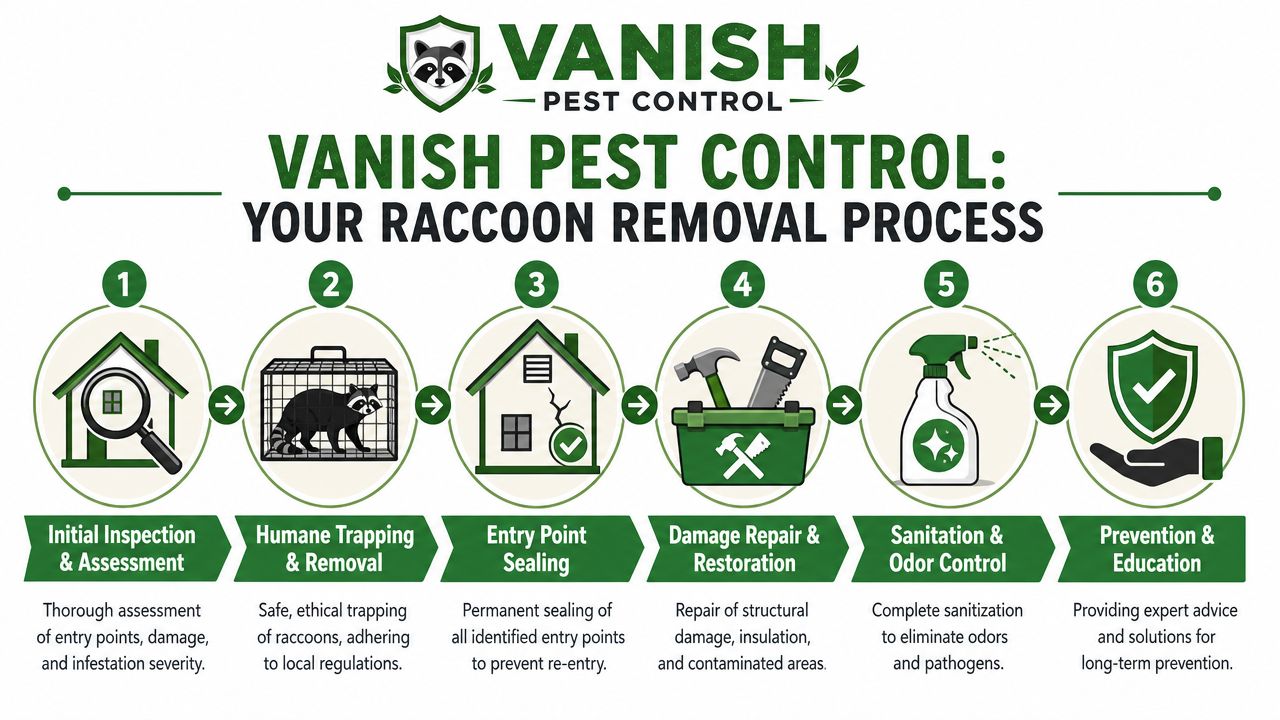
A proper raccoon removal job follows a sequence. Skipping steps causes callbacks, trapped animals, or repeat entries. In Toronto homes, the process has to account for roofline design, season, whether young are present, and the condition of the access points.
Here, a structured approach matters most.
Comprehensive Inspection
The first job is not sealing. It's finding out exactly what's happening.
Professional inspection for occupied structures should determine whether kits are present before exclusion, because one-way doors are typically left in place for 3 to 5 days, or longer in poor weather, to make sure the female has exited while preventing re-entry, as explained in this Ontario raccoon exclusion overview.
That inspection should cover:
- Roofline weak points: soffits, fascia, vents, flashing, and chimney areas
- Attic conditions: nesting material, pathways through insulation, and contamination zones
- Secondary vulnerabilities: gaps that aren't active yet but could become future access points
- Property context: decks, sheds, additions, garages, or shared structures
A rushed seal-up without this step can trap dependent young inside. It can also force an adult raccoon to rip into another part of the house.
Humane Exclusion With One-Way Doors
In many GTA homes, exclusion is the most reliable method when the conditions are right. The active opening is fitted with a one-way device that lets the raccoon exit but not get back in.
That approach works because it uses the animal's existing travel pattern. The raccoon leaves on its own routine, usually around active periods, and then loses access to the den site.
A homeowner looking for a broader overview of humane wildlife removal practices across Toronto, Newmarket, and Southwestern Ontario will see the same principle repeated. Humane doesn't mean casual. It means methodical.
The right question isn't “How fast can the raccoon be taken away?” It's “How can the home be cleared without leaving young behind or creating a route back in?”
In some situations, field conditions call for different equipment and containment decisions. That depends on location and risk. But the underlying goal stays the same. The animal must be removed without creating a worse problem inside the building.
Securing All Entry Points
Once the raccoon is out and the technician confirms the structure is clear, exclusion work shifts to reinforcement.
Permanent outcomes are won or lost. A house with one repaired hole and three weak points is still an open structure.
Important sealing work may include:
- Reinforcing soffit returns
- Securing vent openings with proper guards
- Repairing broken fascia sections
- Capping vulnerable chimney openings
- Closing gaps at roof transitions and wall intersections
For many Toronto properties, especially older detached homes and homes with additions, there is usually more than one issue at the roofline. The active breach gets attention first, but secondary openings are what often trigger the next call a few weeks or months later.
This is also the one place in the article where it makes sense to note that Vanish Pest Control Inc. performs humane wildlife exclusion and structural sealing as part of raccoon removal work in the GTA. That's the practical service category homeowners should be asking any provider about, regardless of who they call.
Attic Decontamination and Repair
After removal and exclusion, the inside of the den area still matters. A raccoon may have compacted insulation, left droppings, created odour, or damaged vapour barriers and wood surfaces around the entry route.
The post-removal stage often includes:
- Removing contaminated nesting material
- Cleaning affected surfaces
- Addressing odour sources
- Reviewing insulation damage
- Repairing the interior area if needed
This part is easy to underestimate because the animal is already gone. But for a Toronto homeowner dealing with smell in an upper hallway, staining on a ceiling, or contamination above a bedroom, it's a major part of getting the home back to normal.
A permanent raccoon removal GTA project ends when the house is secure and the den space is dealt with properly, not only when the noise stops.
Understanding Raccoon Removal Costs in the GTA
Cost is one of the first questions homeowners ask, and the honest answer is that raccoon work in Toronto can range from a smaller targeted service to a much larger attic restoration project. The reason is simple. Some jobs involve one accessible point of entry. Others involve a den site, multiple repairs, sanitation, and interior follow-up.
The pricing only makes sense when the homeowner understands what's being bought.
Typical Cost Ranges
According to Angi's raccoon removal cost guide, professional raccoon removal is often priced as a multi-step job rather than a one-time visit.
| Service Type | Typical Cost Range |
|---|---|
| Average professional removal cost | About $400 |
| Total project range | $150 to $1,900 |
| Complex attic jobs with trapping, sealing, and disinfecting | $1,000 to $3,500 |
| Humane trap-and-release per raccoon | $150 to $300 |
| Nest removal | $300 to $750 |
Those figures line up with what many GTA property owners discover during quoting. The bigger the structural and sanitation component, the more the job shifts away from “animal removal” and toward “wildlife exclusion and restoration.”
What Changes the Final Price
Not every raccoon issue lands in the same category. A roof vent breach with limited contamination is different from a mother and kits in an attic void above finished rooms.
Several factors usually affect price:
- Where the raccoon is living: Attics, chimneys, soffits, and inaccessible voids usually take more labour than open exterior spaces.
- How many access points exist: One active hole is simpler than one active hole plus several likely re-entry points.
- Whether a nest is involved: Young animals change the workflow and often slow the timeline.
- How much cleanup is needed: Droppings, odour, and damaged insulation add a restoration component.
- How difficult the roof access is: Steep areas, high sections, and awkward transitions make the exclusion work more involved.
A low quote that only addresses capture can look cheaper at first, but it often leaves the expensive part unresolved. The house still needs to be closed properly.
For Toronto homeowners, the useful mindset is this. A quote should explain the removal method, the repair scope, and the sanitation scope separately enough that the homeowner can see whether the job ends with a secure structure or just a temporary animal absence.
How to Raccoon-Proof Your Toronto Property for Good
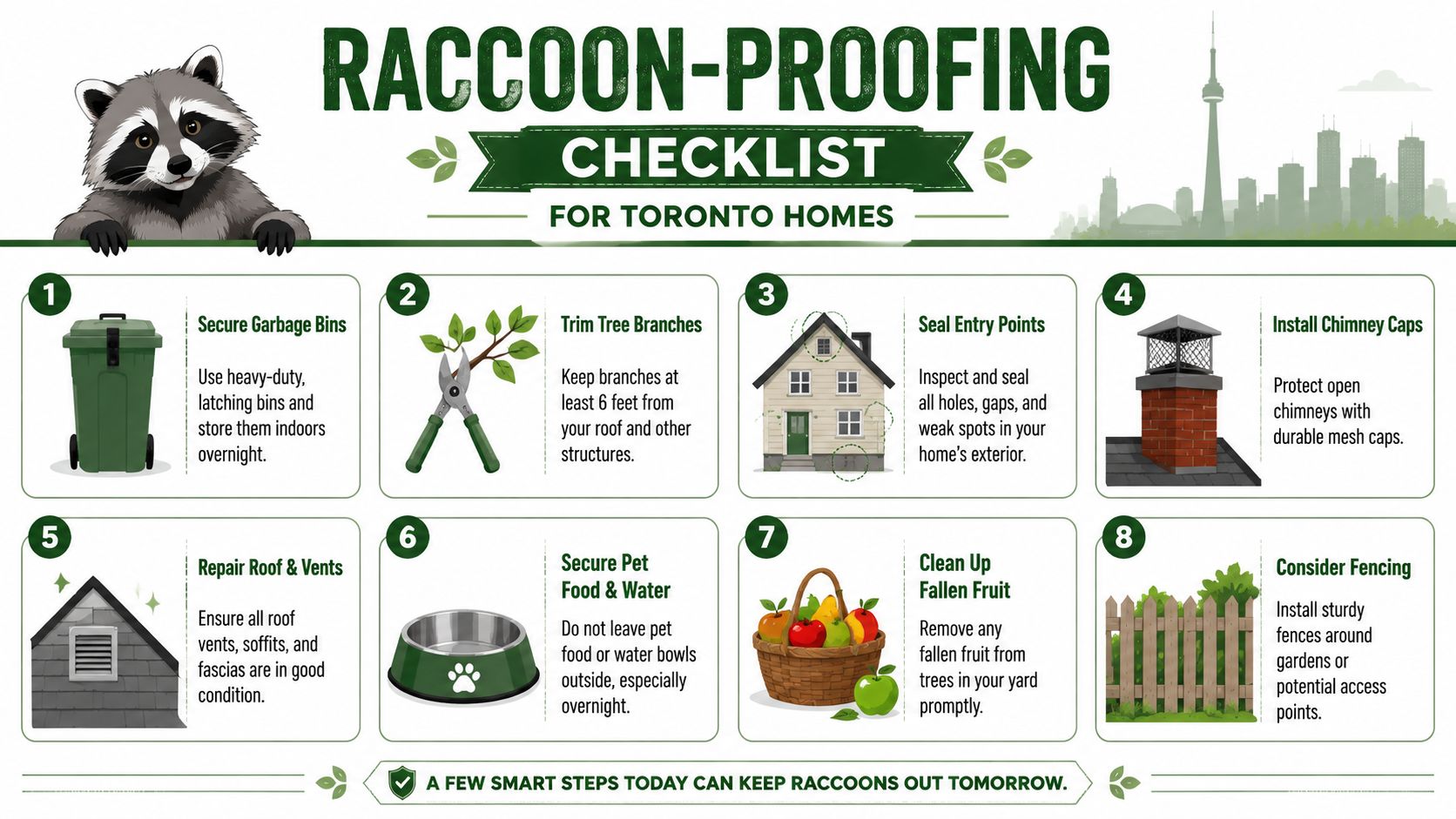
Prevention works better than repeated removals. That's especially true in a city where raccoons already know how to use roofs, chimneys, decks, garages, sheds, and green bins as part of their routine.
For long-term raccoon removal GTA success, the property has to stop functioning like easy habitat.
Outdoor Attractants That Keep Bringing Raccoons Back
Food comes first. Shelter comes second. Both need attention.
Prevention measures such as secured garbage, roof-edge trimming, and chimney caps are more effective long term than repeated trapping because raccoons are highly adapted urban climbers that use chimneys, roofs, and decks, as noted in this GTA raccoon prevention discussion.
A practical outdoor checklist includes:
- Secure garbage and compost: Use bins that close tightly and avoid leaving overflow bags beside them.
- Remove pet food at night: Outdoor feeding stations quickly become wildlife feeding stations.
- Pick up fallen fruit: Yard food sources train raccoons to revisit the property.
- Reduce climbing shortcuts: Trim branches that let animals reach roof edges or garage tops more easily.
For under-deck and garden barrier work, some homeowners also use durable welded wire solutions where a rigid, hard-to-pull material is needed around skirting or exclusion zones. The material still has to be installed correctly for the site, but the goal is sound. Don't give wildlife an easy edge to pry open.
Structural Upgrades That Matter
Raccoon-proofing is strongest when the building envelope is treated as a system, not a collection of isolated repairs.
Focus on these areas:
- Roof vents and exhaust openings: Weak covers fail early.
- Soffits and fascia: Any looseness at the roof edge invites testing.
- Chimney tops: An uncapped chimney is an obvious den site.
- Deck and shed perimeters: Ground-level shelter matters almost as much as attic access.
- Garage roof junctions and additions: These are common weak transitions on Toronto homes.
A homeowner who wants a closer look at how raccoons and squirrels get into attics and how to keep them out should pay special attention to repeat entry points. Wildlife often returns to the same structural weaknesses unless the repair is built for the animal's strength and behaviour.
The key lesson is straightforward. Don't just remove the current raccoon. Change the property conditions that made the house attractive in the first place.
GTA Raccoon Removal Frequently Asked Questions
Toronto homeowners, condo residents, landlords, and property managers often run into the same practical questions after the initial panic settles down. Those questions usually have less to do with the raccoon itself and more to do with responsibility, access, and how to avoid paying twice for the same problem.
Guidance discussed for Toronto-area customers stresses asking for customized plans, fixed pricing, baby checks, and one-year guarantees, especially for multi-unit or rental situations, as outlined in this GTA raccoon den removal FAQ discussion.
Who handles raccoon problems in a rental home
In a rental property, the animal issue and the building repair issue often overlap. The raccoon may be in the attic, but the root cause is usually a building opening, roofline weakness, chimney issue, or exterior gap.
That's why tenants should report the problem immediately and in writing. The report should describe the sounds, where they're happening, when they occur, and whether there's visible damage or odour. Landlords or property managers then need to coordinate access, inspection, and any building-related exclusion work.
What happens in a condo or townhouse
Shared walls and shared roofs complicate wildlife calls. The raccoon may enter from one section and den above another. In townhouse rows, one roof breach can affect several units if the attic space communicates.
Residents in condos and townhouses should avoid arranging isolated seal-up work without involving property management if common elements are involved. If the entry point sits on shared roofing, soffits, vents, or exterior walls, the response has to match the actual ownership and maintenance responsibility.
In multi-unit buildings, the visible noise location isn't always the true entry location. That's why access to the full exterior matters.
What should a homeowner ask before approving work
A stressed homeowner should slow the conversation down and ask direct questions.
Useful questions include:
- Is this a removal-only visit or a full exclusion plan?
- Will the technician check for babies before any sealing starts?
- Which entry points will be repaired now, and which are only being noted?
- Is the pricing fixed for the defined scope?
- What sanitation or cleanup is included if the attic is contaminated?
- What kind of written warranty or guarantee applies to the sealed area?
These questions matter because a quote that sounds simple may still leave cleanup, sealing, or secondary repairs unresolved.
What does a one-year guarantee usually relate to
A one-year guarantee usually applies to the repaired or excluded area, not every possible wildlife issue the house could ever have. Homeowners should read the wording and ask what is covered, what material areas were secured, and what events would fall outside that scope.
That clarity is especially important on Toronto homes with multiple roof levels, additions, old soffits, or separate structures like detached garages. If only one vulnerable section is repaired, the house may still have another future entry opportunity elsewhere.
If there's thumping in the attic, damage at the roofline, or signs of a den inside the home, Vanish Pest Control Inc. can help arrange a proper inspection and exclusion plan for Toronto and the GTA. The safest path is a full response that checks for young, removes the animal legally, secures every active opening in scope, and addresses the contamination left behind so the home stays protected.




