
You've cleaned the crumbs, wiped the counters, and sprayed the ants marching along the baseboard. A few days later, the trail is back. In Scarborough homes, that pattern usually means the visible workers aren't the whole problem. They may be following a concealed route through a foundation joint, plumbing penetration, wall void, damp timber, or shared building space.
The practical answer to how to stop ants in Scarborough homes isn't more random spray. It's accurate identification, a careful inspection, colony-directed baiting, lawful exterior prevention, and moisture or maintenance repairs that remove the conditions attracting ants in the first place.
Table of Contents
- Identifying the Ants Invading Scarborough Homes
- Inspecting Your Property for Entry Points and Nests
- Safe and Effective Baiting Strategies for Indoor Trails
- Legal and Eco-Friendly Exterior Prevention Tactics
- Managing Ants in Condos and Multi-Unit Buildings
- When to Call Professional Pest Control in Scarborough
Identifying the Ants Invading Scarborough Homes
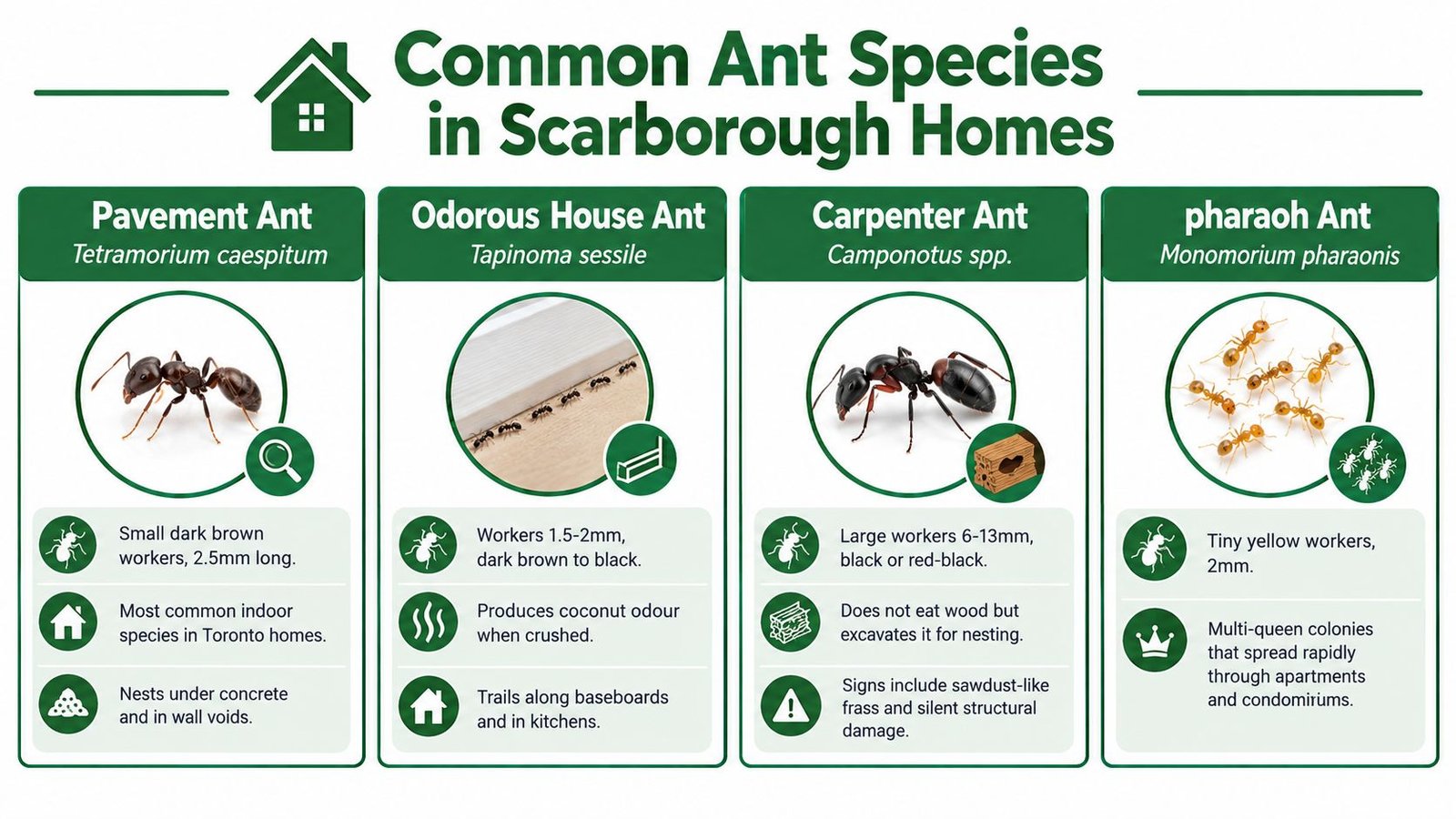
Ants leave clues about where the actual problem sits. Small dark ants moving between a kitchen counter and a foundation crack may be pavement ants or another nuisance forager. Their presence often points to accessible food, moisture, or a route beneath concrete and through wall spaces, not necessarily structural damage.
Carpenter ants deserve a different response. They don't eat wood. They excavate galleries in softened or decaying timber, so indoor activity can indicate a leak, condensation, poor drainage, or damaged wood around a window, roof edge, deck, or wall. Frass below trim, winged ants emerging indoors, audible activity inside a wall, or smooth galleries in damp wood justify a structural-moisture investigation rather than repeated surface treatment.
Scarborough homes also include detached houses, townhomes, older multi-unit buildings, and condominiums. That variety creates different pathways. Shared walls, service chases, plumbing penetrations, balconies, and foundation joints can allow colonies to move beyond the room where residents first notice them.
A University of Toronto Scarborough study analysed global data covering 323 non-native ant species across 477 distinct geographical regions and modelled warming of 2°C to 4°C. The researchers found that species currently confined indoors are more likely to establish outdoors, particularly in colder parts of the Northern Hemisphere. Ontario has five non-native ant species reported as living only indoors, and one was identified as having the potential to cause significant damage if it spreads outdoors. The regional findings are discussed by the University of Toronto Scarborough study on indoor ant populations.
That doesn't mean every indoor trail signals an emerging outdoor colony. It does mean recurring activity deserves identification instead of assumption.
Inspecting Your Property for Entry Points and Nests
You wipe up a kitchen trail at night, then find the same ants at the sink the next morning. In Scarborough, that usually means the route is established somewhere behind the visible activity. Start by mapping movement. Photograph trails, note the time they appear, and mark where workers enter or disappear around baseboard corners, cabinet joints, window frames, plumbing penetrations, foundation cracks, and utility openings.
Season matters, but the inspection matters more. Late winter and early spring are a good time to check for openings before steady warm weather strengthens foraging routes. In Ontario, long-term control usually comes from exclusion, moisture correction, and targeted treatment, not casual perimeter spraying. For broader outdoor exclusion planning, see this guide to ant prevention for Crown Point homes.
Follow the route in both directions
Inside, inspect the places ants use and the conditions that keep them there:
- Kitchens and pantries: Check for food residue, grease, pet food, garbage, and moisture under or behind appliances.
- Basements and crawl spaces: Look at sill plates, joists, plumbing openings, and damp insulation.
- Bathrooms and laundry areas: Trace activity near supply lines, drains, cabinets, and wall penetrations.
- Windows and doors: Check deteriorated frames, failed caulking, and condensation damage.
Outside, keep following the trail. Check soil lines, slabs, vegetation touching the siding, decks, stumps, rotting wood, and leaf buildup. A colony may be under concrete, in exterior soil, inside wet timber, or using a wall void as a protected route. In condo and townhouse settings, the visible trail may only be the access point. Shared walls, service penetrations, and balcony joints can let ants move unit to unit, which is why inspection has to extend beyond the room where they were first seen.
Practical rule: Don't seal every opening while ants are actively feeding. Confirm whether the colony is inside or whether the gap is only a travel route, then time exclusion work with colony reduction.
For kitchen forage ants, sealed food, grease removal, pet food control, and garbage handling matter. For carpenter ants, drying the structure and replacing water-damaged wood matters more than spotless counters.
Safe and Effective Baiting Strategies for Indoor Trails
Spraying visible workers feels decisive, but it can sabotage the treatment. Those workers may be carrying food back to a larger colony. Repellent residue can make them avoid the route, leaving the nest and entry point unidentified.
Health Canada recommends placing bait stations directly in active trails, using multiple stations, and keeping bait available for at least 14 days. The guidance also notes that two bait types can improve results. During that period, insecticide sprays, aerosol cleaners, and trail wiping can interrupt transport of the toxicant to the nest. The complete sequence appears in Health Canada's ant-control guidance.
Use a bait-first sequence
- Map the activity. Photograph trails along baseboards, cabinet corners, windows, plumbing penetrations, and foundation cracks.
- Separate indoor and outdoor activity. Look for connections to soil, slabs, vegetation, damp wood, or wall voids.
- Choose a lawful station. Use a Health Canada-authorized product with a Canadian PCP registration number, and follow the Canadian label.
- Place stations on active routes. Keep them inaccessible to children and pets. Don't place bait beside cleaners, sprays, or food-preparation surfaces where contamination is likely.
- Maintain availability. Keep stations present for at least 14 days. Replenish bait that's consumed or dries out.
- Leave the trail alone. Don't spray, wipe, or use repellent cleaners around feeding workers during baiting.
- Repair the cause afterward. Once activity stops, clean pheromone trails, correct moisture issues, and seal cracks and utility penetrations.
Immediate disappearance isn't the goal. Repeated applications may be necessary because workers represent only the foraging part of the colony. If a bait is ignored, the formulation may not match the species or the station may be placed away from the active route. A spray-plus-bait approach commonly fails when repellent residue prevents workers from feeding.
Household cleaning still matters, but it should support baiting rather than disrupt it. Residents looking for safer cleaning choices around animals can also review guidance on pet safe cleaning products, while keeping all pesticide stations separate from accessible pet areas. For broader household pest-management context, Vanish also publishes material on cockroach exterminations.
Legal and Eco-Friendly Exterior Prevention Tactics
A blanket perimeter spray isn't automatically the strongest defence. In Ontario, cosmetic pesticide use on lawns, gardens, patios, driveways, and around homes is restricted. Homeowners may use certain Class D products or hire a licensed exterminator, while some federally registered products aren't permitted for every Ontario use. The product label is a legal document, and the application location matters.
Ontario's guidance on pesticides for home lawns and gardens supports a more targeted approach. Structural exclusion, moisture correction, vegetation management, and focused indoor treatment can prevent entry without broad applications that may affect pollinators, children, pets, or storm drains.
Make the building harder to enter
- Seal cracks and gaps: Concentrate on window and door frames, foundation joints, utility penetrations, roof edges, and deck connections.
- Remove nesting conditions: Clear rotting wood, stumps, and leaf accumulations away from the structure.
- Trim sheltered bridges: Keep shrubs, vines, and other vegetation from touching the building.
- Correct water problems: Repair plumbing and roof leaks, improve drainage where needed, and replace damaged timber.
- Protect stored materials: Keep firewood and lumber away from the building and remove decaying pieces.
Vinegar and broad outdoor sprays may alter a trail temporarily without eliminating the colony. They also don't repair the damp wood or gap that allowed entry. Disposal matters too. Controlled products shouldn't go into household garbage, drains, or sewers.
The useful question isn't “What can be sprayed around the whole house?” It's “Which entry route, moisture source, or nesting condition needs correction, and what treatment is lawful at that location?”
Managing Ants in Condos and Multi-Unit Buildings
A recurring ant problem in one Scarborough suite may be a building problem disguised as a kitchen problem. Colonies can move through shared wall voids, service chases, plumbing penetrations, balconies, garbage rooms, foundation joints, and adjacent units. Treating one visible room can merely divert activity elsewhere.
For RentSafeTO-covered buildings, Toronto requires common areas to be inspected at least every 30 days and an affected area to be inspected within 72 hours after pest information is received. The city's property-standards and pest-management requirements also make prevention, records, and coordinated management important.
A practical escalation checklist
Residents should record dates, locations, photographs, and whether ants emerge from walls, cabinets, balconies, or plumbing openings. The report should identify affected common areas, garbage storage, landscaping, and adjacent suites rather than only naming the original unit.
Property managers should inspect connected routes, review maintenance records, check for moisture-damaged materials, and coordinate baiting so one resident's spray doesn't contaminate another treatment area. Owners must distinguish RentSafeTO buildings from condominiums, townhomes, and private homes that fall outside that program, while still addressing property-standard responsibilities where applicable.
Building-management guidance, including insights from Towne and Country Property Management, reinforces the importance of treating shared spaces as part of the maintenance system. Supporting documentation with Vanish pest control services can also help managers organise an inspection request and communicate the scope of the issue.
When to Call Professional Pest Control in Scarborough
DIY baiting is reasonable for a small, clearly understood trail. It becomes less suitable when ants return after baiting, emerge from several rooms, appear in multiple suites, or survive through the colder season. Carpenter-ant signs require more than insect control. The property needs an investigation for damp cavities, roof or plumbing leaks, decaying frames, damaged decks, and concealed galleries.
A professional inspection should answer several questions:
- What species is present? Different ants use different nesting sites and food sources.
- Where is the colony or route? The visible trail may be far from the nest.
- Is moisture supporting the activity? Carpenter ants often indicate softened or decaying timber.
- Is the building connected? Shared walls, chases, balconies, and adjacent units may require coordination.
- What treatment is lawful? The label, application site, and Ontario rules determine the available method.
For recurring or multi-unit infestations, a bait-based programme can outperform reliance on barrier sprays. One published comparison reported an 84% reduction inside homes and an 80% reduction in yards for a bait-based programme, as documented in this bait-versus-perimeter-spray comparison. That result illustrates the practical difference between reducing a colony and merely killing exposed workers.
Exterior work also carries notification obligations. Under Ontario Regulation 63/09, written notice must be given to occupants of abutting residential properties at least 24 hours and no more than seven days before certain exterior pesticide exterminations. This matters in closely spaced Scarborough homes, townhouses, and multi-unit properties.
Vanish Pest Control Inc. provides inspection-led ant control for residential and commercial properties, with treatment decisions based on activity, entry routes, moisture conditions, and applicable label requirements. Further service information is available through Vanish Pest Control.
For recurring trails, carpenter-ant warning signs, or ant activity crossing condo units, Vanish Pest Control Inc. can inspect the property, identify routes and moisture conditions, and build a targeted control plan. Contact the team before repeated spraying conceals the colony or pushes activity into another part of the building.