

A Toronto homeowner usually notices the same pattern first. The house gets quiet, the lights go out, and then a faint scratching starts behind the drywall near the bedroom, kitchen, or basement ceiling. It's easy to second-guess that sound for a night or two, but wall activity rarely resolves on its own.
Mice in walls are unsettling because they stay mostly hidden while still moving through the parts of the home that matter most. They travel behind cabinets, around plumbing lines, through utility penetrations, and along framing cavities that connect one area of the property to another. In Toronto homes, that can mean activity in an older detached house, a renovated semi, a condo utility chase, or a small business back room.
The good news is that this problem is manageable when it's handled in the right order. The wrong order creates the headaches most homeowners run into: trapping too lightly, sealing holes too early, or relying on temporary materials that won't hold up. A proper plan starts with confirming the activity, moves into controlled trapping, and ends with permanent exclusion.
Table of Contents
- That Scratching Sound in Your Wall Is Not Your Imagination
- Confirming the Unseen Enemy A Homeowner's Diagnostic Guide
- Your Action Plan DIY Trapping for Mice in Walls
- Fortifying Your Home Sealing Entry Points for Good
- When to Call a Professional Toronto Mouse Control Expert
- Frequently Asked Questions About Mice in Toronto Walls
That Scratching Sound in Your Wall Is Not Your Imagination
If scratching starts at night and seems to move from one stud bay to another, Toronto residents are usually hearing exactly what they think they're hearing. Mice often stay out of sight for a long time, which is why wall infestations feel so unnerving. The noise is real, and it usually means there's already an active route through the structure.
One reason this catches people off guard is how little space a mouse needs to enter. A mouse can get into a home through an opening about the diameter of a standard Number 2 pencil, roughly 7 to 8 mm, which is why gaps around weatherstripping, vents, and pipe penetrations deserve close attention in Toronto properties, as noted by this guidance on mice entering through pencil-sized openings.
That single detail explains why both older Toronto homes and newer buildings can have the same pest problem. Brick homes with aging mortar joints, renovated basements with unsealed service lines, and condo units with plumbing chases all give mice enough room if the finish work isn't tight.
Why wall infestations feel worse than open-room activity
Mice in open living space are at least visible. Mice in walls can travel, nest, and chew without being seen, and homeowners often don't know whether they're dealing with one animal or repeated movement from several access points.
Practical rule: If the sound repeats over multiple nights in the same stretch of wall, treat it as an active infestation until proven otherwise.
To get rid of mice in wall spaces, the answer isn't one trick. It's a sequence. First confirm the activity. Then trap with enough coverage to interrupt movement. After that, seal the structure so the same route can't be used again. That order matters in Toronto homes, kitchens, basements, and small commercial units alike.
Confirming the Unseen Enemy A Homeowner's Diagnostic Guide
The first job is proving the noise is mice and not something else. Squirrels, plumbing expansion, duct movement, and even loose trim can confuse the picture. Wall infestations become easier to identify when the sounds line up with the rest of the evidence.

Toronto residents who hear activity near the kitchen can also compare common wall-noise patterns in this guide on whether kitchen wall noise is a rat or squirrel.
Listen for patterns, not random noise
Mouse activity usually sounds light, quick, and intermittent. It tends to happen after the house settles down, especially along inside partition walls, behind kitchen cabinets, near dishwashers, under sinks, and in basement ceiling cavities. The sound often resembles faint scratching, short bursts of scurrying, or tiny gnawing.
Heavier thumping or broad daytime movement overhead may point to a different animal. Mice usually create smaller, sharper noises and use repeat travel paths. If the same wall section becomes noisy at similar times, that's a strong clue that the route is established.
A pet's behaviour can help too. Dogs and cats often focus on one wall section long before a homeowner finds visible evidence.
Check for physical evidence nearby
The wall itself hides the nest, but nearby surfaces usually don't stay clean for long. The inspection should focus on adjoining spaces rather than the middle of the drywall.
Look in these areas first:
- Under sinks and around pipes: Small gaps where plumbing enters walls often show droppings, smudges, or light chewing.
- Inside lower kitchen cabinets: Mice favour hidden travel lanes near food and warmth.
- Basement utility corners: Furnace rooms, laundry areas, and storage edges often reveal activity before finished rooms do.
- Along baseboards and behind appliances: Greasy rub marks can appear where mice repeatedly squeeze past the same edge.
A strong stale or urine-like smell near one wall section often means the activity isn't brand new.
For Toronto homes, kitchens and basements usually reveal the clearest clues because that's where utility lines and food sources overlap. In small businesses, the same logic applies in staff kitchens, storage rooms, and service corridors.
A practical diagnostic check is simple. Listen at night, inspect in the morning, and map every clue on paper. If droppings appear in one room while the sound comes from the next, the wall cavity is probably acting as the travel corridor between feeding and nesting areas.
Your Action Plan DIY Trapping for Mice in Walls
Once the problem is confirmed, homeowners need a trapping plan that's disciplined enough to interrupt movement. Randomly placing one or two traps in a basement corner rarely solves wall infestations. Mice use edges, hidden transitions, and repeated routes. Traps have to meet them there.
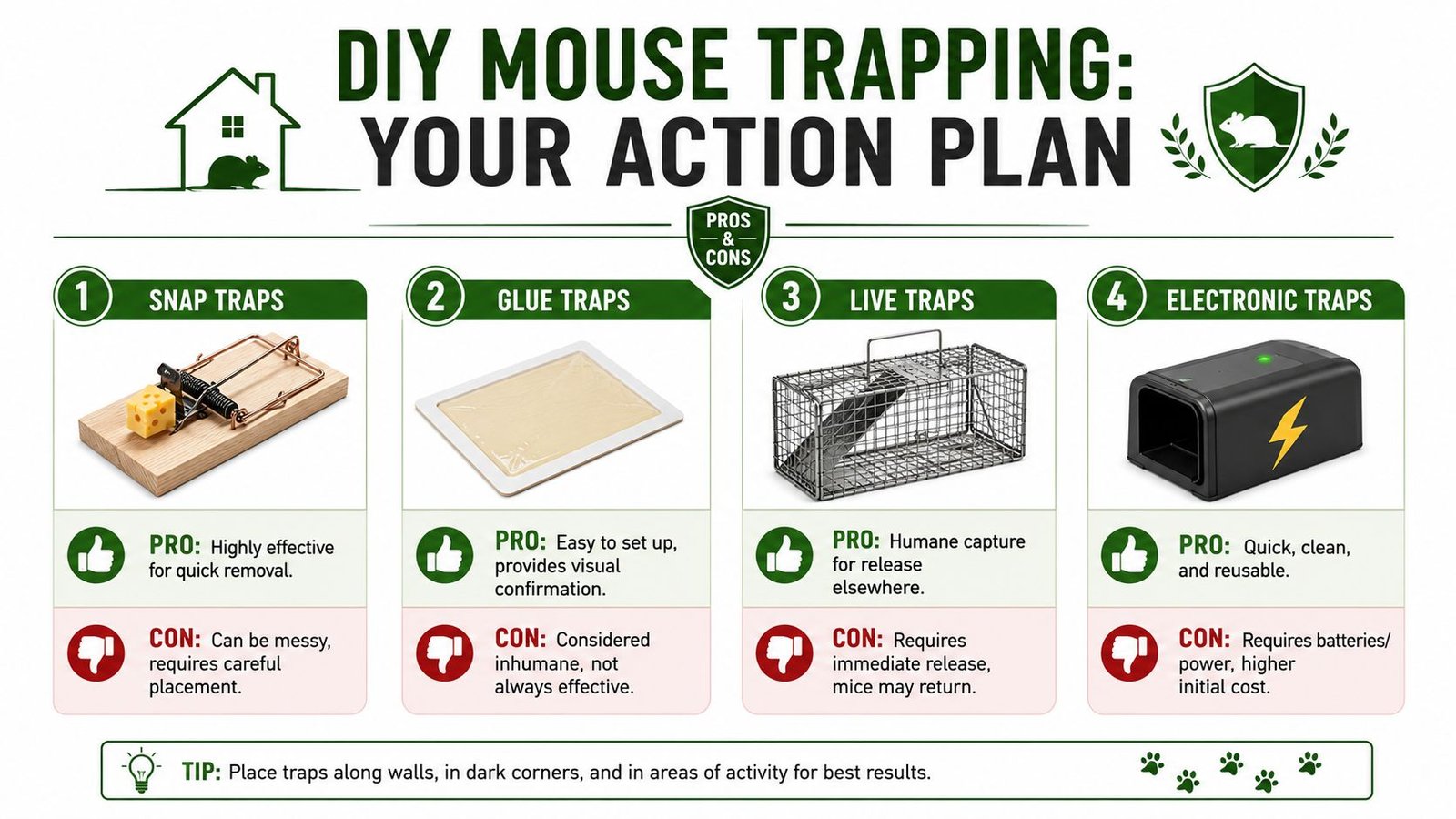
Which trap type fits the job
Different trap styles can work, but they don't all solve the same problem equally well.
| Trap type | Where it helps | Main drawback |
|---|---|---|
| Snap traps | Fast removal near active runways | Needs careful placement and regular checking |
| Electronic traps | Cleaner setup in utility rooms or protected areas | Higher cost and power dependence |
| Live traps | Useful for homeowners focused on catch-and-release | Requires prompt handling and doesn't address re-entry |
| Glue traps | Easy to place in tight spots | Often performs poorly in dusty areas and creates handling concerns |
For most Toronto homes, a mechanical trapping plan remains the clearest DIY route because it gives visible confirmation and can be set exactly where the mice travel. The bigger mistake isn't choosing the wrong trap style. It's using too few traps and spacing them too far apart.
Placement decides whether DIY works
Health Canada's guidance matters here. Effective mouse eradication from wall-related travel routes requires 1 trap per metre, or about 3.3 feet, placed along the walls mice use, and traps should be baited but left unset for a 3 to 4-day warm-up period so mice become comfortable approaching them, according to Health Canada's rat and mouse control guidance.
That standard changes the whole DIY approach. In practice, it means Toronto homeowners shouldn't think in singles. They should think in trap lines.
Place traps:
- Along baseboards: The baited end should face the wall where mice hug the edge.
- Behind appliances: Fridges, stoves, and dishwashers create warm sheltered lanes.
- In cabinet voids and utility areas: Especially where pipes disappear into the wall.
- Near suspected wall exits: If mice are entering the room from behind a kick plate or service gap, that opening needs immediate coverage.
Sparse trap placement is the main reason homeowners catch one mouse and still hear scratching a week later.
The warm-up period is just as important as density. Mice are cautious around new objects. Leaving traps baited but unset for several days lowers that suspicion. Once the mice are feeding confidently, setting the traps creates a far better chance of success than springing them too early.
A few trade-offs matter. Traps should never be left where children or pets can reach them. Food clutter has to be reduced during trapping or the bait won't compete well. And if the only activity is deep inside a finished wall with no accessible travel edge, DIY usually becomes slower and less reliable.
For Toronto residents trying to learn how to get rid of mice in wall voids, this is the hard truth. Trapping removes the animals that are currently using the route. It does not stop the next ones unless entry points are dealt with afterward.
Fortifying Your Home Sealing Entry Points for Good
Removing the mice inside the structure is only half the job. Long-term control comes from exclusion, which means finding every practical access point and closing it with materials mice can't push through, chew through, or slip around.
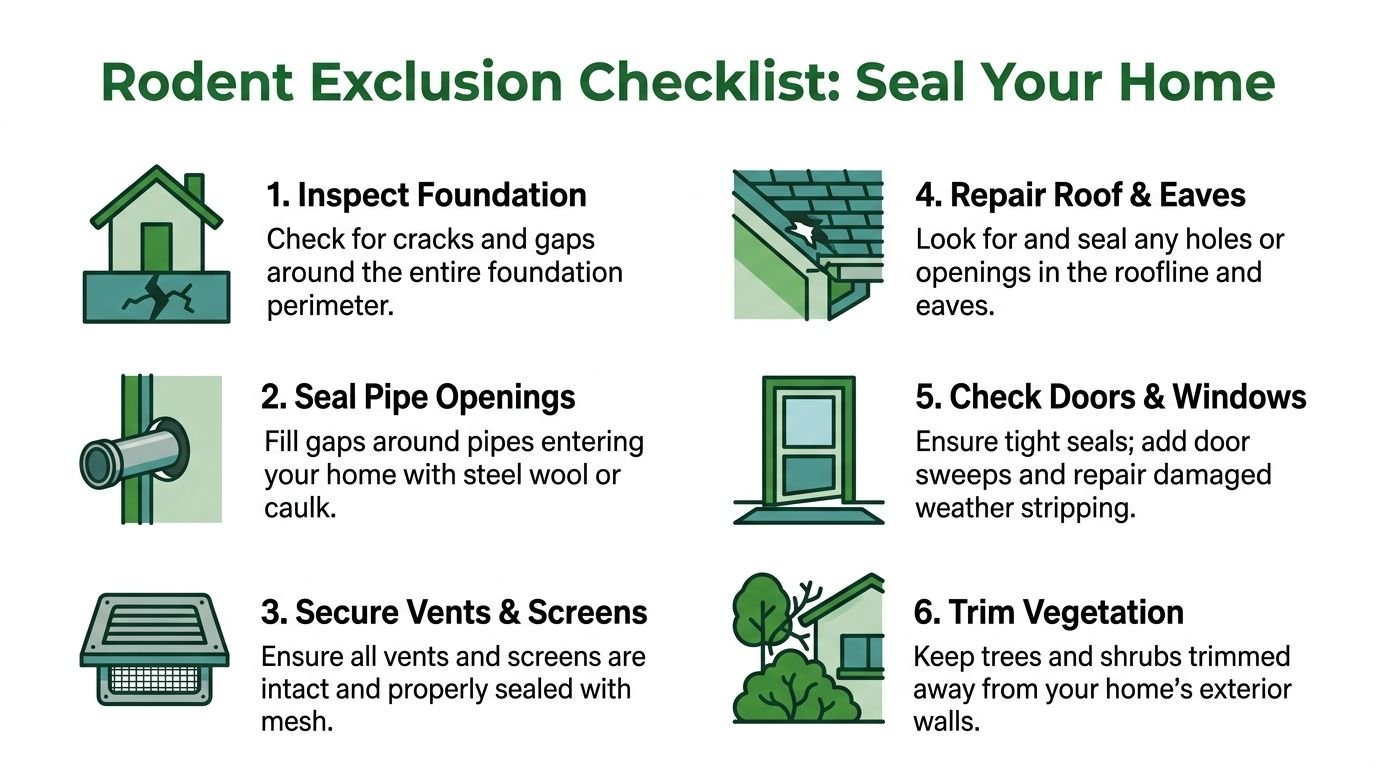
Toronto homeowners often miss the same places. Pipe penetrations under decks, dryer and vent terminations, garage slab edges, door corners, weatherstripping gaps, and foundation transitions around additions are all common weak spots. For a broader prevention framework, this guide on controlling rodent activity at home and preventing future infestations is a useful companion.
Find the openings that matter
A proper inspection starts outside and follows every utility into the building envelope. Then it moves indoors to check where those penetrations emerge in kitchens, basements, laundry rooms, and storage areas.
Focus on these targets:
- Foundation line: Cracks, service entries, and low gaps hidden by landscaping.
- Doors and weather seals: Garage doors, side doors, and old thresholds often leave enough clearance at the edges.
- Vents and roofline details: Screens, soffit returns, and mechanical penetrations can loosen over time.
- Plumbing and cable entries: These are frequent pathways into wall cavities.
One useful field method is to delay permanent closure until it's clear the hole is no longer active. That avoids sealing a live rodent inside a wall.
Use materials mice can't defeat easily
For permanent exclusion in Toronto and the GTA, industry standards call for 1/4-inch (6 mm) hardware cloth or heavy-gauge metal screening because mice can pass through gaps as small as 6 mm. The Toronto Wildlife Centre also describes a 3-day newspaper verification method, often called the paper test, where a hole is loosely stuffed and only sealed once the paper stays undisturbed for 3 days and nights, as outlined in the Toronto Wildlife Centre guidance on mice in the house.
That point matters because soft filler alone isn't a permanent mouse barrier. Caulk can help finish a repair, but structural gaps need metal reinforcement. On larger or awkward seams, especially around flashing details or exterior transitions, some contractors also use sealing products such as butyl tape as part of a weather-resistant assembly around the repair. The tape isn't the mouse barrier by itself. The metal screen or hardware cloth remains the key exclusion layer.
Seal only after activity has stopped. Trapping a mouse inside the wall creates a different problem than the one that started the call.
For Toronto homes, this is the step that prevents repeat infestations. Kitchens, basements, garages, and business service areas all benefit from the same principle. Find the route, verify it's inactive, then close it with durable material.
When to Call a Professional Toronto Mouse Control Expert
DIY works best when the infestation is limited, the travel paths are accessible, and the homeowner can safely inspect and service traps consistently. Once those conditions disappear, the project stops being a tidy weekend fix and turns into a structural pest problem.

Red flags that change the job
Some signs mean a Toronto homeowner should stop experimenting and bring in licensed help.
- Daytime sightings: Mice moving openly during the day often indicate the activity is no longer confined to a small hidden pocket.
- Persistent wall noise after repeated trapping: If the sound continues despite a disciplined setup, there's usually an access issue, a missed route, or activity in connected voids.
- Chewed materials near wiring or appliances: This crosses into property risk and should be treated urgently.
- Infestation in food-handling or shared spaces: Restaurants, cafés, condos, and multi-unit buildings need coordinated action, not isolated unit-by-unit fixes.
Electrical concerns deserve special caution. If there's any sign that rodent activity has affected cables, switches, or appliances, homeowners should pair pest control with qualified electrical review. For that situation, this resource on troubleshooting home electrical problems is relevant because pest damage and electrical faults can overlap.
Why some Toronto properties need coordinated control
A detached house gives one owner control over the whole perimeter. A condo or multi-unit property does not. Mice can move through shared chases, utility penetrations, storage corridors, and adjoining walls. One resident may trap diligently and still hear activity because the entry route begins elsewhere in the building.
That's also true in commercial settings. A back storage room may be clean while activity continues through a neighbouring unit's service void. In those situations, professional inspection adds value because the technician is looking for the full route, not just the room where the sound was reported.
Professional help isn't an admission that the homeowner failed. It's often the fastest way to stop recurring wall activity before it spreads through more of the property.
For Toronto residents, the decision point is straightforward. If the problem is isolated and accessible, careful DIY may work. If the activity is repeated, hidden, shared across units, or tied to damage, licensed intervention is the safer path.
Frequently Asked Questions About Mice in Toronto Walls
Wall infestations leave homeowners with a lot of practical questions after the first scratching sound stops. The answers below reflect what matters most in Toronto homes, condos, basements, kitchens, and small businesses.
Can mice leave on their own
Sometimes activity seems to disappear for a few nights, but that doesn't mean the issue has resolved. Mice often shift timing, food sources, or travel paths without leaving the structure entirely. A quiet wall can still connect to active cabinet voids, ceiling spaces, or basement corners.
The better approach is to judge the problem by evidence, not silence alone. If droppings, smells, fresh gnawing, or trap activity continue, the infestation is still active even if the scratching is less obvious.
What if a mouse dies in the wall
This is one reason many homeowners try to avoid methods that leave the outcome hidden. A dead rodent inside a sealed void can create odour and sanitation problems that are frustrating to deal with afterward.
If a smell develops, the focus becomes locating the likely wall cavity and increasing ventilation in the area while monitoring how the odour changes. Opening drywall is usually a last resort unless the location is fairly clear. In many cases, the more important long-term step is correcting the entry route so the same wall cavity doesn't become active again.
Are mice in walls dangerous for pets and children
They can be. The concern isn't just the sound in the wall. It's the contamination around food storage, pet feeding areas, and hidden surfaces near sinks, stoves, and pantry spaces. Used traps and rodent traffic points also need careful handling.
For families in Toronto homes, that means keeping trap stations inaccessible, cleaning with care, and not treating the issue as harmless because the mice are “only in the wall.” Once mice are using wall cavities, they usually have a reason to enter occupied parts of the home as well.
Do mothballs, noise machines, or sprays solve wall infestations
These options rarely solve the actual problem because they don't remove active mice and they don't close the route that let them in. Homeowners often lose time cycling through repellents while the infestation continues behind the drywall.
Toronto residents considering repellents should read this article on whether mothballs repel mice, because many common DIY assumptions don't hold up once mice are established in a structure.
A more reliable framework looks like this:
- Confirm activity first: Match sound with physical evidence nearby.
- Trap thoroughly: Coverage and placement matter more than gimmicks.
- Seal after verification: Permanent repairs should follow confirmed inactivity.
- Escalate when needed: Shared buildings, recurring activity, and damage call for licensed support.
The core question behind how to get rid of mice in wall spaces is simple. Is the plan removing the mice and shutting down the route, or is it only trying to make the noise stop for a few nights? Only the first approach gives lasting peace of mind for Toronto residents.
Vanish Pest Control Inc. helps Toronto homeowners, condo residents, landlords, and businesses handle mouse infestations with licensed inspections, targeted treatment, and long-term rodent-proofing. If scratching in the wall has turned into a recurring problem, the team can identify the access points, stop the activity, and help keep the property protected.




