

A Toronto homeowner usually finds a hornets nest at the worst possible moment. It's often during a normal routine. Taking out the recycling, cutting back a shrub, opening a shed door, or looking up and noticing a grey paper nest under the eaves. The sound comes next. A low, active buzzing that makes the space feel unsafe almost immediately.
That reaction is reasonable. In Toronto homes, hornet activity becomes more serious when nests are attached to soffits, hidden in rooflines, tucked behind trim, or built near walkways, balconies, decks, and laneways where people pass close without realising it. In a dense city, the risk doesn't stop with one household. A nest beside a shared fence, rear parking pad, porch, or low branch can affect children, pets, tenants, neighbours, and anyone entering the property.
Safe hornets nest removal starts with two things. Correct identification and distance. Homeowners don't need to guess at species from a few feet away, and they shouldn't test whether a nest is active by tapping, spraying casually, or climbing up for a closer look. What matters first is understanding what may be present, what makes it dangerous, and why a professional response is often the safest option when a nest is attached to or near a structure.
Table of Contents
- A Dangerous Discovery in Your Toronto Backyard
- Identifying Hornets and Nests in Ontario
- Understanding Hornet Dangers and Seasonal Cycles
- DIY Hornet Removal vs Professional Services
- The Vanish Pest Control Removal Process Explained
- How to Prevent Hornets from Nesting on Your Property
- Frequently Asked Questions About Hornet Removal
A Dangerous Discovery in Your Toronto Backyard
A hornets nest rarely announces itself politely. In many Toronto homes, the first sign is movement near the roofline or a steady stream of insects entering and leaving the same point under an eave, behind fascia, or around a backyard structure. Sometimes the nest is fully visible. Sometimes only the traffic is visible, which can be more unsettling because the colony may be partly concealed in the building envelope.
The local setting makes a difference. Toronto residents often deal with tight side yards, neighbouring decks, semi-detached homes, rear laneways, and mature trees planted close to houses. Those conditions create many protected nesting spots and reduce the margin for error. A missed step on a ladder or a defensive swarm near a narrow passage can turn a small inspection attempt into an emergency.
Practical rule: If a nest is attached to a house, shed, deck, fence line, or tree near regular foot traffic, nobody should approach it casually.
Children and pets make the decision even clearer. If a nest sits above a play area, beside a barbecue, over a garage door, or near bins that are used daily, leaving it alone without a plan usually isn't realistic. The safer response is to restrict access, keep windows in the area closed when possible, and arrange proper assessment. Toronto property owners who need help with Toronto wasp and hornets nest removal should treat the situation as a safety issue first and a convenience issue second.
Identifying Hornets and Nests in Ontario
Correct identification matters because different stinging insects choose different nesting sites, respond differently to disturbance, and require different treatment approaches. A homeowner doesn't need a close inspection to make a useful preliminary assessment. In most cases, shape, location, colour pattern, and flight behaviour provide enough information to understand the level of risk.
What Toronto residents can identify from a distance
The most familiar aerial hornet-type nest in Ontario is the Bald-faced Hornet nest. It usually appears as a large, enclosed, grey paper structure with a rounded or football-like shape. These nests are often attached to tree branches, shrubs, eaves, and similar high surfaces. From the ground, the insects themselves often look dark with pale or white markings.
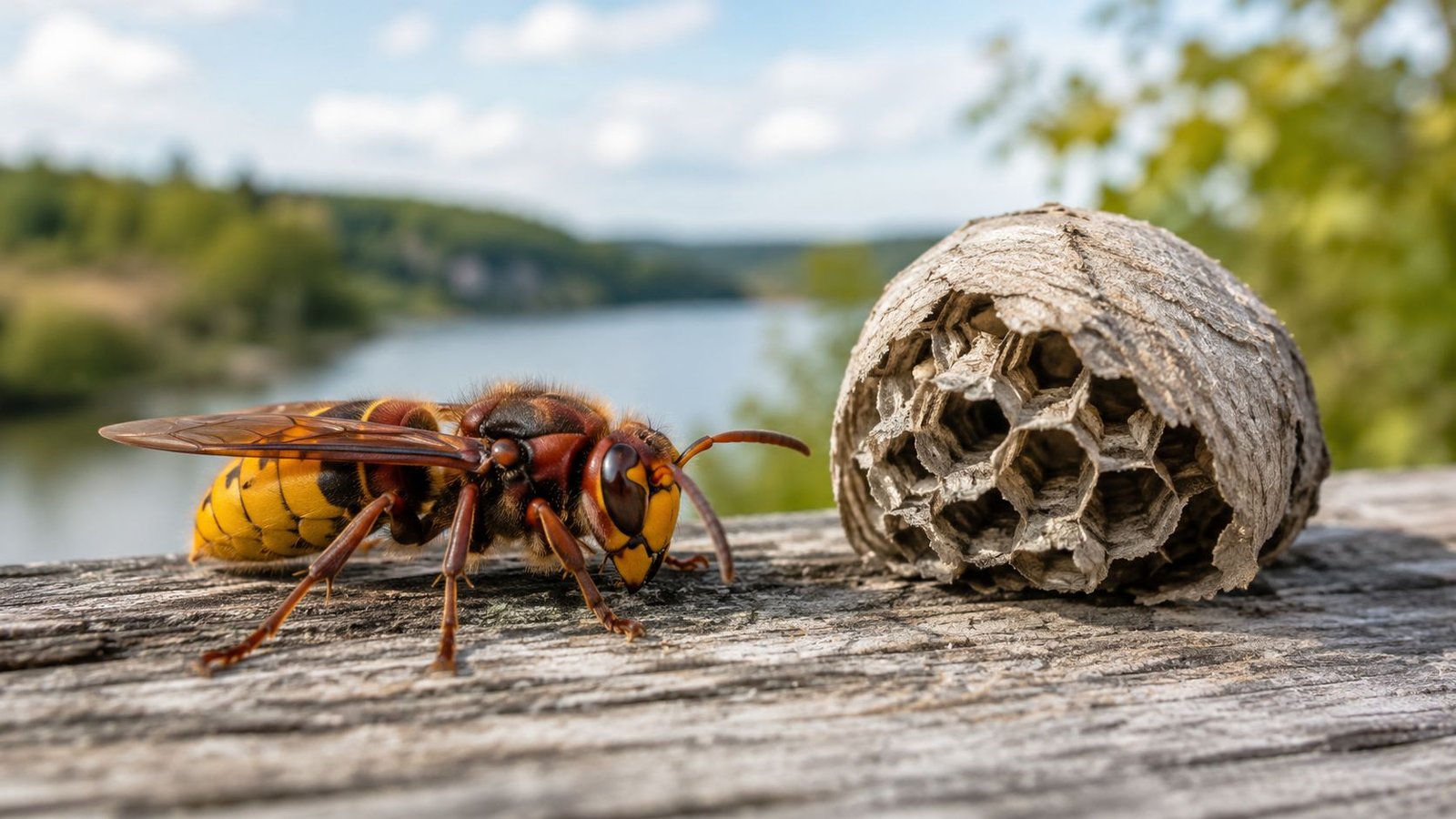
European hornets create a different challenge. Their nests are more often hidden in cavities such as wall voids, attic spaces, hollow areas, or sheltered voids behind exterior building elements. A Toronto homeowner may not see the nest itself at all. Instead, they may notice larger hornets flying in and out of one gap repeatedly, sometimes around soffits, siding joints, or trim.
Paper wasps are commonly mistaken for hornets. Their nests are typically smaller and open-comb rather than fully enclosed. The cells are visible, and the nest often hangs under a sheltered surface like a porch ceiling or a shed overhang. Bees are another important comparison. Honey bees and native bees are beneficial insects, and their handling is different. They generally appear fuzzier, less sleek, and their nesting patterns don't match a grey enclosed paper ball under an eave.
For a broader look at warning signs around a structure, this guide on preventing and solving wasp infestations effectively helps Toronto residents recognise when activity has moved beyond a minor nuisance.
Hornets compared with wasps and bees
A simple distance-based checklist helps avoid misidentification:
- Enclosed paper nest: Usually points toward a hornet-type or hornet-like colony rather than bees.
- Open umbrella-style comb: More consistent with paper wasps.
- Hidden entry into siding or soffit gap: Often suggests a cavity-nesting stinging insect, which can include European hornets or yellowjackets.
- Fuzzy body and pollen-carrying behaviour: More consistent with bees than hornets.
Don't rely on size alone. Nest style and entry pattern usually tell a clearer story than one quick look at a flying insect.
In Toronto pest problems, identification from a safe distance is enough for the next step. Nobody needs to stand underneath the nest to confirm what common sense already says. If the insects are defending a fixed location near the home, the situation deserves caution.
Understanding Hornet Dangers and Seasonal Cycles
The danger of hornets isn't just the sting itself. It's the way colony defence works when a nest feels threatened. Homeowners often underestimate how quickly a routine action can trigger a response. Trimming a branch, opening a shed, pressure washing siding, moving a ladder into place, or even walking too close to an active nest can be enough.
Why late summer changes the risk
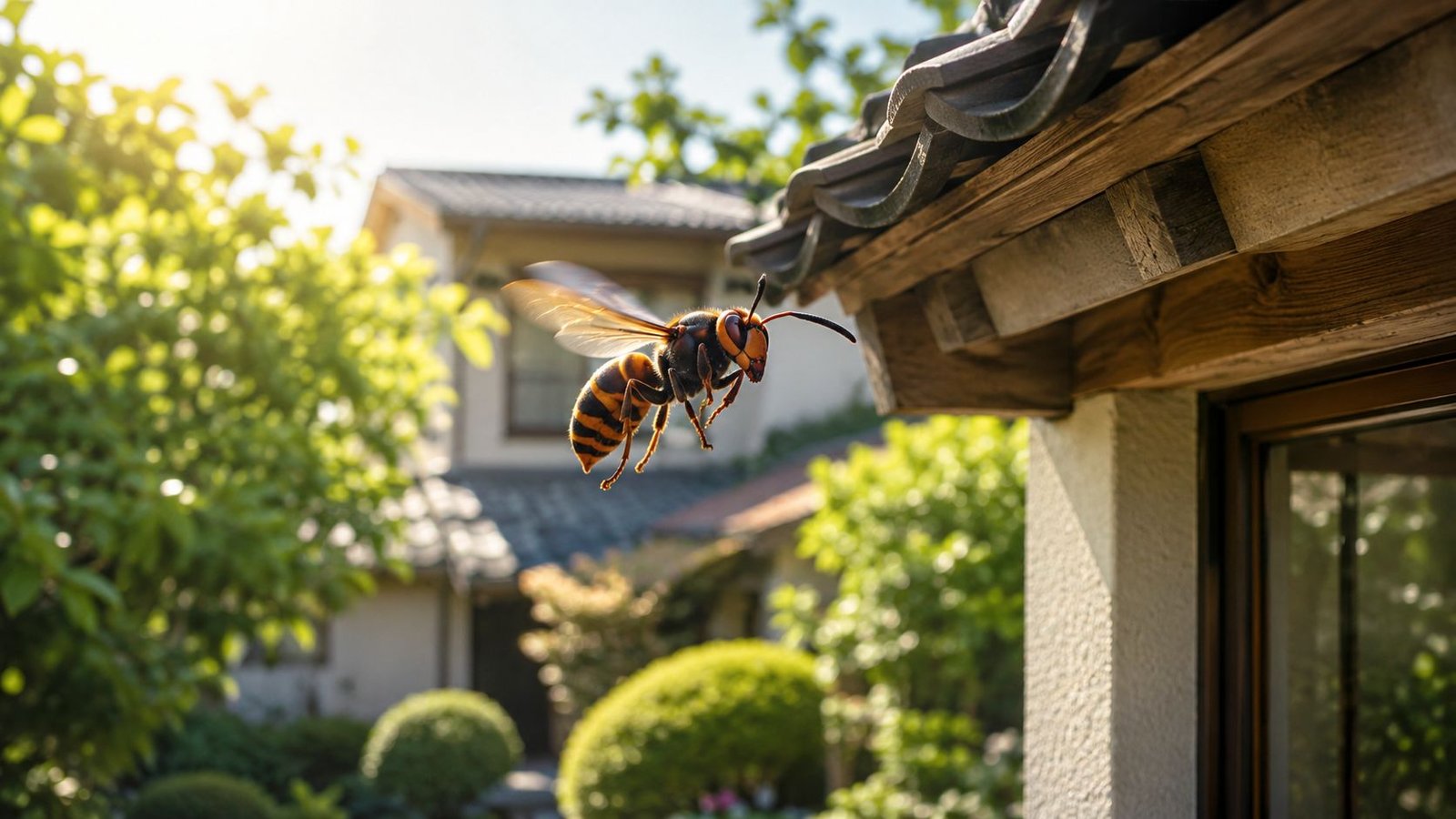
In Ontario, colony pressure becomes more serious as the season advances. A nest that looks modest earlier in the season may become a major hazard by late summer. According to the Government of Ontario, a mature Bald-faced Hornet nest in late summer can house between 400 and 700 workers, all of whom can be mobilized to defend the colony if they perceive a threat within 10-15 feet of the nest (Ontario hornets and wasps guidance).
That single fact explains why generic internet advice often fails Toronto residents. A person may think they're dealing with a small paper nest under the eaves, but if it is mature and active, they are not dealing with one or two insects. They are dealing with a coordinated colony response in a very limited space, often on a ladder, near a doorway, or above a family area.
Why close approaches turn dangerous fast
Hornets defend the nest, not the whole property. That distinction is useful because it means homeowners should focus on avoiding the defence zone rather than trying to test the insects' temperament. Once a nest is established near a high-traffic area, normal use of the property becomes a significant problem. Toronto residents still need to enter garages, use decks, take out compost, and move through side yards.
Several risks make DIY decisions harder than they appear:
- Multiple stings: Hornets can sting more than once, which turns a brief encounter into a severe one quickly.
- Allergic reactions: A person may already know they're allergic, or they may discover it during the incident. Either situation can become a medical emergency.
- Falls and secondary injury: Many nest encounters happen at roof edges, ladders, deck stairs, or uneven yards.
- Hidden colony placement: If the nest is inside a wall or void, surface spraying may agitate the colony without resolving the source.
If hornets are flying to one exact spot over and over, the safest assumption is that the nest is active until proven otherwise.
Season matters because late-summer colonies place more pressure on the property owner. A nest that could be monitored from a distance in spring can become unacceptable by August when traffic, size, and defensiveness increase around Toronto homes and businesses.
DIY Hornet Removal vs Professional Services
DIY hornet removal feels appealing because the first step seems easy. Buy a spray, wait until evening, aim upward, and hope the problem ends. That approach ignores the parts that make hornets nest removal dangerous in Toronto. Height, access, species, nest placement, building materials, and pedestrian exposure all affect the outcome.
Why store-bought sprays create false confidence
Aerosol products can create the impression that treatment is simple because the can is easy to buy. The hard part is not buying the product. The hard part is applying it to the right target, from the right angle, with an exit path, while avoiding direct exposure and without driving hornets into the structure.
DIY attempts often go wrong in predictable ways:
- The nest is higher than expected: The homeowner ends up on a ladder with limited balance and no real protection.
- The visible nest isn't the full issue: Hornets may be entering a void behind siding or soffit, so surface treatment doesn't solve the colony.
- The first spray misses the entry point: Agitated hornets disperse, circle back, and defend the area.
- The nest is over a doorway or shared path: People inside the home or on the neighbouring property are exposed during the attempt.
For many Toronto properties, professional treatment is less about convenience and more about control. A licensed technician evaluates access, species pattern, nest position, and safe perimeter before treatment begins. Homeowners looking for professional wasp exterminator service in Toronto should view that service as risk management, not merely nest disposal.
DIY vs Professional Hornet Nest Removal
| Factor | DIY Approach | Professional Service (Vanish Pest Control) |
|---|---|---|
| Safety | High personal exposure to stings, ladder risk, and uncertain escape route | Controlled approach with protective equipment and a planned work perimeter |
| Identification | Often based on quick visual guesswork | Assessed by a trained technician before treatment |
| Access to hidden nests | Difficult when activity leads into walls, soffits, or roofline gaps | Better suited to cavity entries and difficult structural locations |
| Treatment accuracy | Easy to under-treat, miss the source, or agitate the colony | Treatment is selected for the nest location and activity pattern |
| Impact on household | Residents may still need to move through active areas during the attempt | Occupants can be instructed clearly on where to stay clear and for how long |
| Outcome reliability | Uncertain, especially if nest remains active after spraying | More systematic from inspection through post-treatment verification |
A simple rule helps. If the nest is attached to a structure, hidden in a cavity, high up, or close to any place people use daily, DIY is the wrong tool for the job.
The Vanish Pest Control Removal Process Explained
Professional hornets nest removal feels less intimidating when homeowners know what happens. The process is orderly. It begins with assessing risk, not with immediate spraying. That matters because the safest treatment plan depends on where the nest sits, how the insects are moving, and whether the colony is exposed or concealed.
What happens before treatment begins
The first step is a site review from a safe distance. The technician looks at the visible nest when there is one, or at flight lines when the colony is hidden in a wall, soffit, attic edge, or other building void. On Toronto homes, that often means watching where insects consistently enter and exit rather than forcing a close inspection.
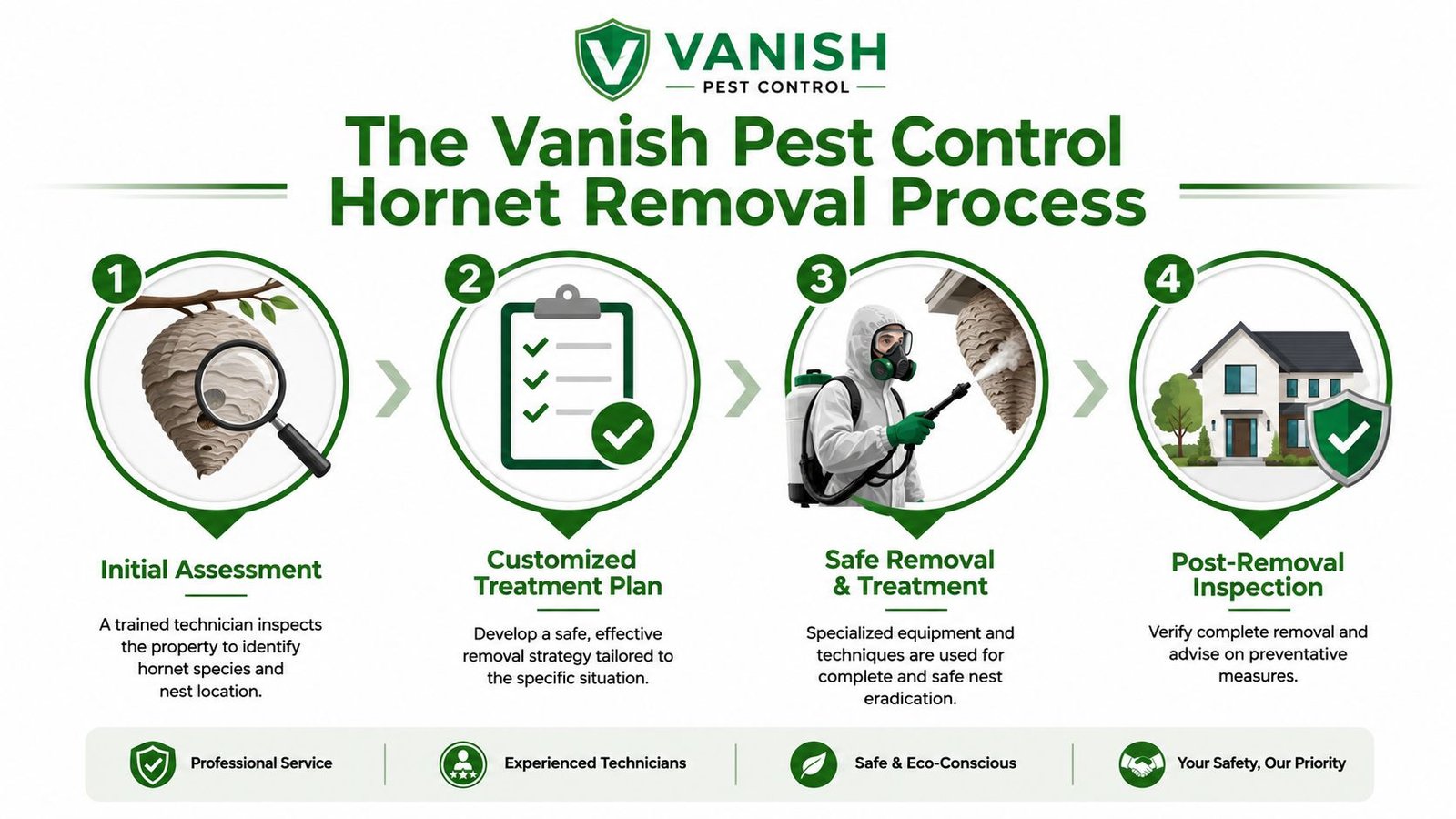
Then the treatment area is defined. That includes identifying which doors, walkways, balconies, or yard sections should be avoided during service. In Toronto homes with tight setbacks, semi-detached layouts, or backyard laneway access, this step is important because nearby spaces can't always remain in use while work is taking place.
A structured professional visit usually includes:
- Visual confirmation of activity through flight observation and nest location.
- Assessment of access risk such as height, footing, overhead obstructions, or hidden void entry.
- Selection of treatment method based on whether the nest is exposed, partially concealed, or fully inside the structure.
- Clear homeowner instructions so residents, children, pets, and visitors stay away from the active zone.
A proper service call starts with perimeter control. Treatment comes after the route in and route out are understood.
What happens during removal and after
During treatment, the technician uses protective gear and applies the chosen control method directly to the active site. If the colony is exposed, removal of the nest may happen once it's safe to do so. If the colony is inside a void, the visible paper structure may not be the primary issue. The focus shifts to stopping active occupancy and ensuring the nest site no longer presents an immediate threat.
After active treatment, a final inspection checks whether movement has stopped or reduced to the expected post-treatment pattern. The homeowner also receives practical guidance on reducing the chance of another colony choosing the same property features next season.
One local service option can be beneficial here. Vanish Pest Control Inc. handles hornet and wasp issues in Toronto with inspection-based treatment and follow-up guidance, which is the right model for structure-adjacent colonies where safety protocols matter as much as the treatment itself.
How to Prevent Hornets from Nesting on Your Property
Prevention works best before a nest becomes established. Toronto homeowners don't need to turn the property into a sealed shell, but they do need to reduce the quiet, protected spaces that queen hornets and similar stinging insects look for when building starts. Maintenance also helps with other Toronto pest problems, including wasps, ants, rodents, and wildlife that exploit the same weak points around a structure.
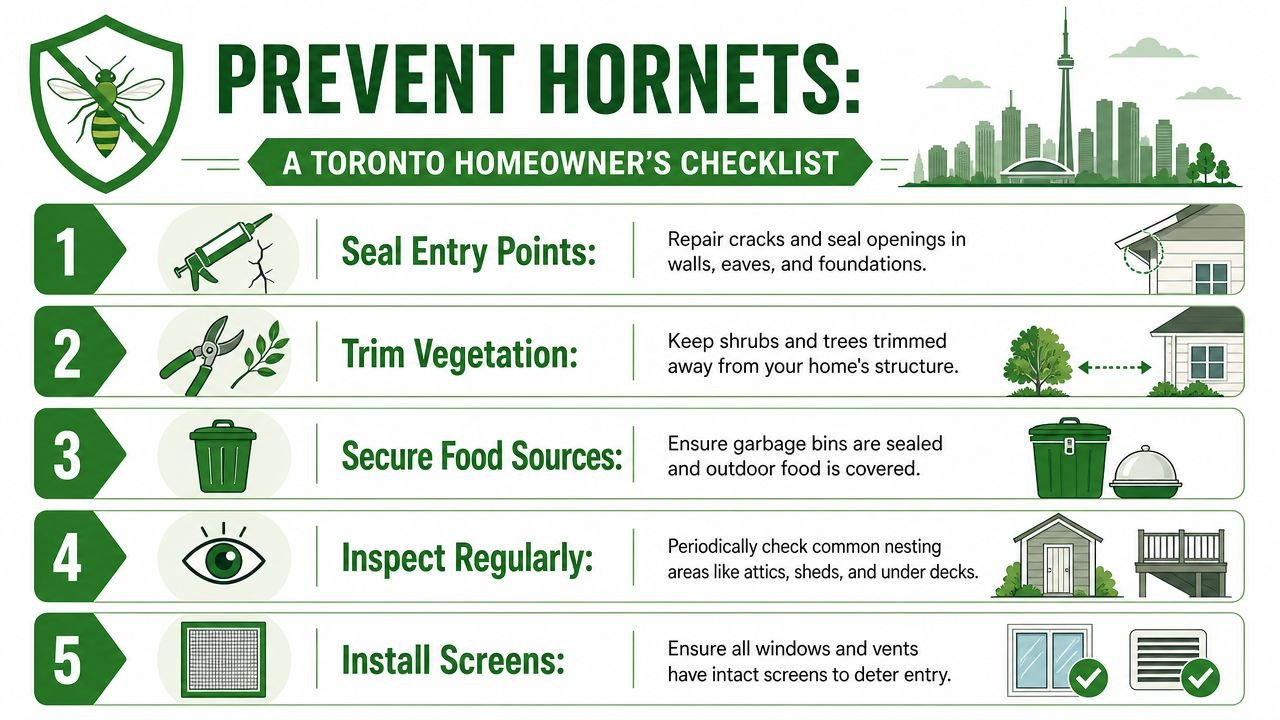
A practical prevention checklist for Toronto homes
- Seal gaps and openings: Check siding transitions, soffits, fascia edges, utility penetrations, and trim gaps where insects can enter hidden voids.
- Trim back overgrowth: Branches and dense shrubs touching the house create sheltered pathways and attachment points near rooflines and decks.
- Manage food attractants: Keep garbage lids closed, rinse sticky containers, and don't leave sweet drinks or food scraps outside after gatherings.
- Remove fallen fruit promptly: Fruit left under backyard trees attracts foraging insects and increases activity around the property.
- Inspect quiet exterior zones: Look under decks, inside sheds, around play structures, behind shutters, and under overhangs during routine yard care.
- Maintain screens and vent covers: Damaged screens and unprotected vents don't just invite stinging insects. They also open the door to other seasonal intruders.
For homeowners building a more consistent exterior maintenance routine, the Flagstaff seasonal guide from Pine Country offers a useful reminder that regular inspections often catch structural issues before they become pest entry points.
One habit makes the biggest difference. Don't ignore early signs of activity. A small amount of repeated insect traffic around one corner of the house is easier to assess than a mature nest discovered after weeks of growth.
Frequently Asked Questions About Hornet Removal
Is it safe to leave a hornets nest alone on a Toronto property
Sometimes a nest far from people can be monitored, but that isn't the usual urban scenario. In Toronto homes, nests are often close to doors, decks, shared fences, garages, sheds, and walkways. If people or pets may come near it during normal use of the property, leaving it alone is usually not the safest option.
Will hornets return to the same spot next year
The old nest itself isn't the main concern. The primary issue is that the location may still be attractive if the shelter and access conditions remain the same. If a property has protected eaves, gaps into voids, and low-disturbance corners, another colony may choose a nearby spot in a future season.
Are hornets active at night
Some hornet activity can continue in lower light conditions, especially around exterior lighting and sheltered entry points. Homeowners shouldn't assume darkness makes a nest safe to approach. Reduced visibility also makes ladders, footing, and escape routes more dangerous.
How much does professional hornets nest removal cost in Toronto
Cost depends on the nest location, accessibility, whether the colony is exposed or hidden, and how much risk the service setup involves. A low nest in a yard structure is different from an active colony inside a soffit above a front entrance. The safest approach is to have the site assessed so the treatment matches the actual problem rather than the visible symptom.
If a hornets nest is making part of the property unsafe, Vanish Pest Control Inc. can help assess the situation and arrange a safe treatment plan for Toronto homes, rental properties, and businesses. The right next step is simple. Keep people and pets away from the area, avoid any DIY spraying or ladder work, and get the nest evaluated before routine activity around the property puts someone at risk.
