

Cockroach problems in Toronto aren't rare housekeeping issues. They're one of the city's most persistent building health problems. In Toronto Community Housing Corporation's pest program, 38,241 work orders were handled in total, and cockroaches led at 37% of pest-related cases, ahead of bed bugs at 35% and mice at 23%, according to the Toronto Community Housing annual pest management report.
That number changes the conversation. A roach sighting in a condo kitchen, basement apartment, rental unit, or restaurant prep area usually isn't a strange one-off. In Toronto's dense housing stock, shared walls, plumbing lines, warm appliance voids, and uneven sanitation between units give cockroaches exactly what they need to stay hidden and spread.
For Toronto residents, landlords, and property managers, the practical question isn't just how to kill roaches. It's whether the issue can still be controlled with sanitation and monitoring, or whether a cockroach exterminator toronto service is now essential. The answer depends on the signs, the building type, and whether the infestation is localised or moving through the structure.
Table of Contents
- The Unseen Cockroach Problem in Toronto
- Confirming an Infestation Beyond a Single Sighting
- Choosing the Right Professional Exterminator in Toronto
- The Professional Treatment Process What to Expect
- Home Preparation and Long-Term Cockroach Prevention
- Frequently Asked Questions About Cockroach Extermination
The Unseen Cockroach Problem in Toronto
Toronto's cockroach problem is easy to underestimate because most of the activity happens where residents don't look. Roaches spend the day behind fridges, under sinks, inside cabinet joints, under dishwashers, in wall voids, and around pipe penetrations. By the time they're crossing the kitchen floor in daylight, the hidden population is often already established.
That's why panic isn't the useful response. Pattern recognition is. In apartment towers, older duplexes, rooming houses, and mixed-use buildings, the infestation may not start in the unit where it's first noticed. Roaches travel along utility lines, move through gaps around pipes, and settle where food residue, moisture, warmth, and clutter meet.
Why this matters in Toronto housing
A detached home and a downtown high-rise don't present the same problem. In a single-family house, the infestation is more often tied to conditions inside the property itself. In a condo or rental building, one clean unit can still get pressure from neighbouring units, compactor rooms, shared laundry spaces, or service corridors.
Practical rule: The more shared infrastructure a building has, the less useful a one-room DIY response becomes.
Toronto also treats this as more than an annoyance. The city requires properties to be kept free of pests under its standards framework, and residents are directed to raise extermination issues with landlords or property managers in writing before escalating through Toronto 311 pest service guidance and Chapter 629 obligations.
The right question to ask first
The first useful question isn't “What spray should be used?” It's “What conditions are supporting the infestation, and is the source inside this unit or beyond it?” That distinction decides everything that follows.
For some Toronto homes, cleaning, food storage correction, moisture control, and monitoring may be enough when activity is isolated and caught early. For others, especially multi-unit buildings and food premises, professional treatment becomes necessary because the insects are breeding in hidden spaces that residents can't safely or effectively reach.
Confirming an Infestation Beyond a Single Sighting
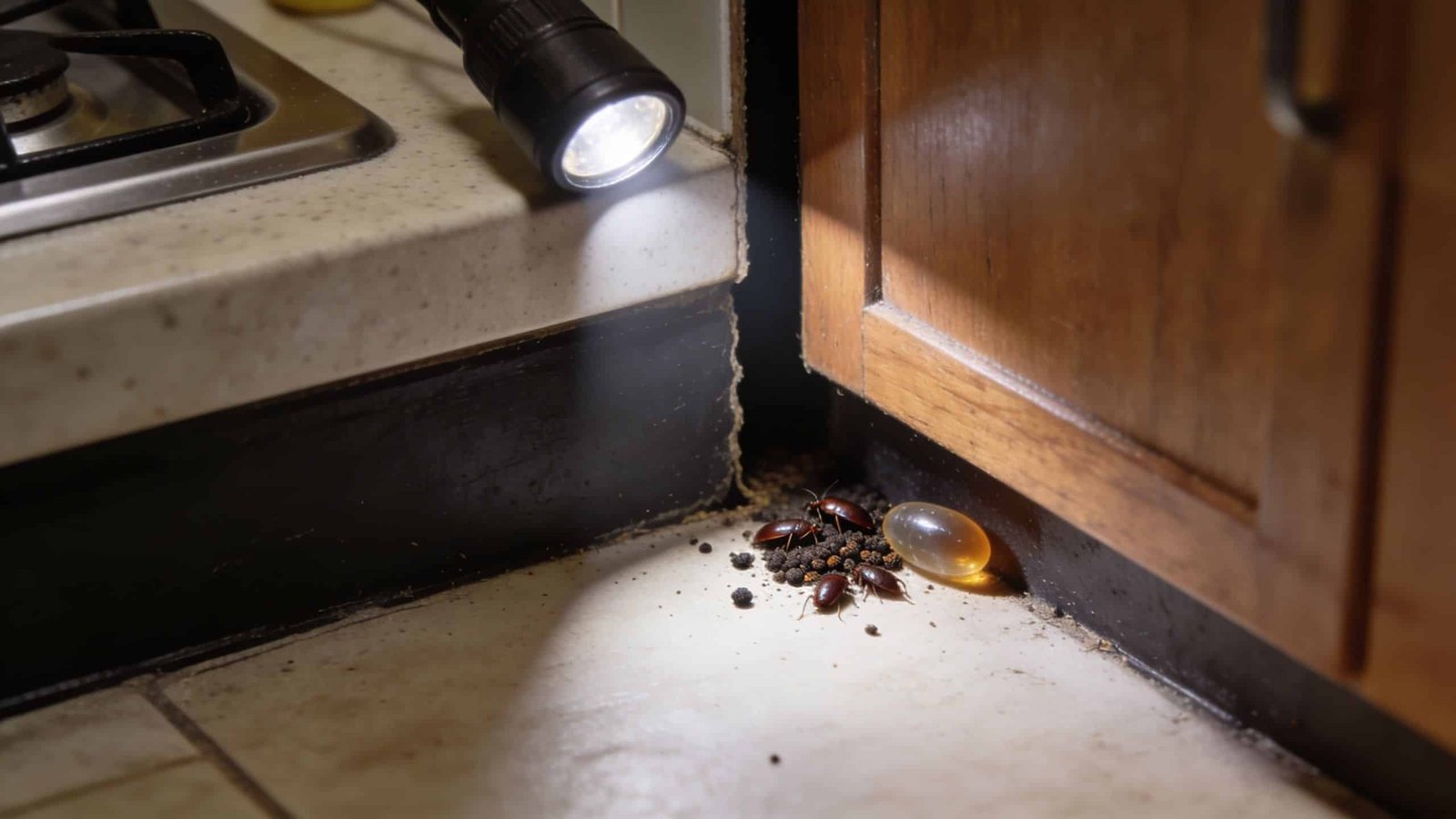
A single roach doesn't always prove a full infestation, but it should never be brushed off in Toronto housing. One insect seen near a sink at night may mean an isolated introduction. Repeated sightings, daytime activity, droppings, egg cases, or signs around plumbing and appliances point to something larger.
What a single sighting does and doesn't mean
If the sighting happens at night, close to water, and nowhere else, a resident may still be in the assessment stage. If the sighting happens in daylight, in more than one room, or more than once over several days, the situation should be treated as active until proven otherwise.
Cockroaches also carry a health angle that many households miss. Cockroach allergens can trigger or worsen asthma symptoms, especially in children, as noted in this Toronto-focused cockroach health and control overview. That's one reason early inspection matters more than waiting for “proof” in the form of a heavy outbreak.
Signs that point to an active colony
Professionals don't rely on sightings alone. They look for evidence that roaches are feeding, hiding, and reproducing nearby.
- Droppings near edges and hinges: Small pepper-like specks often gather along cabinet corners, drawer slides, wall junctions, and the tops of door frames.
- Egg cases in sheltered spots: Oothecae are often found behind appliances, inside lower cabinets, under sink lips, or in storage clutter.
- Musty odour in enclosed areas: Larger infestations often produce a stale, oily smell in pantry voids, utility closets, or under-sink spaces.
- Smear marks on travel routes: In damp areas, repeated movement can leave dark marks along edges and cracks.
- Shed skins and dead nymphs: These show up where colonies are maturing, especially in warm kitchen zones.
If a resident finds droppings, egg cases, and recurring night activity in the same room, the issue should be treated as an infestation, not a nuisance sighting.
Where Toronto residents should check first
In Toronto condos, the first checks should be behind the fridge, around the stove, under the sink, in utility closets, and around pipe cutouts under vanities. In older homes with finished basements, damp storage rooms, laundry corners, and cracks around plumbing stacks deserve close attention. In restaurants and cafés, inspections should focus on prep counters, floor drains, equipment legs, dish areas, and warm motor housings.
For a deeper look at how infestations spread through living spaces, this guide on understanding cockroach infestation and how they invade our homes is useful background.
A practical decision line helps. If activity is isolated to one area and no secondary signs are present, sanitation and monitoring may be enough to start. If signs appear in multiple rooms, around plumbing walls, or in shared-building conditions, a professional inspection is the safer move.
Choosing the Right Professional Exterminator in Toronto
Cockroach jobs fail for a predictable reason. The treatment hits exposed insects, while the breeding pockets stay active behind cabinets, inside pipe chases, under appliances, or in the unit next door.
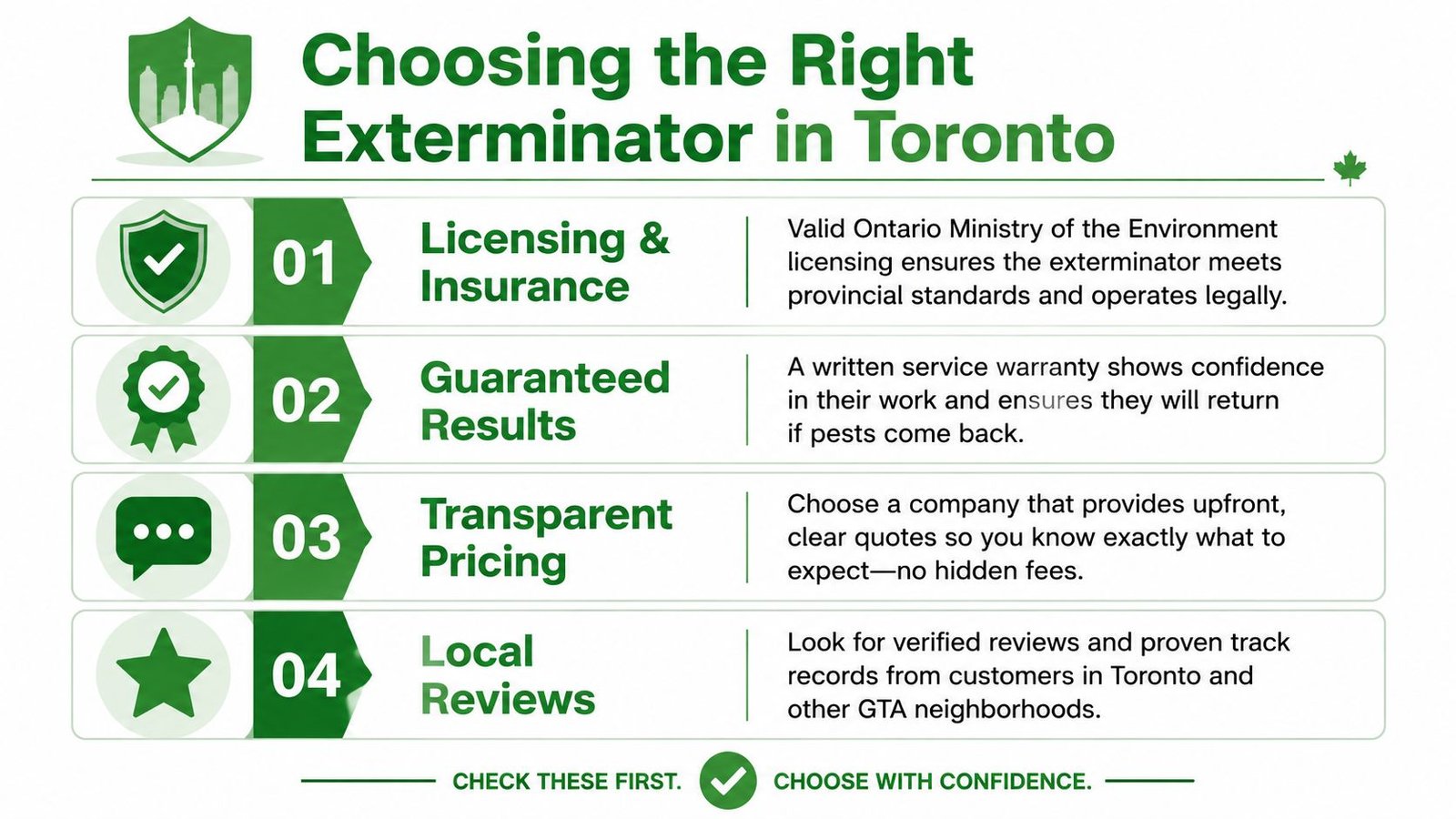
Toronto property owners need to screen for method, not marketing. In a detached house, the problem may be limited to one kitchen, one basement plumbing wall, or one laundry area. In a condo or apartment building, the same insect pressure can move through shared walls, risers, garbage rooms, and service penetrations. That difference changes the response. A single-family home may improve quickly with inspection, targeted treatment, and sanitation corrections. In a multi-unit building, a provider should be prepared to coordinate with management, document spread pathways, and recommend unit-to-unit action where needed.
What separates a real professional from a spray-only service
The baseline is Integrated Pest Management, or IPM. Health Canada explains that cockroach control works best when sanitation, exclusion, monitoring, and targeted product use are combined in the same program, as outlined in Health Canada's cockroach control guidance for Canada.
In practice, that means the technician inspects first, identifies harbourage, looks for moisture and food access, and chooses placements that match how cockroaches move through the space. Gel baits, crack-and-crevice residuals, void dusts, sticky monitors, and follow-up checks all have a role. Visible baseboard spraying alone is usually a weak plan for German cockroaches, especially in Toronto kitchens and bathrooms where heat, humidity, and clutter create protected harbourage close to people.
A good provider should also explain the trade-offs. Heavy product use may feel aggressive, but more chemical does not mean better control. In occupied homes, child-care settings, and food premises, precision matters more than volume. The goal is to reduce the population, interrupt breeding, and keep the insects from relocating deeper into the structure.
Questions Toronto property owners should ask
A short conversation can tell you a lot about the quality of the service. Ask these questions.
- Do you inspect before quoting treatment? If the answer is no, the provider is guessing.
- How do you handle condos and apartments differently from houses? The answer should include shared walls, neighbouring unit pressure, and building coordination.
- What products go where, and why? A capable technician can explain baiting, residual placements, and void treatment in plain language.
- How many visits are usually needed? Cockroach control often requires follow-up, especially in multi-unit properties.
- What preparation is required from residents or staff? Clear prep instructions reduce treatment failure.
- Will I get written service notes? Documentation matters for landlords, managers, restaurants, and repeat issues.
Toronto readers who want a stronger screening checklist can use this guide on what to look for in pest control companies in Toronto. Educational resources also help property owners ask better questions. Some teams publish process-focused material, including pest control specialist content playbooks, that show how clearly they explain inspections, treatment planning, and client responsibilities.
A competent cockroach exterminator toronto service explains where the infestation is established, what will be treated, what the resident must change, and how progress will be checked.
One factual local example is Vanish Pest Control Inc., which provides cockroach treatment in Toronto as part of its licensed pest control services. The point is not the brand name. The point is whether the company uses an inspection-led, targeted, documented process that fits the property type and the level of infestation.
The Professional Treatment Process What to Expect
People often expect cockroach treatment to work like a wasp nest removal. Quick visit, immediate result, problem over. Roaches don't behave that way. They hide deep, breed out of sight, and keep moving through warm service routes unless the whole treatment cycle is completed.
Inspection comes before treatment
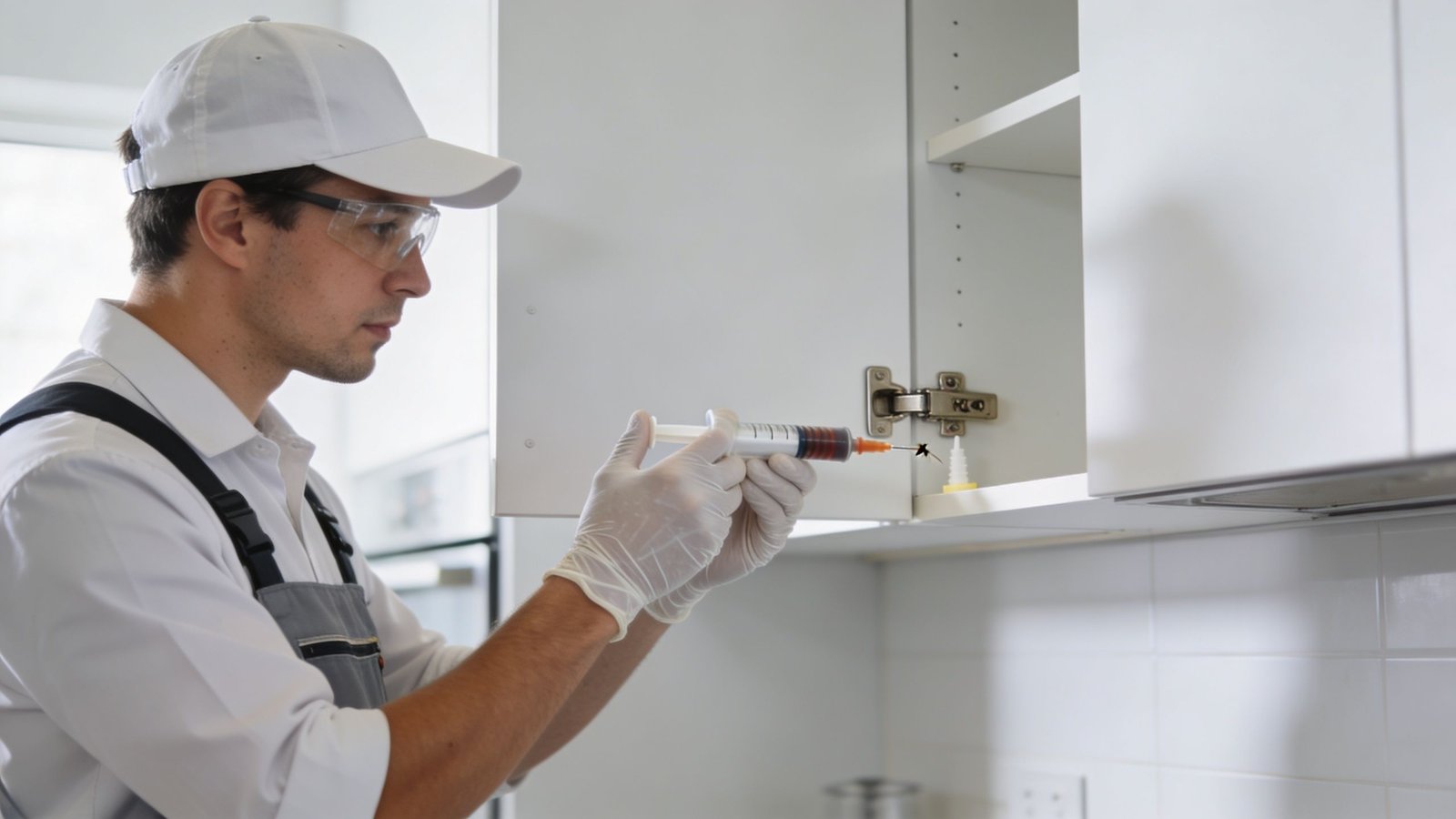
The first visit should identify where the insects are living, not just where they were seen. A technician typically checks under and behind appliances, sink cabinets, wall gaps around pipes, drawer voids, utility chases, and any warm equipment areas. In restaurants, the inspection usually expands to prep lines, storage shelving, floor drains, and hidden equipment cavities.
Treatment selection depends on what the inspection finds. Bait placements are usually used where roaches are actively travelling and feeding. Residual products go into cracks, crevices, and inaccessible edges. Dusts are often reserved for enclosed voids where moisture and harbourage persist. Space sprays and aerosols have a role, but mainly as support tools in heavier infestations, not as the whole program.
Why follow-up visits matter
Local benchmark guidance matters here because it sets realistic expectations. In Toronto, visible results are typically seen within 7–14 days, and most homes need 2–4 visits spaced every 14–21 days for complete elimination. The same benchmark notes that success is highest when technicians combine gel baits, residual dusts, and follow-up inspections, according to this Toronto cockroach control benchmark guide.
That timeline fits cockroach biology and building realities. Freshly hatched nymphs can appear after the first treatment window. Hidden pockets behind cabinets or in wall voids may survive if follow-up is skipped. In apartments, migration from adjacent units can also blur what looks like progress unless monitoring continues.
Field takeaway: The first visit starts the control process. The follow-up visits finish it.
What this looks like in condos restaurants and houses
A condo treatment often involves the kitchen, bathrooms, laundry closet, and any pipe or cable penetrations. The technician may recommend management involvement if activity appears linked to neighbouring units or vertical service lines.
A detached Toronto home usually allows more control over sanitation and access, so progress can be steadier if the source is inside the home alone. Basement kitchenettes, damp storage, and cluttered utility rooms are common weak points.
Restaurants and food businesses need a tighter standard. Roaches in these settings hide in motor housings, under prep equipment, behind coolers, and near drains. Treatment has to work around sanitation protocols, operating hours, and repeat inspections. A provider who doesn't discuss those operational details is usually not approaching the site properly.
Home Preparation and Long-Term Cockroach Prevention
The technician can place the right materials in the right spots, but treatment weakens fast if the environment keeps feeding the infestation. Roaches don't need much. Crumbs under a toaster, grease along cabinet seams, a leaking trap, cardboard storage, and cluttered voids can keep a colony going long after the first service.

How to prepare before service day
Preparation should focus on access and habitat reduction, not random deep cleaning everywhere. Residents and staff get better results when they concentrate on the areas roaches use most.
- Empty under-sink cabinets: Remove stored items so the technician can treat around plumbing, corners, and wall gaps.
- Pull clutter off kitchen floors: Bags, boxes, pet supplies, and loose storage block access and create shelter.
- Clean grease and crumbs: Wipe cabinet edges, counter seams, and appliance sides. Don't wash away placed baits after service.
- Store food in sealed containers: Dry goods, pet food, and snacks should be enclosed, not left in opened packaging.
- Fix obvious leaks if possible: Moisture under sinks and around dishwashers keeps harbourage active.
- Make appliances reachable: Access behind fridges and stoves matters because those warm voids often hold the heaviest activity.
For a household-level prevention checklist, this guide on protecting a home from a cockroach infestation is a useful reference.
How Toronto homes keep roaches from coming back
Long-term prevention is less about pesticide volume and more about denying food, water, shelter, and movement routes. In multi-unit Toronto housing, that includes cooperation with management. In single-family homes, it often comes down to maintenance discipline.
A good prevention plan usually includes:
| Prevention area | What to do in practice |
|---|---|
| Food control | Store pantry goods in sealed containers, clean under small appliances, and avoid overnight dishes in the sink |
| Moisture control | Repair drips, dry sink areas overnight, improve bathroom ventilation, and watch basement dampness |
| Harbourage reduction | Cut cardboard storage, clear cabinet clutter, and reduce packed utility spaces |
| Entry and movement points | Seal gaps around pipes, baseboards, cabinet backs, and utility penetrations where practical |
| Monitoring | Use traps in hidden hotspots to see whether activity is dropping or shifting |
Canadian guidance for dense housing and commercial spaces favours exclusion, sanitation, moisture reduction, monitoring, and targeted treatment over routine spray-heavy routines. That's also why housekeeping standards affect not only pest pressure but public confidence in the space. For readers interested in that operational side, this article on improving customer perception through sanitation adds useful context.
Cleanliness alone won't solve a hidden building infestation, but poor sanitation will absolutely make a professional treatment underperform.
In condos and apartments, residents should also report recurring activity in writing. If traps keep catching roaches after unit treatment, the source may sit in a neighbouring suite, garbage room, wall void, or common service area. That's a building management problem as much as a unit problem.
Frequently Asked Questions About Cockroach Extermination
In Toronto, one cockroach sighting often turns out to be more than one insect. In houses, that may mean a localized kitchen or basement issue. In condos and apartments, it often points to movement between units, service chases, or shared garbage areas. That difference is what drives the right response.
Short answers that help with real decisions
Public health and building operations follow the same logic here. Lasting control depends on inspection, sanitation, moisture correction, exclusion where practical, monitoring, and targeted treatment. Spray-only work rarely holds up, especially in multi-unit buildings where the source may sit outside the unit that first reported activity.
| Question | Answer |
|---|---|
| When should someone call a cockroach exterminator toronto service instead of trying DIY first? | Call a professional after repeated sightings, visible droppings, egg cases, activity in more than one room, or any sign of roaches in a condo, apartment, restaurant, or other shared property. DIY steps can help in a detached home if activity appears limited, sanitation gaps are corrected fast, and traps show the problem is actually shrinking. In multi-unit buildings, delays usually give the infestation more time to spread. |
| Are cockroach treatments safe for families and pets? | They can be, if the work is done properly. A technician should explain what is being used, where it is being placed, how long re-entry should take, and what cleaning should wait. Targeted baiting and crack-and-crevice treatment are very different from broad surface spraying. Written instructions matter. |
| How much does cockroach extermination cost in Toronto? | Price depends on the size of the property, the severity of activity, access to hiding areas, and whether follow-up visits are included. A single detached house visit is usually priced differently from a condo unit in an active building, and both differ from a restaurant or mixed-use site. If a quote sounds unusually low, check what it leaves out. Follow-up, monitoring, and coordination with management often determine whether the job holds. |
| Can one clean condo unit still get roaches? | Yes. I see this regularly in Toronto towers. Roaches move through plumbing openings, electrical penetrations, hallway gaps, and wall voids. Good housekeeping lowers food and water access inside the unit, but it cannot seal off building-wide migration by itself. |
| Why do roaches come back after treatment? | Return activity usually means one of five things. The infestation was larger than the first visit revealed, nearby units or common areas were not addressed, follow-up was skipped, moisture or food sources remained available, or clutter kept key harbourage out of reach. In a house, that often means a missed void or appliance area. In a multi-unit building, it often means the source was never limited to one suite. |
| Do landlords in Toronto have responsibilities when tenants report roaches? | Yes. Owners and managers are expected to address pest conditions and maintain the property to a habitable standard. Tenants should report the issue in writing, keep dated photos or trap counts, and ask for a treatment timeline. That paper trail matters if the response stalls or if activity keeps spreading between units. |
Shame slows reporting. Reporting protects the building.
For many Toronto properties, the smartest approach is to treat cockroaches as a property condition with public health implications, not as a housekeeping accusation. In a single-family home, prevention and monitoring may be enough if signs are light and isolated. In a multi-unit building, professional inspection and coordinated treatment are usually required because the source often extends beyond one kitchen or bathroom.
If cockroach activity is showing up in a Toronto condo, rental unit, house, restaurant, or mixed-use property, Vanish Pest Control Inc. is one local option for inspection-led treatment and prevention planning. Document the signs, arrange an inspection, and deal with the source before the problem spreads deeper into the building.




