

A Toronto resident usually notices roaches the same way. The kitchen light flips on late at night, something small moves across the counter or disappears under the dishwasher, and the whole home suddenly feels different. One insect can trigger a lot of worry because what it often means is commonly understood. If one is visible, others may already be tucked behind cabinets, around plumbing lines, or inside appliance voids.
That fear is justified, but it's manageable. Cockroach extermination in Toronto works best when the problem is treated as a building, structure, and sanitation issue, not just a bug issue. In Toronto homes, condos, rentals, restaurants, and mixed-use properties, roaches survive by exploiting heat, moisture, food residue, and hidden travel routes. A proper plan has to remove the active population and change the conditions that let it persist.
Table of Contents
- The Unseen Cockroach Problem in Toronto Homes
- Identify Your Unwanted Guests Cockroaches Common to the GTA
- The Professional Inspection Process Diagnosing Your Infestation
- Modern Cockroach Control The Integrated Pest Management Approach
- Cockroach Extermination Costs and Timelines in Toronto
- How to Choose a Licensed Cockroach Exterminator in Toronto
- Long-Term Prevention and Answers to Your Lingering Questions
The Unseen Cockroach Problem in Toronto Homes
A single roach in a Toronto condo kitchen rarely stays a single-unit problem for long. In dense housing, insects move through pipe penetrations, wall gaps, utility chases, shared waste areas, and service corridors. That's why a homeowner or tenant can keep a unit tidy and still see activity returning.
The larger pattern matters. In surveys of apartment residents, 50% reported that their building had a cockroach problem, and the German cockroach was identified as the most common species in these settings, according to published apartment survey findings. For Toronto, that tracks with what residents deal with in towers, older walk-ups, student housing, and mixed residential buildings where kitchens and bathrooms share infrastructure.
Why Toronto properties create easy travel routes
Cockroaches don't need much space to move. In an older semi-detached house, they may travel behind baseboards and around sink lines. In a downtown condo, they may come through gaps under cabinets or openings around plumbing. In restaurants and cafés, they often settle near equipment that gives off heat and around areas where grease or food debris collects.
That's why local pest problems often feel confusing. A resident may clean thoroughly, use store products, and still keep seeing nymphs near the same dishwasher or bathroom vanity. The source may not be the visible area at all.
Practical rule: If roaches are showing up in a Toronto apartment or condo, the problem should be assessed as a possible building-wide issue, not just a single-room nuisance.
Why quick panic responses usually miss the root cause
The first reaction is often to spray the visible insect, wipe the counter, and hope that solves it. It usually doesn't. Roaches spend most of their time hidden. The visible ones are only the part of the infestation that happens to break cover.
Toronto homes also create seasonal misconceptions. People assume winter reduces the issue. Indoors, heated kitchens, bathrooms, laundry rooms, and garbage areas still provide what roaches need. What matters more is access to food, water, harbourage, and untreated hiding spots.
For worried Toronto residents, the important takeaway is simple. Seeing cockroaches doesn't mean the home is beyond saving. It means the treatment has to be organised properly, with inspection, targeted control, and follow-up instead of a one-night cleanup.
Identify Your Unwanted Guests Cockroaches Common to the GTA
The term “roach” gets used loosely, but species matters. The size, colour, preferred hiding areas, and movement patterns tell a technician where the colony is likely nesting and which control strategy will work best.
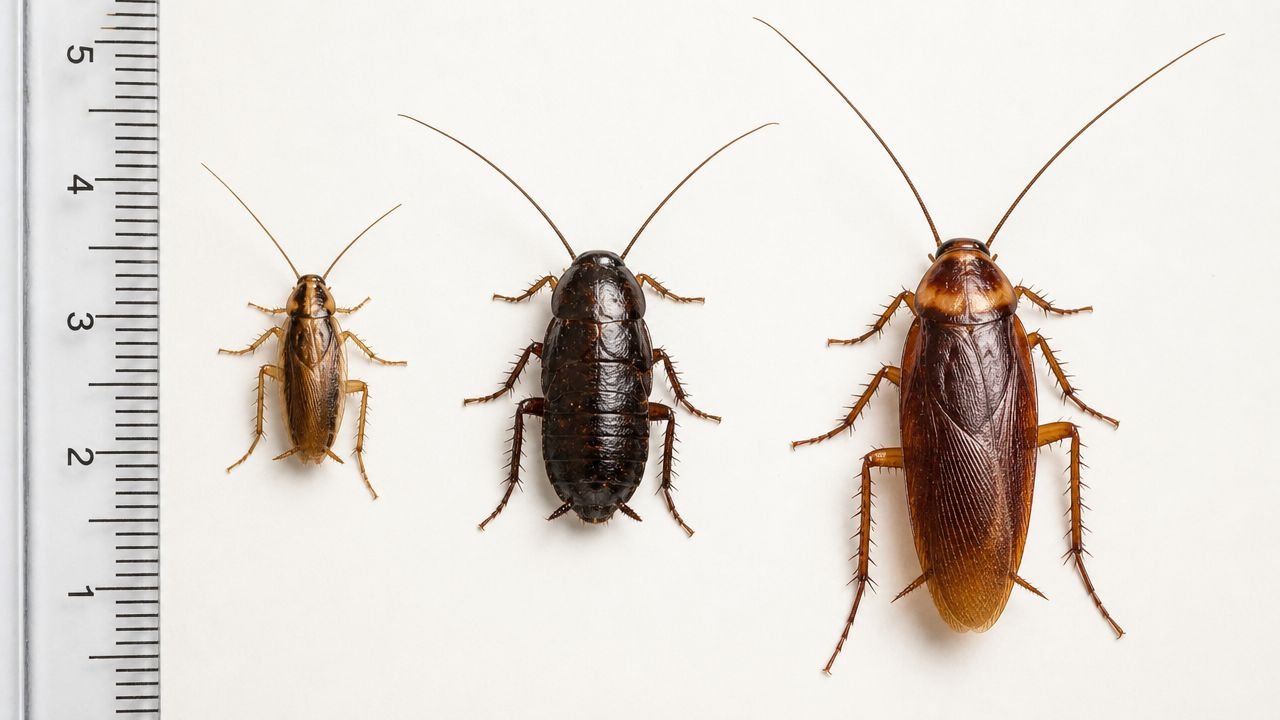
Homeowners who want a non-technical overview of behaviour and prevention can also review natural roach solutions, which gives a basic consumer-friendly starting point. For a more detailed look at how infestations begin indoors, this guide on understanding cockroach infestation and how they invade homes is useful before booking treatment.
German cockroaches
This is the species most Toronto residents are likely to encounter indoors. They're smaller than many people expect, light brown to tan in appearance, and usually found close to food and moisture. Kitchens are the main hotspot, especially around fridges, stoves, dishwashers, sink cabinets, microwave stands, and coffee stations.
German cockroaches also prefer tight harbourage. If a gap looks too narrow to matter, it may still be enough. They commonly scatter when lights switch on, which is one reason residents first notice them during late-night kitchen visits.
Typical signs include:
- Fast movement in kitchens: Most sightings happen on counters, backsplashes, cabinet edges, and around appliances.
- Activity near heat and moisture: Dishwasher insulation, motor housings, and sink voids are common shelter sites.
- Recurring nymph sightings: Smaller roaches usually mean the infestation is established nearby, not just passing through.
American cockroaches
American cockroaches are much larger and easier to identify on sight. In the GTA, they tend to be associated with basements, boiler rooms, floor drains, sewer-connected areas, utility rooms, and lower-level commercial spaces. They're less often a classic upper-cabinet kitchen infestation and more often tied to damp structural areas.
A Toronto homeowner may see them in a basement laundry area, near a drain, or in a room with plumbing and humidity. In restaurants or commercial buildings, they may appear near service corridors and mechanical spaces.
Oriental cockroaches
Oriental cockroaches are darker and more strongly associated with damp environments. They're often linked with cool, wet locations such as crawl spaces, foundation edges, under-sink voids, and basement floor areas. When a Toronto resident describes “large dark roaches” near a drain or laundry area, this species is part of the differential.
Correct identification matters because bait placement, moisture correction, and exclusion work differently in a warm kitchen infestation than they do in a damp basement or drain-linked problem.
The Professional Inspection Process Diagnosing Your Infestation
Good cockroach extermination in Toronto starts with diagnosis, not chemical application. A licensed technician has to answer three questions first. What species is present, where is it harbouring, and how far has it spread through the structure?
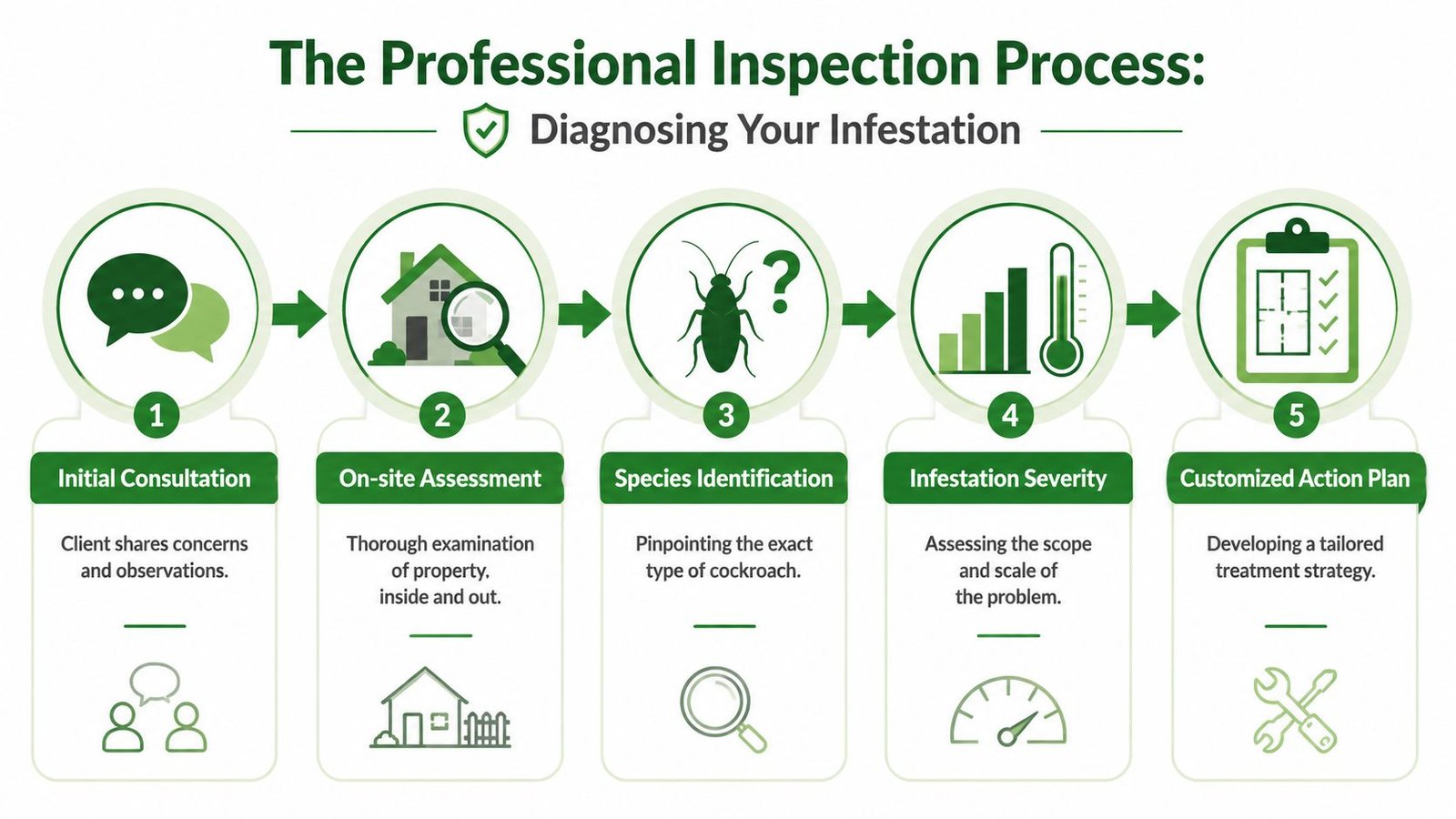
Where technicians look first
In a Toronto condo, the first inspection points are usually the kitchen and bathroom. That means under the sink, behind the fridge, around the stove, inside cabinet hinges, around plumbing penetrations, and beneath or behind the dishwasher. Utility closets, laundry areas, and storage rooms also matter, especially in compact units where mechanical lines run through living space.
In detached Toronto homes, the inspection often widens quickly. Basements, furnace rooms, laundry connections, sump-adjacent areas, and drain-linked zones can reveal how the infestation is entering or surviving. In food-service spaces, the focus shifts toward prep stations, grease zones, under equipment, and wall-floor junctions.
What confirms the infestation
Technicians aren't just looking for live adults. They're reading evidence. Small dark spotting, shed skins, egg cases, insect fragments, and concentrated debris patterns often tell more than a quick daytime sighting.
The inspection usually includes checking for:
- Fecal spotting: Often seen as pepper-like marks in corners, hinges, shelf joints, and equipment seams.
- Egg cases and shed material: These indicate active reproduction or a recent established population.
- Moisture conditions: Leaks, condensation, and damp cabinetry support survival.
- Structural access points: Gaps around pipes, cracked sealant, cabinet voids, and wall penetrations often serve as travel routes.
A serious inspection also asks the occupant practical questions. Where are sightings happening most often. Are they mainly in the kitchen or bathroom. Are there recent appliance deliveries, move-ins, renovations, or waste-room issues. Those details often explain why the infestation appeared when it did.
A roach treatment plan is only as good as the inspection behind it. If the hiding zones aren't mapped properly, the product ends up in the wrong places.
By the end of the inspection, the resident or property manager should understand whether the issue is isolated, spreading through adjacent units, or being sustained by structural and sanitation conditions that need correction alongside treatment.
Modern Cockroach Control The Integrated Pest Management Approach
Spraying every baseboard and hoping for immediate relief is the old model. It's still what many worried property owners expect, but it usually isn't what solves a persistent infestation. Modern pest control is moving away from broad spray-only treatments due to increasing insecticide resistance, while public-health guidance now emphasizes Integrated Pest Management, which combines sanitation, sealing entry points, vacuuming, and targeted baiting, as explained in this overview of Integrated Pest Management for cockroach control.
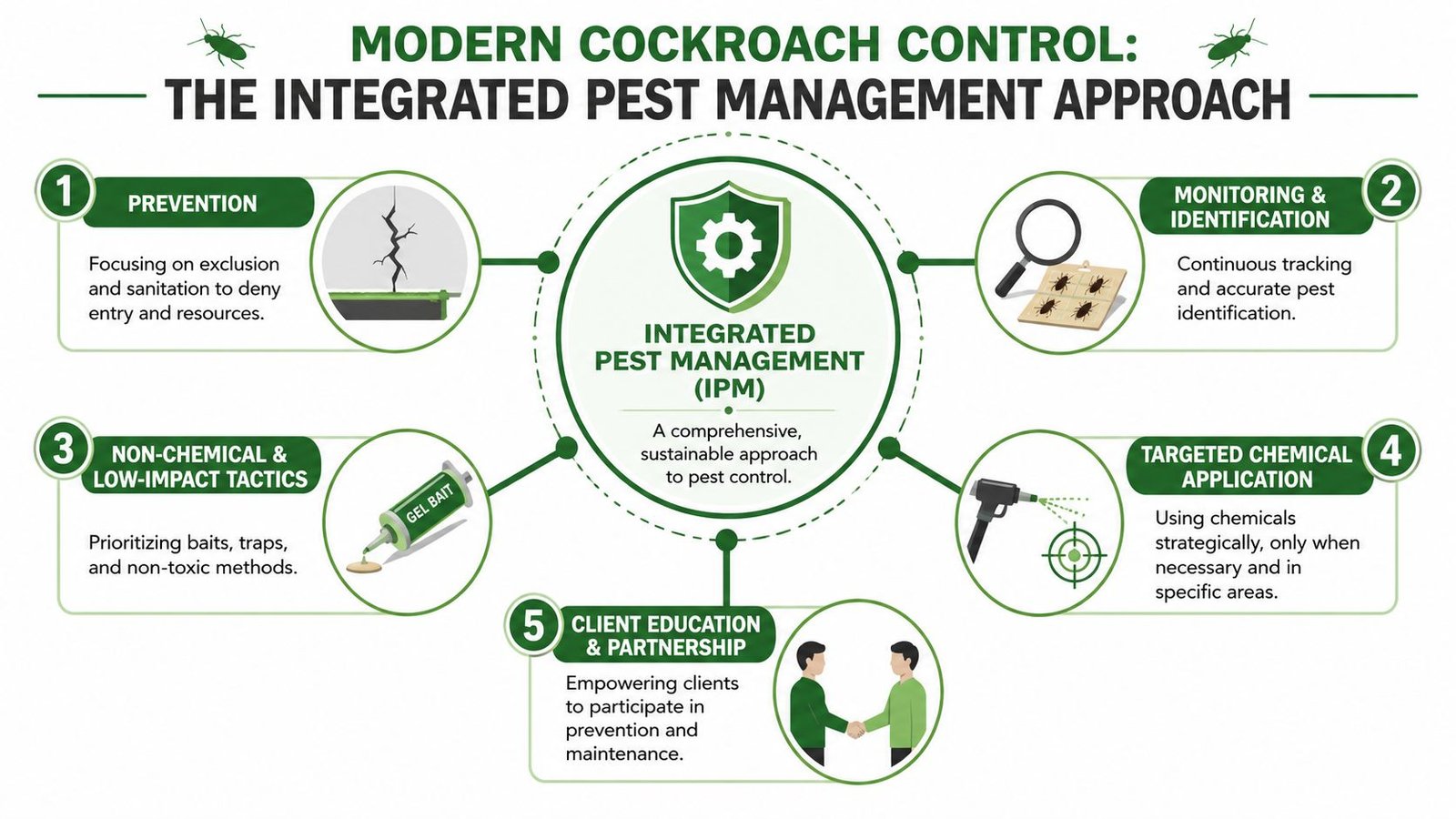
Why spray-only treatments often fail
Spray-only work tends to focus on exposed surfaces. Roaches don't live on exposed surfaces. They stay in compressor cavities, cabinet seams, wall voids, under sink lips, behind trim, and around plumbing openings. A visible knockdown can happen quickly while the main harbourage stays active and protected.
There's another trade-off. Broad application can push some roaches deeper into inaccessible voids or into adjacent units in multi-residential buildings. That's one reason spray-heavy treatment can produce temporary relief followed by a frustrating rebound.
For Toronto properties, the urban layout matters. High-rise kitchens share plumbing stacks. Older houses have hidden voids and retrofitted service lines. Restaurants combine heat, grease, cardboard, drains, and equipment gaps. In all of those settings, lasting control depends on precision.
What a modern treatment program includes
Integrated Pest Management, or IPM, works because each part handles a different weakness in the infestation.
Targeted baiting
Baits go where roaches feed and travel, not where people want to see “something done.” Proper placement is usually inside cracks, hinges, void edges, and protected harbourage areas. The point isn't smell or immediate contact. The point is ingestion and transfer within the active population.
Dusting and growth regulation
In difficult harbourage zones, technicians may use dust formulations and an insect growth regulator, often shortened to IGR. Growth regulators interrupt development and help break the cycle that keeps younger stages replacing the adults residents see first.
Vacuuming and physical removal
Physical removal is underrated. Health Canada notes that vacuuming can remove cockroaches and egg cases, and it advises freezing infested items for at least 24 hours at -8°C or lower as part of practical control, according to Health Canada's cockroach guidance. That matters because extermination isn't just chemistry. It's removal, cleanup, and habitat disruption.
Exclusion and sanitation correction
A treatment can't overcome constant reintroduction from open entry points and easy food access. Sealing pipe gaps, repairing torn kick plates, fixing leaks, storing food properly, and reducing grease or residue around appliances all change the environment roaches depend on.
Monitoring and adjustment
Sticky monitors, follow-up checks, and resident reporting help confirm whether activity is declining in the right locations. If movement shifts from one side of the kitchen to another, the treatment plan should adjust.
Broad spraying often satisfies the urge for a fast response. IPM solves the actual problem by combining removal, baiting, growth disruption, exclusion, and monitoring.
For Toronto homes and buildings, this is the approach that makes practical sense. A staged, lower-impact, targeted program usually outperforms aggressive one-time spraying because it deals with the colony, not just the insects that happened to be visible that day. A licensed provider such as Vanish Pest Control Inc. can build that type of plan around the property layout, occupancy needs, and follow-up requirements.
Cockroach Extermination Costs and Timelines in Toronto
Price questions are fair, but there isn't one fixed answer for every property. Cockroach extermination in Toronto depends on what's being treated, how widely the infestation has spread, how accessible the harbourage areas are, and whether the site is a private residence, rental unit, or commercial space.
What changes the price
A small condo with kitchen-centred activity is a different job from a detached house with basement moisture issues. A restaurant with multiple prep areas, equipment lines, and sanitation coordination is a different job again. The treatment plan may involve one main area or several connected zones that all need service.
The other factor is follow-up. A proper program is usually staged rather than one-and-done. When a technician has to revisit, inspect monitors, reapply bait in consumed areas, or address neighbouring spread conditions, that affects the full job cost more than the first visit alone.
Residents looking for a local breakdown can review this page on pest control cost for roaches for property-specific context.
Estimated Cockroach Extermination Costs & Timelines in Toronto 2026
Because no verified dollar figures are available here, the table below stays qualitative rather than inventing price ranges.
| Property Type | Typical Cost Range | Typical Timeline |
|---|---|---|
| Condo unit | Varies based on infestation severity, unit access, and whether adjacent-unit issues are involved | Usually staged over inspection, initial treatment, and follow-up |
| Single-family home | Higher than a simple unit treatment when kitchens, basements, laundry, and utility areas all need service | Often requires more than one visit, especially if moisture and exclusion issues are present |
| Commercial kitchen or restaurant | Usually the most complex due to equipment, sanitation coordination, and operational constraints | Commonly structured as an ongoing or multi-step program rather than a single visit |
What can be stated clearly is the service rhythm. A professional cockroach program typically involves inspection first, then treatment, then reassessment. Some infestations respond quickly when caught early. Others need multiple rounds because the colony is deep inside inaccessible voids or because the source includes shared building areas that also need attention.
For property managers, timelines depend on cooperation as much as chemistry. Access to suites, resident preparation, leak repair, housekeeping standards, and waste-area management all affect how quickly the visible activity drops. In multi-unit Toronto buildings, delays often happen because one treated unit improves while a neighbouring untreated source unit keeps feeding the problem back into the corridor or plumbing line.
A realistic contractor won't promise instant total eradication from one blanket spray. A realistic contractor will explain the stages, the conditions that help treatment succeed, and what signs show that the program is moving in the right direction.
How to Choose a Licensed Cockroach Exterminator in Toronto
The right company doesn't just sell treatment. It shows a method. That matters because roach control can look similar from the outside while being very different in practice once the technician arrives.
A professional cockroach extermination service typically follows a staged sequence of inspection, targeted baiting or dusting with an insect growth regulator, and a follow-up visit 7–10 days later, according to this description of a professional cockroach removal sequence. That sequence gives Toronto residents a useful benchmark when evaluating any provider.
Questions worth asking before booking
A careful homeowner, landlord, or property manager should ask direct questions and expect direct answers.
- Are the technicians licensed and insured: This is basic. If the answer is vague, move on.
- What species do you think this is and why: A serious provider should ask about location, behaviour, and sightings before suggesting treatment.
- What does the first visit include: Inspection should be part of the service, not an afterthought.
- Will you use baits, dusts, IGRs, monitors, or only sprays: The answer reveals whether the company is following modern practice or relying on a quick visible application.
- Is follow-up included or recommended: Roach jobs often need reassessment. If a provider insists one visit always solves everything, that's a warning sign.
- What preparation is required from the occupant: Cabinet access, clutter reduction, sanitation, and pet or child safety instructions should be clear in advance.
What a serious treatment plan looks like
A competent plan is specific. It identifies hotspots, explains where products will and won't be applied, addresses moisture and exclusion issues, and sets expectations for what residents may still see after treatment. Some activity can continue briefly as roaches contact baits or emerge from harbourage.
It should also address the property type. In a detached house, that may mean adding basement and drain-area inspection. In a Toronto apartment building, it may mean documenting neighbouring-unit concerns and advising management that isolated treatment may not hold if shared pathways remain active.
If the proposal sounds like “we spray and the problem is gone,” the plan is too thin. Roach control should sound methodical because the work is methodical.
The strongest providers also explain the limits of service. They can treat the infestation, but the property owner or manager may still need to repair leaks, seal openings, improve garbage handling, or coordinate access across multiple units. That honesty is a good sign, not a weakness.
Long-Term Prevention and Answers to Your Lingering Questions
Treatment removes the pressure. Prevention keeps the pressure from rebuilding. In Toronto homes, especially kitchens, basements, rental units, and mixed-use buildings, small maintenance habits make a large difference because roaches only need food, water, and shelter to stay established.
Prevention habits that matter in Toronto homes
Health Canada's guidance focuses on denying cockroaches those basics. That means storing food in sealed containers, keeping garbage in bins with lids, repairing leaks, and sealing cracks and crevices around floors, walls, and pipes. This page on how to protect a home from a cockroach infestation gives a practical local checklist built around those same principles.
A strong prevention routine includes:
- Food control: Store dry goods properly, clean crumbs fast, and avoid leaving pet food out overnight.
- Moisture control: Fix sink leaks, wipe standing water, and check under dishwashers and bathroom vanities.
- Structural sealing: Close gaps around plumbing lines, cabinets, baseboards, and utility penetrations.
- Waste management: Use sealed bins and don't allow garbage or recycling residue to sit uncovered indoors.
FAQ
Who is responsible in a Toronto rental unit?
Ontario housing guidance generally places responsibility on landlords to maintain rental units and common areas in a good state of repair, while tenants are expected to keep the unit reasonably clean and cooperate with access for repairs and pest treatment. In practice, roach disputes are usually coordination problems. Documentation, written notices, and access arrangements matter.
What if roaches seem to be coming from a neighbour's unit?
That's common in multi-unit housing. The issue should be reported clearly and in writing to building management or the landlord, with dates, locations, and photos where possible. Treating one unit may help, but it may not hold if the source unit or shared service area isn't addressed.
What should residents expect after treatment?
Some roach activity may still be visible for a period after service, especially as hidden insects move through treated zones or consume bait. That doesn't automatically mean failure. The more useful signs are whether sightings become less frequent, more localized, and increasingly limited to problem areas already identified during inspection.
Can cleaning alone solve it?
Cleaning helps, but established infestations usually need targeted professional treatment plus sanitation and exclusion. Clean conditions support success. They don't replace treatment when a colony is already active.
If roaches are showing up in a Toronto home, condo, rental unit, or commercial property, a staged inspection and treatment plan is the safest next step. Vanish Pest Control Inc. provides licensed pest control across Toronto and the GTA, with targeted cockroach treatment, follow-up planning, and practical prevention guidance for residents and property managers who want lasting control rather than a temporary knockdown.




