

A Toronto resident usually notices a cockroach problem at the worst possible time. The kitchen light flips on late at night, something small disappears behind the stove, and the mind immediately jumps to every cabinet, every food container, and every shared wall in the building. Condo owners worry about neighbouring units. Homeowners worry about how far the problem has spread. Restaurant operators worry about inspections, staff reports, and customer safety.
That first sighting feels bigger than one insect because it often is. In Toronto, cockroach issues are tied to dense housing, older infrastructure, moisture, food handling, and the small gaps around pipes, drains, and wall penetrations overlooked until pests show up. A practical response starts with two truths. First, this problem is common enough that it needs a serious plan. Second, quick knockdown and long-term elimination aren't the same thing.
A proper cockroach plan for Toronto homes and businesses has to do more than kill visible insects. It has to identify where they're hiding, what resource is keeping them alive, and what building condition is letting them return.
Table of Contents
- That Unsettling Scuttling Sound in Your Toronto Kitchen
- Identifying Common Cockroaches in Toronto Properties
- Health Risks and Toronto Property Standards
- Your Step-by-Step Home Inspection Checklist
- The Professional Treatment and Eradication Process
- Long-Term Prevention for a Roach-Free Toronto Home
- Frequently Asked Questions on Toronto Cockroach Control
That Unsettling Scuttling Sound in Your Toronto Kitchen
You walk into the kitchen late at night, hit the light, and something small shoots from the counter line to the gap beside the dishwasher. By breakfast, the cupboards are open, a store-bought spray is on the counter, and the questions start. Did they come from the sink area, the garbage chute, the wall behind the stove, or the unit next door?
That reaction is normal. Cockroaches feel personal because they show up where food is stored and where families spend time. In Toronto, I also look at the building itself. Older plumbing penetrations, humid cabinet voids, shared walls in condos and semis, and chronic leaks under sinks often give roaches what they need to stay hidden between sightings.
Sometimes the warning sign is not the insect. It is the musty odour under the sink, the damp particleboard around plumbing, or residue building up around a drain. If you are already trying to fix a smelly sink drain, treat that as part of the roach problem, not a separate annoyance. Bad drain conditions often point to the moisture and organic buildup that support ongoing activity.
A common first mistake
A common first mistake is focusing only on the insect that was seen. The better question is what allowed it to survive in that kitchen in the first place.
Practical rule: If cockroaches have water, food residue, and a tight hiding space, killing the visible ones will not end the infestation.
This is why quick sprays disappoint homeowners so often. They kill the roach that crosses the floor. They do not reach the harbourage behind the fridge motor, under the sink base, inside cabinet joints, around pipe openings, or in the wall void beside the dishwasher. In many Toronto homes, especially in multi-unit buildings, the visible roach is the surface sign. The underlying problem is the protected space behind it and the moisture that keeps that space usable.
Local context matters here. A detached house with a plumbing leak needs a different plan than a downtown condo with shared service lines and recurring activity near risers. In both cases, the long-term fix starts the same way. Find the water source, find the entry or harbourage point, and correct the building condition that keeps feeding the infestation.
Homeowners usually feel pressure to act fast, and they should. But speed matters less than accuracy. A treatment plan aimed only at insects gives temporary relief. A plan that also addresses leaks, gaps, damp voids, and sanitation pressure gives you a realistic chance at stopping the cycle.
Identifying Common Cockroaches in Toronto Properties
Not every cockroach in Toronto behaves the same way. That matters because treatment depends on where the species prefers to hide, how it moves through a building, and whether the problem is mostly indoor harbourage or a sign of moisture and infrastructure trouble.
Why species matters
A resident may use the word "roach" for anything brown and fast, but a technician needs to narrow it down. The three species most often discussed in Toronto properties are German, American, and Oriental cockroaches.
German cockroaches are usually the main kitchen and appliance pest. They favour warmth, food residue, tight harbourage, and the protected spaces around stoves, fridges, dishwashers, and cabinet hinges.
American cockroaches are larger and are often connected to commercial buildings, boiler areas, service corridors, and basements where warmth and access points are available.
Oriental cockroaches tell a different story. They are commonly associated with damp basements, drains, sewer-linked areas, and persistent moisture conditions.
Toronto Cockroach Identification Guide
| Species | Size & Appearance | Common Hiding Spots in Toronto Homes |
|---|---|---|
| German cockroach | Small, tan to light brown, fast-moving | Behind fridges and stoves, under sinks, inside cabinets, near dishwashers, around pipe penetrations |
| American cockroach | Large, reddish-brown | Basements, utility rooms, service areas, around drains, warm mechanical spaces |
| Oriental cockroach | Darker in colour, slower-moving, often linked to dampness | Damp basements, floor drains, laundry rooms, near sump areas, around sewer or drain access points |
Location usually gives the first clue
If cockroaches are concentrated in the kitchen and bathroom of a condo unit, German cockroaches move high on the suspect list. If a detached Toronto home has repeated sightings in a damp cellar or near floor drains, Oriental cockroaches become more likely.
A cockroach found near a drain isn't just a pest sighting. It can be a warning about moisture, access, and hidden harbourage.
This is one reason pest control Toronto cockroaches work can't rely on one generic treatment. The species points to the likely harbourage zone, and the harbourage zone points to the effective fix. A kitchen-heavy infestation calls for targeted baiting, crack-and-crevice work, and sanitation changes. A basement-heavy infestation may require drainage correction, sealing, and moisture management before the problem stops cycling back.
For a homeowner, precise identification turns a vague fear into a practical search pattern. It tells them where to inspect first and what kind of conversation to have when booking professional service.
Health Risks and Toronto Property Standards
Cockroaches aren't just unpleasant to see. They create a health concern inside kitchens, food-storage areas, and shared living spaces, especially when they move across surfaces that people use every day.
Why this is more than a nuisance
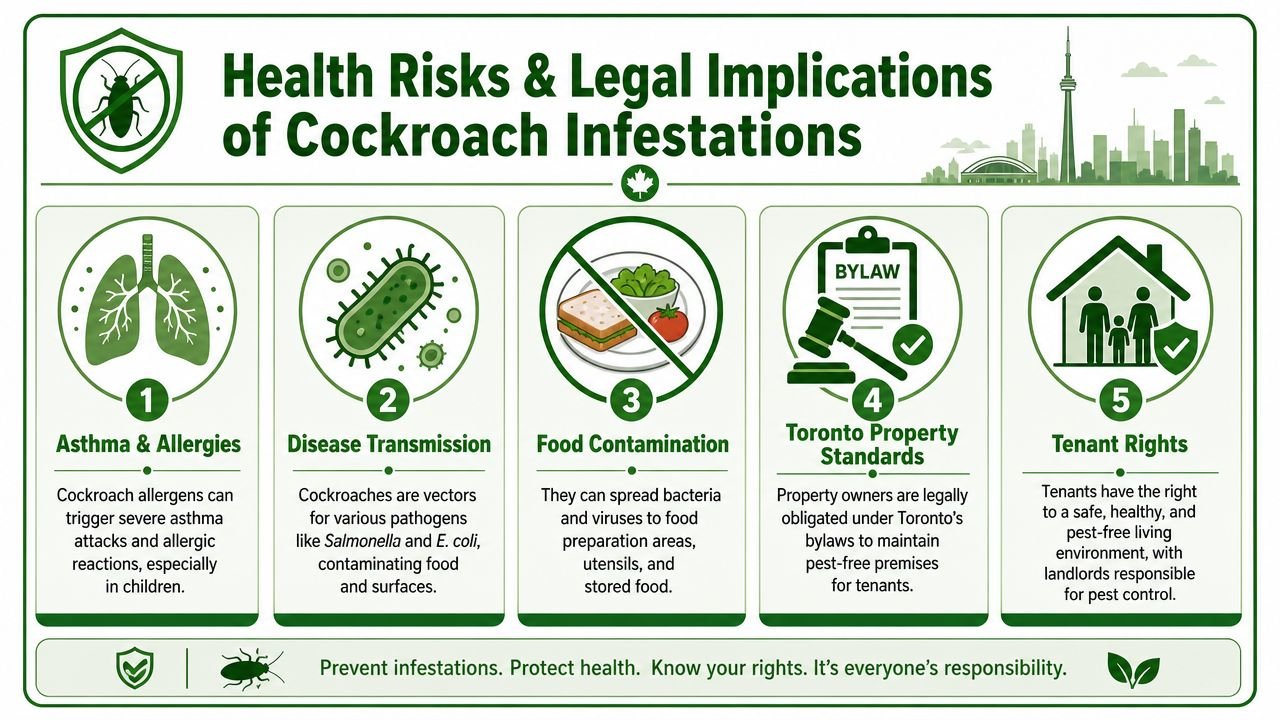
Cockroach infestations are often treated casually until activity becomes visible in daylight or starts affecting daily routines. That delay is risky. In homes, they contaminate food preparation zones and stored items. In restaurants and commercial kitchens, they create an immediate sanitation issue.
Many landlords also underestimate how quickly a pest complaint becomes a building-management problem. For readers who want a plain-language overview of general repair obligations in rental housing, AIM Properties' California landlord repair guide is useful as a comparison point for how maintenance duties are commonly framed, even though Toronto owners still need to follow local law.
Cockroach control belongs in the same conversation as sanitation, leak repair, exclusion work, and occupant communication.
In severe situations, property managers sometimes also arrange cleaning support after treatment, especially in units with heavy contamination or after vacant-unit turnover. Where that makes sense, professional disinfecting services may be part of the practical recovery plan.
What Toronto property owners need to understand
Toronto makes this issue clear. Under Toronto Municipal Code Chapter 629, all properties must be kept free of rodents, vermin, insects, and other pests at all times, which makes cockroach control a property-standards issue for landlords and commercial operators, not just a housekeeping concern (Toronto property standards for pest-free premises).
That changes the conversation in a useful way. A landlord can't treat recurring cockroaches as a tenant inconvenience to be handled later. A restaurant operator can't assume a one-time spray is enough if the source remains active. A condo board can't ignore service areas, waste rooms, or plumbing penetrations in common spaces if units keep reporting activity.
The practical takeaway is simple:
- Homes need health protection: Any pest moving through food and moisture zones deserves prompt action.
- Rental properties need documented response: Complaints, inspections, repairs, and treatments should be coordinated, not improvised.
- Businesses need compliance discipline: Staff should know what signs trigger immediate reporting and treatment follow-up.
Your Step-by-Step Home Inspection Checklist
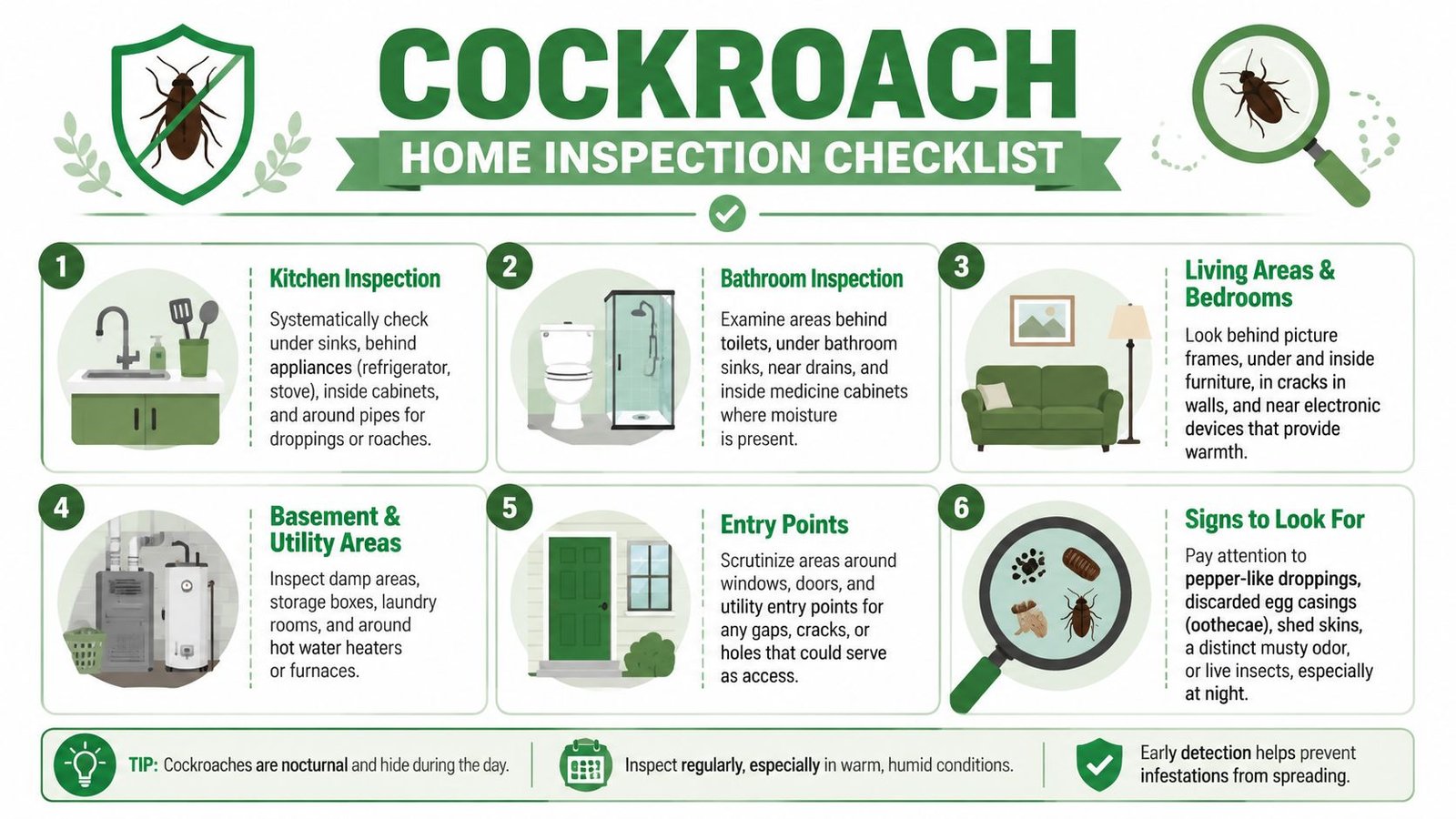
A proper inspection does more than confirm that cockroaches are present. It shows why they are staying. In Toronto homes, the answer is often a mix of moisture, hidden access points, and protected voids inside kitchens, bathrooms, and utility areas.
Start at the sink cabinet in the kitchen. Look under the trap, around supply lines, and along the back corners where cabinet panels meet. Then check behind the garbage bin, beside the dishwasher, under the fridge, and at the joint where the countertop meets the wall. These are the spots I inspect first because heat, food residue, and small plumbing leaks often come together there.
Next, move to the bathroom. Open the vanity, inspect around pipe cutouts, and check the floor line behind the toilet. Look along baseboards near the tub or shower and pay attention to soft caulking, swollen trim, or signs of repeated condensation. Roaches do well in dark, tight areas that stay damp.
If the home has a basement, laundry room, or utility closet, spend time there. Check around the hot water tank, laundry hookups, floor drains, storage shelves, electrical penetrations, and any opening where plumbing or wiring enters the wall. In older Toronto houses and basement apartments, these service areas often connect the infestation from one part of the building to another.
The signs are usually small.
Look for live roaches, dead ones caught in corners, pepper-like droppings, egg cases, shed skins, and staining along cabinet edges or wall junctions. A stale, oily odour inside a closed cabinet can also point to a well-established harbourage. If you only inspect the open floor, you will miss the protected population that keeps the problem active.
Record what you find room by room. A simple note on location, moisture condition, and activity level is enough. That record helps separate a minor kitchen-focused issue from a building-wide problem coming through shared plumbing, wall voids, or a chronically damp area.
This order works well in most Toronto properties:
- Kitchen first: Check sink bases, appliances, cabinet hinges, drawer tracks, and wall gaps.
- Bathroom second: Inspect vanity voids, toilet area, tub edges, and plumbing penetrations.
- Laundry and utility areas: Focus on drains, heaters, hookups, and service entries.
- Storage zones: Cardboard, paper bags, and undisturbed clutter provide cover.
- Entry and connection points: Door sweeps, window gaps, pipe openings, and vent transitions.
One practical point matters here. If activity shows up in more than one wet area, or on more than one floor, the job usually goes beyond a simple spot treatment. At that stage, homeowners should also understand the cost factors in professional cockroach treatment, because repairs, follow-up visits, and moisture correction often determine whether the infestation ends or returns.
The goal of the inspection is to find the shelter, the water source, and the route the insects are using through the building.
That is how you get past temporary relief and toward a permanent fix.
The Professional Treatment and Eradication Process
Professional cockroach control works when treatment, exclusion, and monitoring are handled as one workflow. It fails when the job is reduced to spraying visible areas and leaving the source untouched.
What works and what usually fails
The reason many DIY attempts stall out is simple. Cockroaches don't spend most of their time crossing open floors. They stay hidden in narrow cracks, behind equipment, under sinks, inside wall voids, and close to heat and moisture sources. Surface sprays may kill exposed insects, but they often miss the protected population that keeps the infestation going.
Toronto-area cockroach guidance consistently points to the same persistence factors: food, water, and harbourage. Effective control depends on removing those resources and sealing entry points, not just applying product (cockroach control built around food, water, and harbourage removal).
That is the core principle behind pest control Toronto cockroaches service done properly. Product matters, but placement and building conditions matter more.
How a complete treatment plan is built
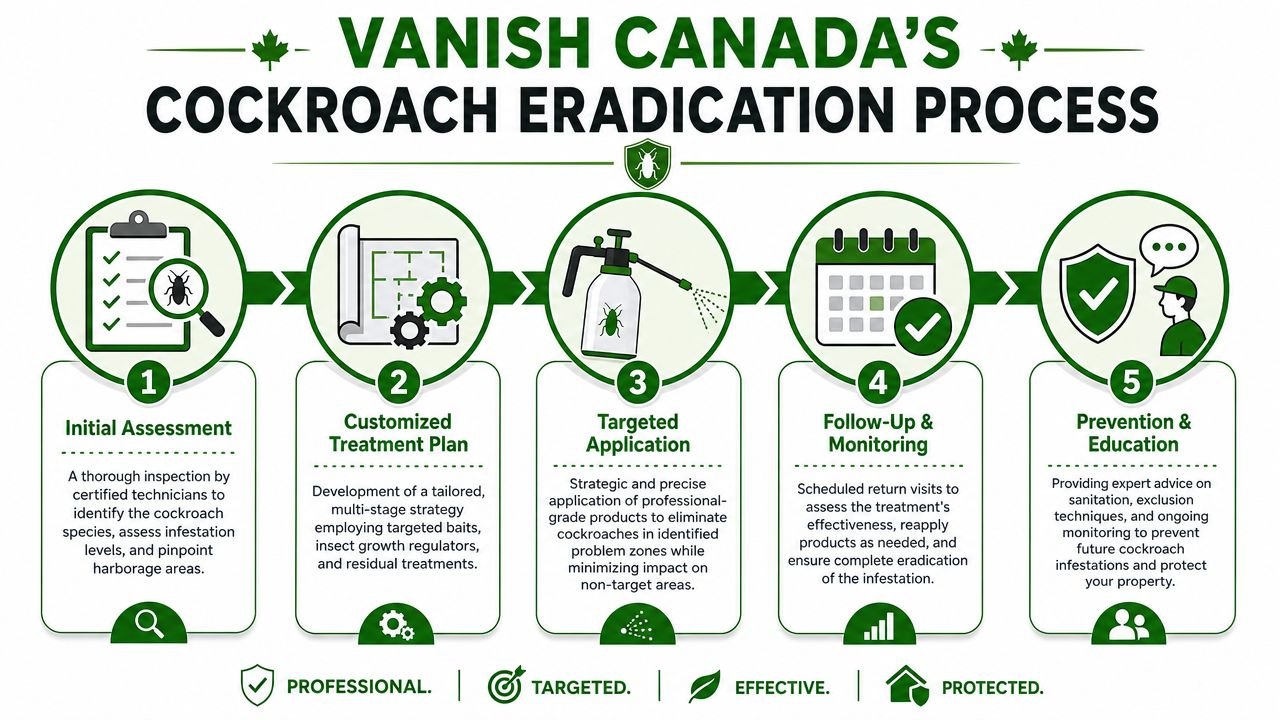
A technician usually starts by confirming the activity pattern. Which rooms show signs. Which species is most likely involved. Whether the issue appears isolated or connected to shared walls, drains, or service penetrations.
After that, the work typically includes several layers:
- Targeted bait placement: Baits are placed where cockroaches forage and harbour, not where residents merely want visible reassurance.
- Dust or crack-and-crevice treatment: Applied in voids, gaps, and concealed pathways that support movement.
- Exclusion work: Gaps around plumbing, cabinetry, and utility lines are identified for sealing.
- Sanitation guidance: Residents need practical corrections, especially around crumbs, grease film, pet food, recycling, and water sources.
- Monitoring and follow-up: Activity is checked after the first visit because hidden insects and egg-related cycles can keep producing sightings for a period after treatment begins.
A professional provider may also help the client understand the likely cost factors before work starts. Infestation severity, property size, room count, access to harbourage, and whether a detached home or multi-unit setting is involved all affect the plan. Readers comparing service options can review common pricing factors for roach treatment costs in Toronto.
Vanish Pest Control Inc. provides cockroach treatment in Toronto using inspection-led service plans that combine targeted applications with prevention guidance. That approach reflects what technicians already know from field conditions. The chemical step only works well when the environment is made less hospitable at the same time.
What clients should expect after treatment
Some sightings may continue briefly after the first service. That doesn't always mean the treatment failed. Disturbed insects often emerge from harbourage as they contact baited or treated zones.
A more useful measure is whether activity becomes more limited, more predictable, and increasingly tied to known hotspots that can be addressed on follow-up. Good service should leave the client with a clear list of what to clean, what to seal, what to monitor, and when to call back if activity changes.
Long-Term Prevention for a Roach-Free Toronto Home
A lot of people still assume one strong treatment should permanently solve cockroaches. In many Toronto properties, that assumption is exactly what keeps the problem coming back.
Why repeat infestations usually point to a building issue
When cockroaches return after treatment, the next question shouldn't be which spray to try next. It should be what condition in the building is still supporting them.
A major blind spot in Toronto is the role of moisture and infrastructure. Oriental cockroaches are often tied to damp basements, drains, and sewer lines, which means prevention may require exterior sealing, drainage correction, and moisture control, not just indoor treatment.
That matters in older houses, basement apartments, condo utility areas, and commercial spaces with persistent dampness. If thresholds leak air, drain covers fit poorly, pipe penetrations stay open, or humidity remains high, treatment can become a cycle instead of a solution.
The recurring infestation is often the symptom. The building condition is the cause.
The prevention habits that matter most
Long-term control is less dramatic than spraying, but it is what keeps the property stable.
- Seal food properly: Dry goods, snacks, pet food, and pantry items should stay in closed containers, not in soft packaging that attracts foraging.
- Manage moisture aggressively: Fix leaks, dry sink cabinets, improve airflow in bathrooms, and watch basement humidity.
- Reduce hidden shelter: Clutter under sinks and in utility closets gives cockroaches protected harbourage close to water.
- Seal access points: Caulk small gaps around pipes, backsplashes, baseboards, and cabinet penetrations.
- Rework problem storage areas: In kitchens, better organisation can make inspection and cleaning easier. For example, ideas for efficient under-sink kitchen storage can help residents reduce clutter and expose the dark, damp voids cockroaches prefer.
For homeowners who want a focused prevention checklist, this practical guide on how to protect a home from a cockroach infestation is a useful next step.
A roach-free Toronto home usually comes from consistent pressure on the basics: less water, less access, less shelter, and faster response when the first sign appears.
Frequently Asked Questions on Toronto Cockroach Control
Does one cockroach mean there are more?
Not always, but it often means a closer inspection is justified. Cockroaches are good at staying hidden, so a visible insect in a kitchen or bathroom can be the first sign of a larger harbourage nearby.
What should a landlord do after a tenant reports cockroaches?
Treat it as a building issue, not just a unit issue. The response should include inspection, treatment where needed, and correction of conditions such as leaks, openings around pipes, and sanitation failures in common or shared areas.
Are restaurant owners in Toronto expected to watch for specific signs?
Yes. Inspection signs commonly include live or dead roaches, pepper-like feces, and egg cases, especially in food handling and storage areas.
Are there any non-chemical steps families can take right away?
Yes. Health Canada advises keeping food in sealed containers, vacuuming often, and freezing infested items for at least 24 hours at -8°C to help kill cockroaches and egg cases (Health Canada cockroach prevention guidance for households).
Are treatments safe around children and pets?
The right answer depends on the product used, where it is applied, and whether the client follows preparation and re-entry instructions. A licensed technician should explain exactly what is being used, where it is going, and what precautions apply in that home.
If cockroaches have shown up in a Toronto home, condo, restaurant, or rental property, a fast inspection matters. Vanish Pest Control Inc. handles cockroach problems across Toronto with treatment plans built around inspection, targeted applications, exclusion, and practical prevention. The fastest way to stop repeat activity is to address both the insects and the building conditions that are helping them stay.




