

Ontario health requirements put pest control in the same category as food safety, sanitation, and recordkeeping. For Woodstock restaurant owners, that means a pest issue is not just an inconvenience. It can affect inspection results, trigger enforcement action, and damage customer trust fast.
I have seen operators do many things right and still get caught by the same hard truth. A kitchen can look clean during service and still support pests if grease is building up under equipment, drains stay wet, deliveries bring in hitchhikers, or gaps around doors and pipes are left open. In Woodstock, older buildings, mixed-use downtown properties, seasonal humidity, and constant product movement make those risks more common than many owners expect.
Good restaurant pest control is a prevention system, not a last-minute spray call. It has to match Ontario’s legal requirements under O. Reg. 493/17, hold up during inspections, and make financial sense for a local operator watching labour, food costs, and maintenance budgets at the same time.
The trade-off is simple. Spending steadily on sanitation discipline, exclusion repairs, monitoring, and professional service costs less than failed inspections, spoiled stock, emergency closures, or one customer photo posted online.
Table of Contents
- The High Stakes of Pest Control for Woodstock Restaurants
- Know Your Enemy Common Pests in Woodstock Kitchens
- Building Your Defense A Restaurant Sanitation Checklist
- Fortifying Your Restaurant Structural Exclusion and Monitoring
- Choosing and Working With a Professional Pest Control Partner
- Understanding Ontario’s Health Codes and Your Legal Duties
- Frequently Asked Questions From Woodstock Restaurant Owners
The High Stakes of Pest Control for Woodstock Restaurants
Across Ontario, over 85,000 food service establishments compete in a market where compliance matters every day, and non-compliance with pest control mandates led to over 1,200 restaurant closures or suspensions between 2020 and 2024, with fines averaging $5,000 to $50,000, according to Ontario restaurant pest control market data. Woodstock restaurant owners don’t need a large infestation for the consequences to become serious. A small problem caught late can still trigger inspection trouble, product loss, schedule disruption, and reputational damage.
That pressure hits independent operators hardest. A family-run restaurant, café, bakery, pub, or quick-service kitchen usually doesn’t have extra management time to chase recurring pest issues. Staff are already handling deliveries, prep, service, inventory, cleanup, and hiring. When pests get added to that list, corners often get cut without anyone intending it.
Why reactive pest control fails
Reactive pest control sounds cheaper because it delays spending. In practice, it often costs more. Waiting until someone sees a cockroach, mouse, or fly problem means the conditions supporting that activity have usually been present for a while.
A spray-only mindset also misses the main reasons pests stay active in restaurants:
- Food access stays open: Grease film, crumbs under equipment, residue in drains, and spill buildup keep feeding insects and rodents.
- Water is available: Condensation, mop sinks, leaking fittings, and wet floor-wall junctions support breeding and harborage.
- Entry points remain open: Back doors, utility gaps, damaged sweeps, dock edges, and pipe penetrations let pests re-enter after treatment.
- No one is tracking patterns: Without logs and monitoring, staff notice pests only after activity becomes obvious.
Practical rule: Restaurants don’t beat pest pressure with occasional treatment. They beat it by removing food, water, shelter, and access at the same time.
What a restaurant owner is really protecting
In Woodstock, pest control for restaurants isn’t just about avoiding embarrassment. It protects four things that directly affect whether the business stays stable.
First, it protects inspection performance. Second, it protects guest confidence, especially in dining areas and washrooms where customers judge cleanliness quickly. Third, it protects inventory and equipment, because pests contaminate food, packaging, and hidden service spaces. Fourth, it protects staff morale. Teams work better when they know the kitchen is under control.
The professional standard is Integrated Pest Management, or IPM. That means prevention first, monitoring second, targeted treatment third, and documentation throughout. It’s more disciplined than emergency service, but that’s exactly why it works better for busy Woodstock restaurants.
Know Your Enemy Common Pests in Woodstock Kitchens
A restaurant can have a polished dining room and still carry serious pest pressure in the kitchen. In Woodstock, I see the same pattern repeatedly. Older wall penetrations, damp service areas, shared commercial units, and frequent door traffic create different risk points depending on the pest. Correct identification matters because the fix for cockroaches is not the fix for rats, and the fix for flies often starts in drains, not in the air.

Under Ontario rules, operators are expected to keep the premises free of conditions that lead to infestation. That matters in a real, day-to-day way. If staff misread the pest, they usually waste money on the wrong correction, lose time before an inspection, and let the population spread into harder-to-reach areas.
German cockroaches
German cockroaches are the pest I take most seriously in restaurant kitchens because they build undetected and spread fast. They stay close to heat, moisture, and tight harbourage. In Woodstock kitchens, that usually means the compressor area under coolers, hinge channels, sink cabinets, wall voids, coffee stations, dishwasher components, and the gap behind hot line equipment.
Their biology is the problem. One female can produce large numbers of young over her lifetime, so a small, missed pocket can turn into a building-wide issue if cleaning and treatment are delayed. By the time staff spot one crossing a prep surface in daylight, the infestation is often well established behind equipment.
Watch for these indicators:
- Pepper-like droppings: Small dark marks around seams, shelf lips, hinges, and corners
- Egg cases and shed skins: Common in cracks near motors, plumbing, and warm cabinets
- A stale, oily odour: Heavier infestations often have a noticeable smell in enclosed spaces
- Sticky activity around electronics or heat sources: Control panels, warmers, and small appliances are common harbourage
If I were advising a new Woodstock owner, I would say this plainly. A single cockroach sighting in a food prep area deserves an immediate inspection, not a wait-and-see approach.
Mice and rats
Rodents create a different operational problem. They contaminate ingredients, damage packaging, foul storage areas, and can trigger sharp questions from inspectors because the evidence is hard to explain away. In Woodstock, I pay close attention to rear exits, receiving doors, utility penetrations, patio-adjacent walls, and waste storage zones. Older brick buildings and multi-unit commercial plazas tend to make exclusion work more difficult, which raises the long-term cost if problems are left alone.
Staff often look only for droppings. That is too narrow. Mice and rats also show up through gnawing, greasy rub marks, scratching in wall voids, shredded nesting material, disturbed stock, and repeated activity along wall-floor junctions.
The signs usually look like this:
- Droppings along edges and behind stored goods: Rodents prefer protected travel routes
- Chewed packaging or entry points: Dry goods, soft plastic, and low wall gaps are frequent targets
- Rub marks on repeated routes: Grease staining points to established movement
- Nesting material in cluttered areas: Storage rooms, voids, and seldom-opened cabinets are common sites
The trade-off is simple. Early rodent work usually means sealing, monitoring, and minor corrections. Delayed rodent work often means product loss, staff disruption, and more invasive service.
Flies and drain-breeding pests
Flies hurt guest confidence faster than almost any other pest because customers see them immediately. In the kitchen, they also tell you where your process is breaking down. Fruit flies point to fermenting residue. Drain flies point to organic film in drains, floor sinks, and wet plumbing voids. House flies usually trace back to door management, bins, or exterior waste conditions.
A fly issue in a restaurant is usually a cleaning and moisture issue first.
That is why surface wiping alone does not solve recurring activity around bars, prep sinks, dish areas, or floor drains. The breeding material has to be removed from the place where larvae are developing. For many operators, that means tightening drain cleaning routines, checking hidden moisture sources, and retraining closing staff on residue removal. Reviewing commercial kitchen cleaning best practices can help owners connect fly activity to overlooked cleaning failures.
For Woodstock operators dealing with repeat sightings near drains, beverage stations, or garbage areas, targeted professional fly control in Woodstock for restaurant drain and sanitation issues helps locate the breeding source instead of only knocking down adult flies.
Stored-product pests
This group gets missed in restaurants because owners are focused on the kitchen line, not the dry shelf. Beetles and pantry moths move into flour, grains, spices, cereal products, nuts, and opened bulk goods. I see this more often where deliveries are stacked quickly, stock rotation is loose, or damaged bags sit too long in storage.
The warning signs are subtle at first. Webbing in corners of packaged goods, small beetles on shelving, larvae in seams, or fine product dust collecting below torn bags all point to a stock problem that sanitation alone will not fix. The right response usually includes disposal of affected product, inspection of nearby inventory, and tighter receiving checks so the problem does not keep coming in with new shipments.
Building Your Defense A Restaurant Sanitation Checklist
A restaurant doesn’t have to be visibly dirty to support pests. In most kitchens, pest activity builds in the places staff touch least often. The base under the dishwasher. The void behind a reach-in cooler. The drain lip that gets rinsed but not scrubbed. The underside of a shelf bracket where grease mist settles.
Ontario guidance notes that a core tenet of Integrated Pest Management is prevention, and that sealing cracks, elevating food at least 6 inches off the floor, and maintaining strict sanitation can reduce cockroach harborage by as much as 80%, according to food industry pest control procedures. For Woodstock restaurants, that means the sanitation program has to do more than satisfy closing duties. It has to remove the conditions pests rely on.
The sanitation failures pests exploit first
The highest-risk sanitation misses usually have one thing in common. They happen in hidden zones that no one owns clearly.
These are the trouble spots that deserve strict attention:
- Under and behind equipment: Fryers, ranges, coolers, and prep tables collect grease, crumbs, and standing moisture.
- Drains and floor-wall junctions: Organic film builds steadily and supports flies and cockroaches.
- Dry storage shelving: Torn bags, loose product dust, and poor stock rotation invite stored-food activity and rodent feeding.
- Waste staging areas: Interior and exterior bins become attraction points when lids, liners, and cleaning routines slip.
- Employee break and locker spaces: Open snacks, spills, and clutter can undermine an otherwise clean kitchen.
Daily and weekly sanitation priorities
The easiest way to make sanitation work is to separate it into daily and weekly tasks. Daily work keeps pests from feeding. Weekly work removes what daily cleanup misses.
| Task | Frequency | Why It Matters |
|---|---|---|
| Wipe food contact and splash surfaces fully, not just visible spill points | Daily | Removes residue that attracts insects overnight |
| Pull movable equipment and clean beneath it | Daily | Stops grease and crumbs from building in warm harbourage zones |
| Scrub floor drains and nearby floor edges | Daily | Disrupts organic buildup linked to fly and cockroach activity |
| Empty indoor waste before close and clean bin rims | Daily | Reduces odours and accessible food sources |
| Store all food off the floor and keep lids closed | Daily | Limits pest access and supports inspection readiness |
| Check incoming deliveries for damaged packaging | Daily | Prevents pests from being carried into storage |
| Deep clean behind fixed equipment where possible | Weekly | Targets hidden residue staff don’t see during line cleanup |
| Wash and sanitise shelving in dry storage and walk-ins | Weekly | Removes product dust, spills, and harbourage debris |
| Clean exterior bin pads and surrounding ground area | Weekly | Reduces rodent and fly attraction outside the building |
| Review sighting logs with supervisors | Weekly | Turns staff observations into action before patterns grow |
Restaurant managers who want a broader operations resource can also review these commercial kitchen cleaning best practices, especially for assigning cleaning responsibilities by zone instead of relying on vague end-of-shift expectations.
Staff habits that make the checklist stick
A checklist only works if it fits the pace of service. Long forms get ignored. Vague tasks get initialled without being done. The strongest systems assign areas to roles, not to “everyone.”
A practical sanitation routine usually includes:
- Opening checks: Look for overnight pest evidence, drain odours, and delivery-area issues before prep begins.
- Mid-shift resets: Clean spill zones and waste areas before residue bakes on or gets tracked.
- Closing verification: Require a visual check of drain covers, food elevation, bin status, and equipment-line cleanup.
- Manager review: One supervisor should confirm high-risk zones instead of relying only on staff sign-off.
Clean-looking isn’t the same as pest-resistant. Pest-resistant means hidden food, hidden moisture, and hidden harbourage are being removed on schedule.
For Woodstock kitchens, sanitation is the part of pest control for restaurants that staff control most directly. It’s also the part that prevents the greatest number of recurring problems before treatment is ever needed.
Fortifying Your Restaurant Structural Exclusion and Monitoring
Sanitation cuts off food and moisture. Exclusion cuts off access. Both matter, but exclusion often gets neglected because the building defects feel small. A thin gap under a rear door. A missing escutcheon plate around a pipe. A damaged screen on a vent. Those details matter because pests don’t need a dramatic opening.
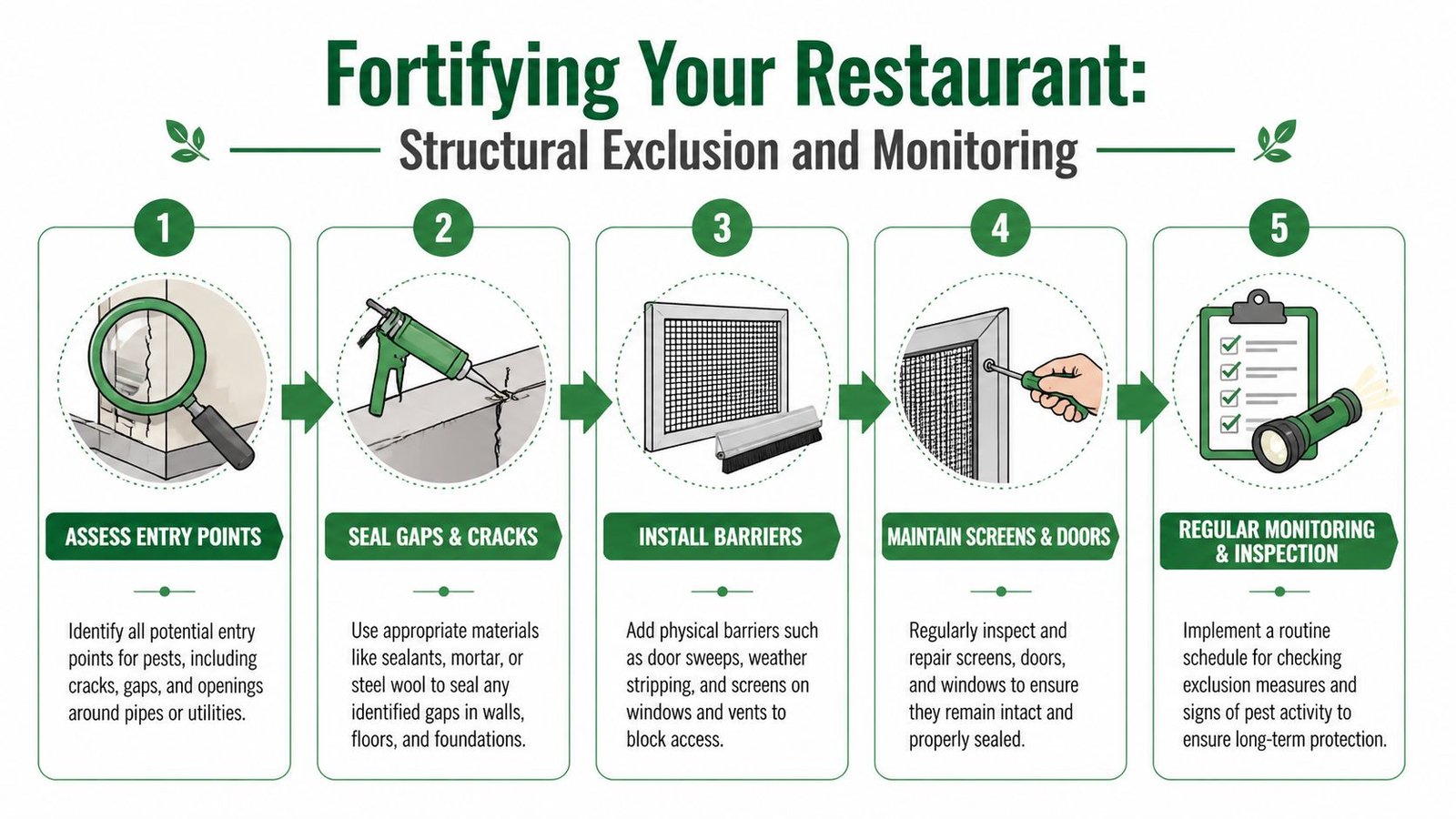
A Zero-Tolerance Exclusion Strategy can yield over a 95% pest elimination rate within six weeks, and 72% of restaurant pest infractions are linked to unsealed utility penetrations and other structural gaps, according to restaurant exclusion strategy data. That’s especially relevant for Woodstock restaurants operating in older units, retrofitted storefronts, or service spaces with repeated plumbing and electrical modifications.
Where Woodstock restaurants usually lose the battle
The most common structural weak points are easy to miss because they sit below eye level or behind equipment. A proper walk-through should focus on how pests travel.
Priority inspection points include:
- Back doors and receiving doors: Check the sweep, threshold contact, side gaps, and whether light is visible from inside.
- Utility penetrations: Pipes, conduit, gas lines, and refrigeration lines often leave irregular openings into wall voids.
- Floor drains and sink cabinets: These zones combine moisture with concealment.
- Wall-floor joints and damaged tile edges: Cracks and broken transitions create harbourage for insects.
- Vents and screens: Torn mesh and loose covers allow entry from rooflines and rear service areas.
Restaurants often discover that good exclusion has side benefits too. Tightening door edges and seals can help with comfort and energy efficiency, which is why many operators also look at practical guidance on reducing energy costs with door seals when reviewing receiving doors and rear access points.
How monitoring turns guesswork into action
Exclusion keeps pests out. Monitoring shows whether they’re already in, where they’re moving, and whether a fix is holding. Without monitors, managers often rely on random sightings, which usually happen too late and in the wrong places.
A smart monitoring layout in a restaurant usually includes:
- Glue boards in hidden interior zones such as under sinks, behind equipment, near compressor motors, and inside cabinet voids.
- Mechanical rodent devices in non-food-contact areas along walls, in utility spaces, and near likely travel lanes.
- Regular map reviews so recurring captures point to a missed gap, leak, or sanitation problem.
- Staff reporting logs for any live sighting, odour change, or unusual droppings.
- Immediate correction work after a pattern shows up, not at the next convenient maintenance date.
Monitoring works best when every device has a purpose. A trap placed only to satisfy a checklist doesn’t tell management much. A trap placed near a known route or risk area becomes an early-warning tool.
Structural exclusion should be treated like food safety equipment. If a seal fails, the building is no longer performing as intended.
Woodstock restaurants dealing with repeated exterior pressure or rear-lane rodent movement should pair exclusion with a dedicated plan for rat control in commercial settings, especially when activity keeps returning after cleanup.
Choosing and Working With a Professional Pest Control Partner
At some point, every restaurant has to decide whether it wants emergency help or an actual control program. Those aren’t the same thing. Emergency service deals with a visible problem. A real commercial partnership combines inspection, documentation, treatment, prevention advice, and follow-up.

For restaurants in the GTA, the return on investment is clear. A proactive plan with a Royalty Program can offer up to 40% in discounts, yielding 3x the savings compared to the average $10,000 per week revenue loss from an emergency pest-related shutdown. The lesson for Woodstock owners is straightforward. Consistent prevention usually costs less than crisis response.
What good service actually looks like
A restaurant owner should expect more than a quick treatment and a generic invoice. A quality service relationship should give the business usable records and specific operational direction.
Strong commercial pest service usually includes:
- A clear inspection scope: The technician should inspect kitchens, storage, washrooms, receiving zones, waste areas, and exterior entry points.
- Written findings: Reports should identify activity, likely causes, and required corrections.
- Targeted treatment choices: Baits, monitoring tools, and focused applications usually make more sense in food environments than broad, indiscriminate treatment.
- Trend tracking: Repeated findings in one zone should trigger structural or sanitation recommendations.
- Inspection-ready documentation: Service reports, site maps, and recommendations should be easy to show during a health review.
A useful commercial program should also fit the operation. A high-volume restaurant with frequent deliveries and extended hours won’t have the same needs as a small café with limited cooking and tighter storage control.
How to prepare for service visits
Restaurant managers get better results when they prepare the site properly. Treatment in a cluttered or poorly organised kitchen is less precise and harder to evaluate later.
Before a scheduled visit, staff should:
- Pull accessible items from under sinks and prep stations so hidden areas can be inspected.
- Flag any recent sightings with time, location, and what was seen.
- Make sure sanitation has been completed thoroughly, not cosmetically.
- Set aside previous reports so unresolved issues can be reviewed.
- Tell the technician about building changes such as renovations, plumbing work, new equipment, or delivery pattern changes.
A restaurant that wants support built around inspections, documentation, and ongoing asset protection can review commercial pest control services for Woodstock businesses.
The best pest control partner doesn’t just treat activity. They help the restaurant management team make better operational decisions.
Understanding Ontario’s Health Codes and Your Legal Duties
Ontario does not treat pest control in a food premise as a housekeeping preference. Under O. Reg. 493/17, the owner and operator are responsible for keeping the premises sanitary and free of conditions that can contaminate food or create a health hazard. For a restaurant in Woodstock, that matters for two reasons. You have to satisfy the law, and you have to protect a reputation that can be damaged faster than the issue itself is fixed.
I tell new operators the same thing. Inspectors do not grade effort. They assess conditions, risk, and whether management has acted in a way that shows the problem is under control.
What the law looks like on the floor
Legal compliance shows up in daily habits, maintenance decisions, and records. If an inspector finds evidence of pest activity, the question is not only whether you called for service. The question is whether you identified the cause, corrected it, and kept proof.
That usually means keeping:
- Service reports from qualified pest control visits
- Sighting logs with dates, locations, and what staff observed
- Corrective action records for cleaning, repairs, product rotation, and sealing work
- Monitoring records that show follow-up, not a one-time response
In practical terms, a missing binder or scattered emails can make a contained issue look unmanaged. That is a hard position to defend during an inspection.
What inspectors in Ontario will look for
Inspectors are not waiting to see a mouse run across the floor. They look for the evidence and the conditions behind it. In restaurants, that often includes droppings, rub marks, gnawing, insect activity around drains or storage, damaged food packaging, grease buildup, standing water, and gaps around pipes or doors.
Woodstock operators can get caught due to several factors. Older buildings, shared walls, seasonal moisture, and frequent deliveries create real pressure points. A clean dining room does not offset a cluttered dry-storage area or a leaking mop sink in the back. Under Ontario rules, both the visible problem and the contributing condition matter.
Your legal duty is ongoing, not occasional
One treatment does not satisfy your duty if the underlying conditions stay in place. If activity returns because staff were not reporting sightings, a door sweep was never replaced, or food debris kept collecting under a line, the record will show a pattern instead of control.
That is also where cost decisions become business decisions. Spending on door sweeps, drain maintenance, storage changes, and scheduled service usually costs less than lost product, emergency callouts, failed inspections, or a public complaint that reaches local review pages. In a city like Woodstock, word travels quickly.
If you remember one point, make it this. The legal standard is not “do something after pests appear.” The standard is to run the restaurant in a way that prevents pest conditions, catches problems early, and proves you responded properly when risk showed up.
Frequently Asked Questions From Woodstock Restaurant Owners
Woodstock operators often ask the same practical questions once they realise pest control has to be built into daily operations, not handled only when something goes wrong.
| Question | Answer |
|---|---|
| How often should a restaurant schedule professional pest control? | The right frequency depends on the kitchen layout, service volume, building condition, surrounding environment, and pest history. Restaurants usually need a recurring service plan rather than occasional call-outs, because monitoring and follow-up are what keep small issues from becoming visible problems. |
| Can staff handle pest problems with store-bought products? | Staff should focus on sanitation, reporting, and prevention. In a food premise, treatment decisions need to be handled carefully to avoid contamination risks and compliance issues. DIY treatment also tends to scatter pests or mask the source without fixing it. |
| What if pests are coming from a neighbouring unit? | Shared walls, common service corridors, and adjacent food businesses can all contribute to recurring activity. The restaurant still needs to protect its own unit through sealing, monitoring, sanitation, and documentation. Waiting for the neighbour to act usually prolongs the problem. |
| What should be kept in a pest control binder? | Keep service reports, sighting logs, corrective action notes, monitoring records, and any repair notes related to exclusion or sanitation. The goal is to show that the restaurant has an active management process, not just occasional treatment. |
| Are flies less serious than rodents or cockroaches? | No. Flies may look less alarming than rodents, but they often signal moisture and sanitation failures that inspectors take seriously. Any recurring fly activity deserves prompt investigation, especially around drains, waste zones, and beverage areas. |
| What’s the first sign a restaurant’s pest program isn’t working? | Repeated sightings in the same area, recurring droppings, traps showing ongoing activity, or repeated staff complaints after service visits all suggest the program is missing a root cause. Usually that means sanitation, exclusion, monitoring, or communication is breaking down. |
A Woodstock restaurant doesn’t need a perfect building to stay protected. It needs disciplined routines, fast correction of risk points, and professional support when activity appears. For operators who want a practical commercial plan that protects inspections, reputation, and day-to-day operations, Vanish Pest Control Inc. can help build a restaurant-specific pest management program.
Powered by Outrank tool




