

A Mississauga homeowner usually doesn’t start by searching for raccoon removal mississauga out of curiosity. It starts with a thump over the bedroom ceiling, scratching above the bathroom, or a low growl from the attic at night. Then comes the second worry. If something got in, what has it already damaged?
That concern is justified. Raccoons don’t just visit. Once they find a warm, sheltered void in a roofline, attic, chimney, or under a deck, they test the home for weak points and turn a small opening into a repeat access route. The removal is only part of the job. The bigger issue is making the property safe again, sealed again, and clean again.
Table of Contents
- That Noise in the Attic A Common Mississauga Problem
- Identifying Raccoon Infestations and Understanding the Risks
- Raccoon Removal and Mississauga Bylaws What You Must Know
- The Vanish Pest Control Humane Removal and Exclusion Method
- Estimating Costs and Timelines for Raccoon Services
- Permanent Prevention Raccoon-Proofing Your Mississauga Home
- Why Choose Vanish for Mississauga Raccoon Removal FAQ
That Noise in the Attic A Common Mississauga Problem
It usually happens in the quietest part of the night. A family in one of Mississauga’s residential neighbourhoods hears shuffling overhead, then a hard bump that sounds too heavy to be mice. By morning, there’s insulation near the attic hatch or debris below a soffit line. The first instinct is often denial. The second is panic.
That reaction makes sense because attic wildlife feels personal. The intrusion is inside the structure, close to where people sleep, and most homeowners know they can’t just ignore it and hope it leaves on its own. Raccoons are strong, persistent, and comfortable around people in urban areas.
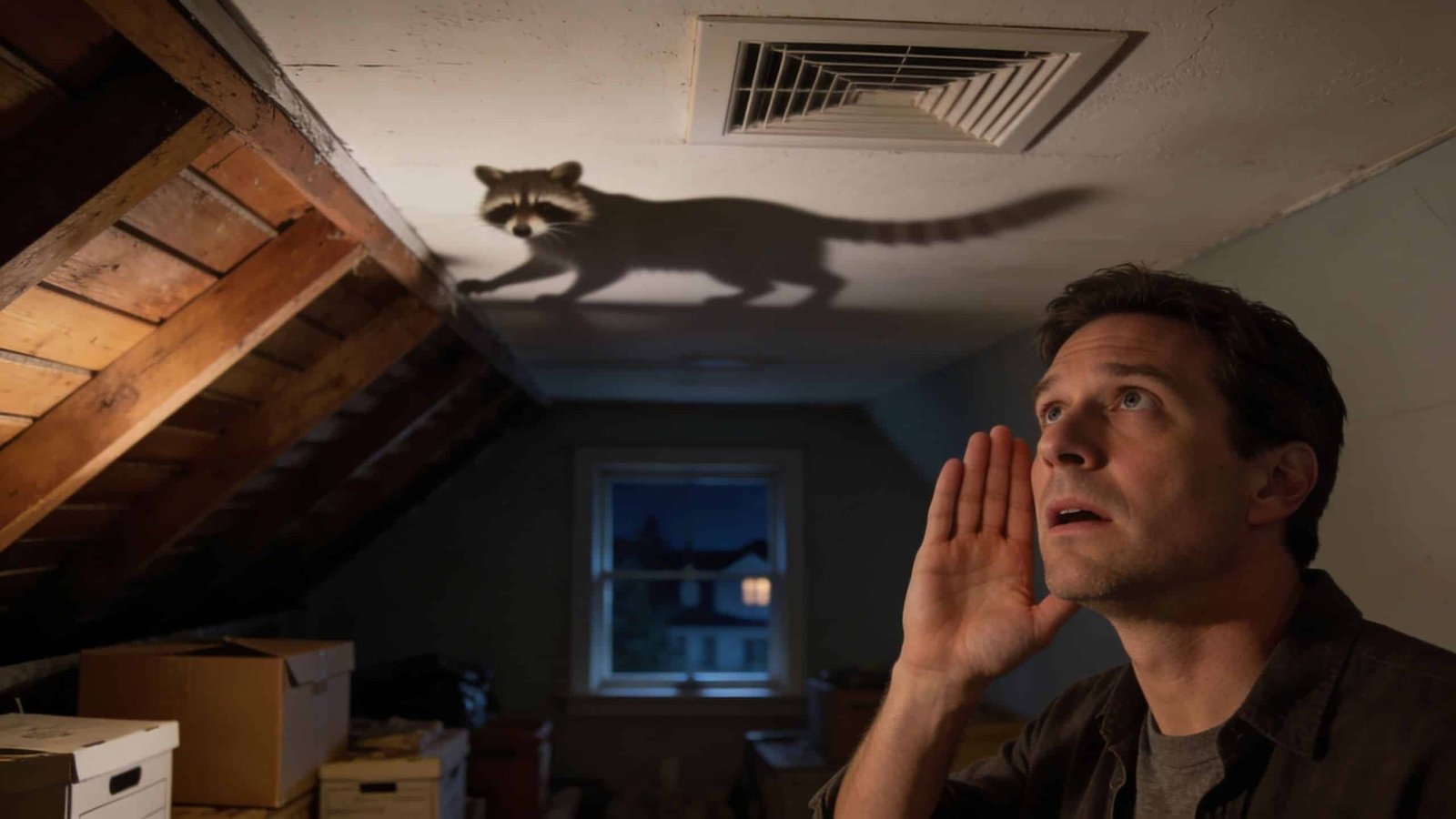
Mississauga deals with this regularly. Local reporting on City information notes that Mississauga Animal Services received 644 raccoon-related calls in the previous year on private and public property. That matters because it confirms what many residents already suspect. This isn’t an unusual one-off problem. It’s a recurring city-wide issue in neighbourhoods with mature trees, accessible roofs, garages, sheds, and easy food sources.
Why Mississauga homes are frequent targets
Raccoons do well where people leave opportunity. Green bins, garbage set out too early, uncapped chimneys, loose soffits, aging roof vents, and quiet attic cavities all make a property more attractive. Spring and fall tend to bring the most urgent calls because denning and foraging pressures increase around those times.
For homeowners, the important point isn’t just that a raccoon got in. It’s that the home has already shown a vulnerability.
A raccoon problem is rarely just an animal problem. It’s usually a building access problem that now needs removal, repair, and proofing.
What residents need right away
A lecture isn’t needed when activity is heard overhead. A calm, workable path forward is what’s required:
- Confirm the animal type: Heavy nighttime movement, vocal sounds, and visible roofline disturbance often point to raccoons rather than smaller attic pests.
- Avoid sealing too soon: Closing an opening before the animal has fully exited can trap wildlife inside and create far worse damage.
- Treat the whole structure as part of the job: Entry points, contamination, and damaged materials all need attention, not just the animal itself.
A proper response turns a stressful night into a controlled repair process. That’s the difference between temporary relief and a home that stays secure.
Identifying Raccoon Infestations and Understanding the Risks
A raccoon infestation leaves clues long before the animal is seen. The problem is that many Mississauga residents misread those clues at first, especially when the noise comes and goes. By the time the attic smell becomes obvious or the drywall stains appear, the cleanup usually involves more than removal.
What raccoon activity looks and sounds like
Raccoons are larger and heavier than the pests homeowners typically imagine first. Their presence often has a distinct pattern:
- Night noise: Scratching, dragging, thumping, and steady movement after dark.
- Entry damage: Bent roof vents, torn soffits, disturbed shingles, or widened gaps near roof edges.
- Attic evidence: Compressed or scattered insulation, nesting material, droppings, and musky odours.
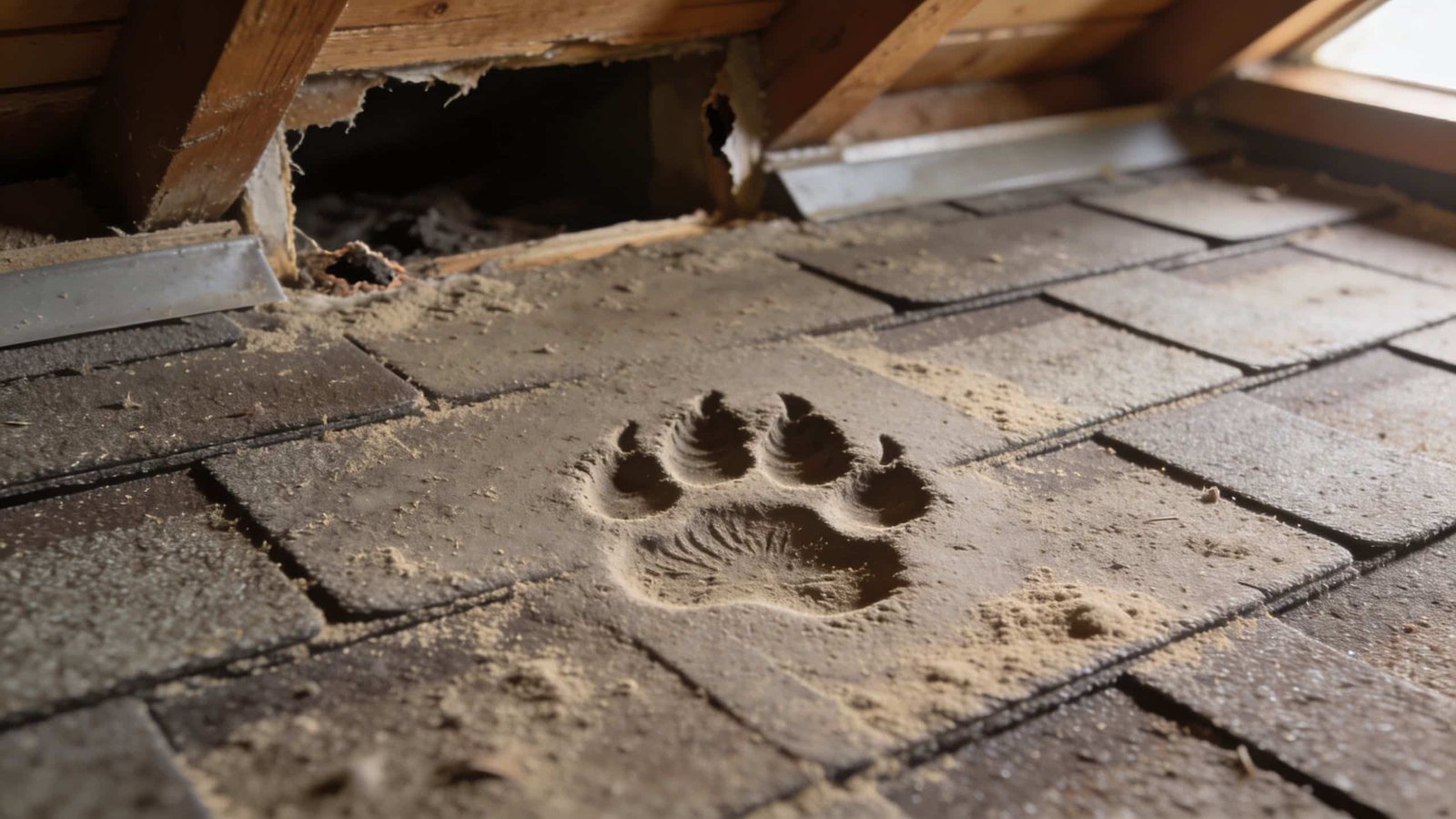
- Outdoor signs: Tracks in dust or soft ground, tipped bins, and staining near recurring travel routes.
When droppings are present, identifying them properly matters for both cleanup and next steps. This guide on how to identify raccoon scat in a GTA home helps residents distinguish raccoon waste from signs left by smaller attic invaders.
For homeowners also thinking beyond removal, attic hardening matters. Work such as sealing weak access points and upgrading vulnerable spaces pairs well with broader advice on preventing attic pests so the same access route doesn’t keep attracting new wildlife.
Why the damage often goes beyond the animal itself
The hidden cost of raccoons is usually in what they disturb. A Mississauga pest article discussing infestations points out that the financial fallout is often underestimated, especially once shredded attic insulation, damaged ductwork, or chewed electrical wiring are involved. That’s exactly where many homeowners get surprised. The animal is removed, but the structure still isn’t restored.
There are two major categories of risk.
First is structural damage. Raccoons pull, rip, claw, compress, and soil materials as they build access and denning space. Insulation loses usefulness once it’s flattened or contaminated. Venting and air pathways can be disrupted. Roofline openings often get worse with each entry and exit.
Second is sanitation and health risk. Feces and urine in enclosed spaces create a serious cleanup issue. Contaminated attic areas can’t be treated like ordinary dirt. Waste around insulation, wood framing, or stored items needs controlled handling and proper disposal.
Practical rule: If there’s visible droppings, strong odour, or material pulled apart in the attic, the job isn’t finished when the raccoon leaves.
Mississauga residents frequently request removal services due to disruptive sounds. A vital priority involves stopping the subsequent issues that remain once the noise ceases.
Raccoon Removal and Mississauga Bylaws What You Must Know
A lot of homeowners ask the same question at the start. Can the raccoon just be trapped and dropped off somewhere else? In Mississauga, that’s where legal trouble and bad outcomes often begin.
Why DIY usually creates bigger problems
A raccoon in an attic feels urgent, so people try hardware-store fixes, improvised traps, or rushed sealing. The problem is that wildlife law and humane removal rules don’t leave much room for guesswork. Ontario-related guidance summarized here states that unlicensed individuals can’t trap and relocate a raccoon more than 1 kilometre from the capture site, and body-gripping traps are forbidden in dense urban areas.
That changes the whole DIY equation. A homeowner can easily break the rules while still failing to solve the infestation. Worse, a poorly timed trap or sealed opening can separate a mother from young hidden in an attic, wall void, or soffit pocket.
What the local rules mean for homeowners
The legal limit exists for practical reasons. Moving a healthy raccoon too far can spread problems rather than solve them, and moving it too close often means it returns. That’s why licensed wildlife work focuses on humane exclusion and access denial rather than simple catch-and-dump tactics.
Mississauga residents should also keep bylaw enforcement in mind around feeding wildlife. Leaving food out, intentionally or unintentionally, keeps raccoons comfortable around homes and increases repeat visits.
For condo boards, offices, retail units, and mixed-use buildings, there’s another layer to think about after removal. Shared spaces and common areas may need sanitation or restoration support, which is why some property managers coordinate with professional Mississauga workspace cleaners after wildlife activity has affected service rooms, storage zones, or other interior areas.
Sealing first and asking questions later is one of the most expensive mistakes a homeowner can make.
The safest route is simple. Confirm where the raccoon is denning, make sure no young are present, remove access properly, and then secure the structure in a way that complies with the law and will last.
The Vanish Pest Control Humane Removal and Exclusion Method
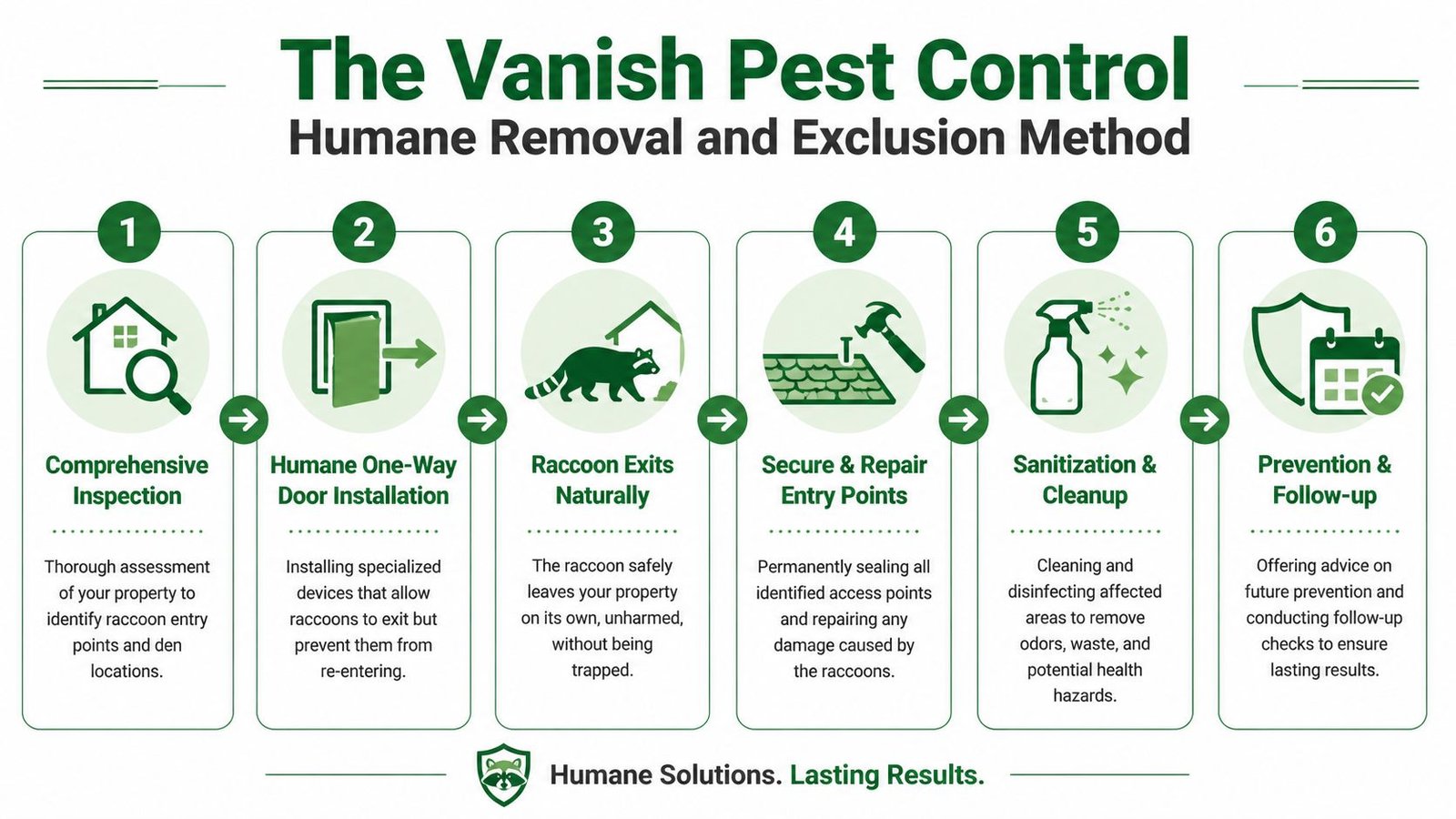
Raccoon removal mississauga should be handled as a sequence, not a single event. The animal has to leave safely. The home has to be checked fully. The entry point has to be secured only when it’s appropriate to do so. The contaminated area then has to be dealt with like a restoration problem, not a quick patch.
Step one starts outside not in the attic
The first stage is a full exterior-led inspection. In Mississauga, that means checking roof intersections, soffits, vents, dormers, chimney lines, deck perimeters, sheds, and any route the animal may be using to climb or pry. Some wildlife providers in the area describe this as a 50-point inspection, which is a useful way to think about the level of detail required when locating every vulnerability.
An inspection should answer four questions:
- Where did the raccoon get in?
- Is there more than one access point?
- Is the animal actively denning or just visiting?
- Is there evidence of babies, contamination, or structural damage nearby?
This is also the point where the full home restoration plan begins. If insulation is disturbed, if odour has spread, or if droppings are present, the removal strategy has to account for cleanup and repair from the start.
Exclusion works when timing is handled properly
Humane exclusion is the preferred method because it gets the animal out without unnecessary harm and reduces the risk of trapping wildlife inside. City guidance for raccoons in Mississauga recommends deterrents such as bright lights and sound for 72 continuous hours, and notes an 85 to 90 percent success rate for voluntary eviction before sealing.
That timing matters. If the raccoon is using the space only because it feels secure, sustained disturbance can push it to move on. Once activity confirms the den is clear, a one-way device can be placed where appropriate so the raccoon exits but can’t re-enter. If young are present, the process changes. The work must be staged to avoid separation and to allow proper reunion.
For readers who want a broader look at the same humane approach across the GTA, this page on professional raccoon removal and wildlife control outlines how exclusion, proofing, and follow-up fit together.
The right time to seal an opening is after the animal has left, not when the homeowner is most frustrated.
Removal is only complete after repair and cleanup
Many jobs fall short at this stage. Once the raccoon is out, the access route has to be reinforced with materials that stand up to prying and clawing. Loose vent covers, weak soffits, and easy roofline gaps need stronger protection than they had before.
Then the inside has to be addressed. A complete service may include:
- Contaminated insulation removal: Material that’s soiled or flattened often needs to come out.
- Waste cleanup: Droppings and urine-affected debris require controlled handling.
- Odour reduction: Scent left behind can attract new wildlife or keep the area smelling unsafe.
- Damage repair: Torn screening, damaged venting, and minor structural openings need closure.
- Final proofing: Every known vulnerability identified during inspection should be secured.
Vanish Pest Control Inc. handles wildlife work as a combined removal, exclusion, and proofing service, which fits the way raccoon problems unfold in Mississauga homes. The animal is the first problem. The opening it used is the second. The contamination and restoration work are the third.
That order matters because a quiet attic isn’t necessarily a safe attic. A proper finish means the home is not only raccoon-free, but also sealed and reset for the next season.
Estimating Costs and Timelines for Raccoon Services
Homeowners usually ask about price after the first shock wears off. That’s reasonable, but raccoon work doesn’t have one flat answer because the scope changes fast from house to house. A raccoon under a shed is a different job from a mother in an attic with contaminated insulation and multiple roofline breaches.
What changes the scope of work
The service cost usually depends on how much of the property is involved and what condition the structure is in after the animal leaves. Removal is one line item. Restoration is often another.
| Service Component | Description | Cost Impact |
|---|---|---|
| Inspection and assessment | Confirms entry points, den location, and whether young or contamination are present | Higher when access is difficult or multiple areas must be checked |
| Humane exclusion | Uses the correct timing and devices to let raccoons exit and stay out | Increases when there are several active access points |
| Entry point repairs | Seals soffits, vents, roof gaps, or other structural vulnerabilities | Rises with the number and complexity of repairs |
| Attic cleanup and sanitation | Addresses droppings, urine, odour, and affected materials | Higher when waste is widespread or insulation is compromised |
| Insulation or material replacement | Restores affected attic sections after contamination or nesting damage | Depends on how much material needs to be removed and replaced |
| Follow-up and warranty coverage | Rechecks work and supports long-term exclusion | Affects value differently depending on the guarantee offered |
One thing should be said plainly. Publicly available information often discusses removal but doesn’t give reliable average repair pricing after an invasion. That gap leaves many Mississauga homeowners underestimating the total job until the attic is opened and the damage becomes visible.
What a realistic timeline looks like
Some jobs move quickly. Others need staged work, especially when humane eviction has to happen before sealing. The timeline depends on where the raccoon is located, whether babies are involved, weather conditions, and how much repair and sanitation are needed after removal.
A realistic service flow usually includes:
- Initial assessment: Often the same day or as soon as access can be arranged.
- Active removal or exclusion period: This can require observation rather than immediate closure.
- Repair phase: Entry points are secured once the den is confirmed empty.
- Cleanup and restoration: Contaminated areas are addressed after exclusion is complete.
- Final verification: The property is checked again to make sure the access issue is resolved.
Fast service matters, but rushed sealing doesn’t. A slightly longer humane process is usually better than a quick mistake that creates trapped wildlife, odour, or re-entry.
The most useful estimate is one that separates removal from repair and explains what is included in writing. That’s how homeowners compare real value rather than just the first number they hear.
Permanent Prevention Raccoon-Proofing Your Mississauga Home
Once raccoons have used a property successfully, that address becomes easier for them to test again. Prevention isn’t about making a home look perfect. It’s about removing the easy wins that urban wildlife looks for.
Roof and upper structure checks
Most recurring problems start high and stay unnoticed until nighttime noise begins again. On many Mississauga homes, the vulnerable points are roof vents, loose soffits, fascia transitions, chimney openings, and weak intersections where additions meet the original roofline.
Use this checklist:
- Inspect vent covers: Replace damaged or weak covers with sturdier protection that can’t be pushed open easily.
- Check soffits and roof edges: Look for gaps, staining, or lifted sections near corners and overhangs.
- Secure chimneys and similar openings: Open vertical access points should never be left inviting.
- Trim back direct routes: Branches close to the roof give raccoons easier access and reduce the effort required to test the structure.
For a broader look at how upper-entry wildlife behaves, this guide on how raccoons and squirrels invade attics and how to keep them out is useful background for homeowners dealing with repeated roofline activity.
Yard and ground level prevention
Ground-level prevention matters more than many residents think. A raccoon may den above the ceiling, but the attraction often starts in the yard.
Focus on the basics:
- Control garbage access: Use tight-fitting lids and avoid leaving waste out longer than necessary.
- Remove feeding opportunities: Pet food, accessible compost, and deliberate wildlife feeding keep animals returning.
- Protect under-deck and shed zones: These sheltered spaces often become backup den sites.
- Watch for digging or repeated traffic paths: Wear marks near fences, decks, or foundation edges often reveal where wildlife is testing access.
A raccoon-proofed home is usually a series of small corrections, not one dramatic fix. Stronger covers, fewer food cues, cleaner yard habits, and properly sealed openings make the property much less attractive over time.
Why Choose Vanish for Mississauga Raccoon Removal FAQ
Homeowners in Mississauga usually need more than an animal removed. They need someone to identify the breach, handle the situation humanely, restore affected areas, and reduce the chance of another intrusion. That’s why a full-service approach matters more than a quick catch-and-go visit.
A strong wildlife service should include inspection, exclusion, proofing, sanitation planning, and clear communication about what happens if damage is found after the raccoon is gone. It should also stand behind the exclusion work. Wildlife firms in the Mississauga area commonly offer multi-year warranties, including examples of a 2-year guarantee against re-entry, which shows how important lasting sealing and proofing are in this field.
FAQ
Are the raccoons harmed during humane removal
The goal of humane exclusion is to let the animal leave safely and prevent it from getting back inside. The method focuses on eviction and proofing rather than unnecessary harm.
What happens if baby raccoons are found
The process must change immediately. Young can’t be treated the same way as a lone adult. The removal plan has to protect the litter and avoid separation from the mother.
How quickly should a homeowner act
As soon as raccoon activity is suspected. Waiting usually gives the animal more time to settle in, expand damage, and contaminate the area.
Is the job finished once the noise stops
Not always. A silent attic can still contain waste, damaged insulation, odour, or weakened entry points that invite the next intrusion.
If raccoons have moved into a Mississauga attic, roofline, shed, or wall space, Vanish Pest Control Inc. can help arrange humane removal, exclusion, and the repair-focused follow-up that keeps the problem from restarting. The right next step is a proper inspection, because the sooner the access point is identified, the easier it is to restore the home safely.
Generated with Outrank




One Response