

A Toronto business owner usually doesn't start thinking about commercial pest control during a calm afternoon. It starts when a server spots a cockroach near a dining area before the dinner rush, when a warehouse supervisor finds gnaw marks on incoming packaging, or when a property manager gets a tenant email about mice in a shared garbage room. The pest itself is only part of the problem. Damage comes from what follows: customer complaints, staff distraction, inspection pressure, cleanup costs, and the risk that a small issue turns into a reputation problem.
In Toronto, that chain reaction moves fast. Restaurants, offices, mixed-use buildings, warehouses, and multi-unit properties all operate in tight schedules and shared environments. A single untreated access point in a loading dock or utility room can affect far more than one suite. That's why commercial pest control belongs in the same operational category as security, maintenance, and emergency planning. Businesses already prepare for water leaks, fire damage, and mould because downtime is expensive. The same thinking applies to pest risk, especially when continuity planning also includes resources like water, fire, and mold solutions for businesses.

Toronto businesses don't need another generic article about “bugs and rodents.” They need a working guide that treats pest management as operational risk control. For foodservice operators, that means audit-ready records. For property managers, it means proving due diligence across common areas and tenant complaints. For warehouses, it means protecting inventory flow and reducing disruption before pests spread through pallets, drains, dock doors, and wall voids.
Table of Contents
- What Commercial Pest Control Means for Toronto Businesses
- A Guide to Core Commercial Pest Control Services
- Navigating Pest Control Compliance for Toronto Businesses
- Choosing Your Commercial Pest Control Partner in Toronto
- The ROI of Proactive Pest Management Real-World Examples
- Frequently Asked Questions About Commercial Pest Control
- How often should a Toronto business schedule commercial pest control service
- Are commercial pest control treatments safe for staff and customers
- Can service be done after hours or discreetly
- What pests are most common in Toronto commercial buildings
- What should staff do after a pest sighting
- What should a business keep on site for inspections or landlord audits
What Commercial Pest Control Means for Toronto Businesses
Commercial pest control isn't the same as residential service with a bigger invoice. In Toronto, it's an ongoing operational program built around prevention, monitoring, documentation, and targeted response. A business can't rely on a one-time treatment and hope the problem stays solved, especially in buildings with frequent deliveries, waste movement, shared walls, employee kitchens, floor drains, and customer traffic.
The scale of the industry helps explain why. Statista's U.S. pest control industry overview reports that the industry was worth over US$24 billion in 2023 and included over 33,000 businesses. For Toronto operators, the key takeaway isn't the U.S. number itself. It's what that scale says about the service model. Pest control is a mature, recurring business function tied to continuity, not a one-off extermination purchase.
It is a program, not a one-time spray
A commercial site has repeating risk points. The back door opens dozens of times a day. Staff leave food in lockers or breakrooms. Drains hold organic buildup. Deliveries bring in corrugated cardboard, pallets, and packaging. Garbage rooms stay warm. Even very clean businesses can still attract pests because access and shelter matter as much as crumbs.
That changes the job completely. A proper commercial pest control plan should include:
- Scheduled inspections: not just when someone sees activity, but before activity becomes visible to staff or customers.
- Site-specific monitoring: trap placement, bait mapping where appropriate, and regular review of what those devices show over time.
- Corrective actions: sealing, sanitation changes, storage adjustments, and maintenance follow-up.
- Documentation: records that a manager can hand to an inspector, landlord, or head office without scrambling.
Operational rule: If a provider only talks about products and never talks about trend lines, entry points, and documentation, that isn't a commercial program.
Toronto buildings create steady pest pressure
Toronto businesses face layered exposure. A downtown restaurant may share a wall with another food operator. A warehouse in an industrial area may have large dock doors, staff lunchrooms, and long storage aisles. A mixed-use property may deal with restaurant waste at grade level and rodent pressure moving upward through service penetrations.
The common pests vary by use. Foodservice sites often battle cockroaches, flies, rodents, and stored product pests. Property managers deal with mice, rats, cockroaches, ants, wasps around exterior access points, and occasional wildlife around roofs, garages, and waste areas. Warehouses often see rodents, flies near waste or drains, and insects introduced through shipments.
What matters is tolerance. In a Toronto home, one ant trail is annoying. In a Toronto business, one visible pest can trigger customer concern, internal reporting, or inspection questions. Commercial pest control protects more than a building. It protects inventory, workflow, employee confidence, and brand trust.
A Guide to Core Commercial Pest Control Services
A restaurant passes its health inspection in the morning, then staff spot German cockroaches under the prep sink during the dinner rush. A warehouse manager sees fresh rodent droppings along the racking after a new shipment comes in. A condo superintendent gets repeated tenant complaints about flies near the waste room. In each case, the problem is not just pest activity. It is interruption, documentation risk, staff time, and the cost of letting the issue spread.
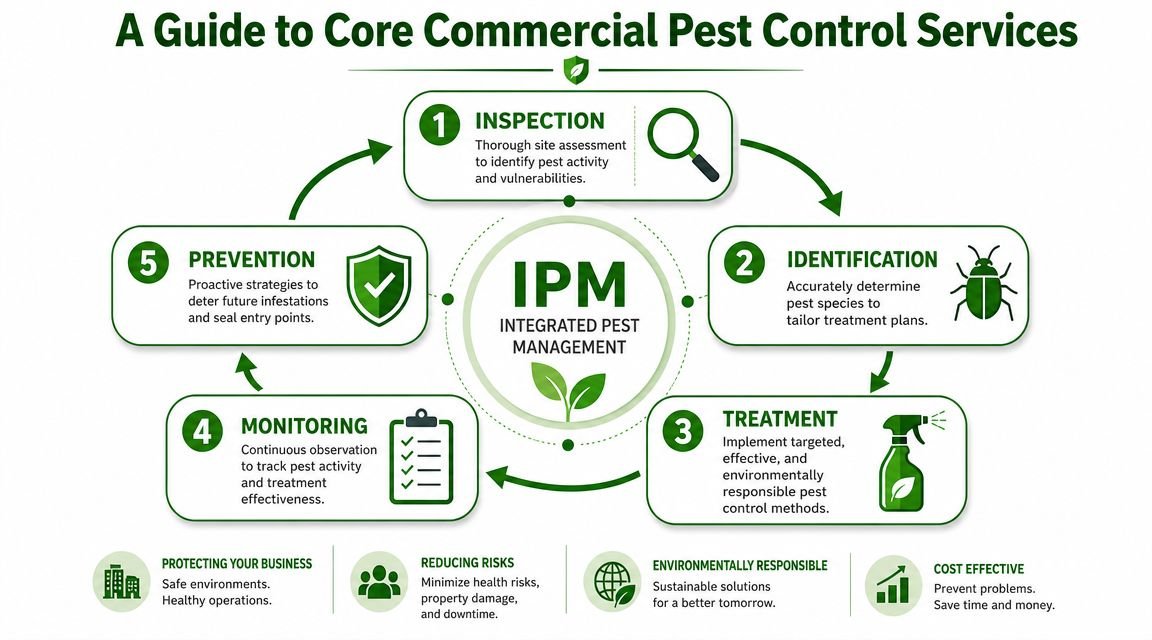
The strongest commercial programs use Integrated Pest Management, or IPM. In practice, that means fixing the conditions that let pests stay established. Cleaning gaps, moisture, clutter, storage habits, and structural entry points get addressed alongside treatment. Chemical work still has a place, especially when activity is active or sensitive accounts need quick knockdown, but it should match the pest, the area, and the operating schedule.
Inspection and identification come first
A proper commercial inspection answers three questions. Where is the activity concentrated? What conditions are supporting it? What has to change so the problem does not return after treatment?
That requires more than a quick walk-through.
In foodservice sites, the high-risk zones are usually behind cooking equipment, under sinks, around floor drains, inside dry storage, and at receiving doors. In apartment and mixed-use properties, pest pressure often builds in garbage rooms, boiler rooms, pipe chases, locker areas, and suites beside refuse chutes or shared plumbing lines. In warehouses, inspection work should follow the building the way pests use it. Perimeter walls, dock plates, staging lanes, employee break areas, and inbound shipments usually reflect the true situation.
Correct identification affects both cost and outcome. Pharaoh ants react differently than pavement ants. German cockroaches require a different approach than occasional invaders brought in through deliveries. Mice, rats, and stored product pests each call for different placement, follow-up timing, and sanitation corrections. If the species is wrong, the service plan is usually wrong too.
Treatment works when it matches the site
The right treatment in a commercial building is rarely the most visible one. It is the one that controls activity without creating unnecessary downtime, odour complaints, product exposure concerns, or repeat callbacks.
A practical plan may include:
- Targeted baiting: useful in kitchens, electrical areas, and other locations where precise placement matters more than broad application.
- Crack-and-crevice treatment: applied to harbourage zones where pests are hiding, not across open occupied surfaces.
- Trapping and mechanical control: common in offices, warehouses, food plants, and property common areas where monitoring and capture both matter.
- Exclusion work: sealing gaps at door frames, wall penetrations, dock areas, vents, and utility entries.
- Heat treatment: sometimes used for bed bugs or other specific infestations where chemical use is restricted or less practical.
Trade-offs matter. A food plant may need after-hours service to avoid production disruption. A property manager may need low-odor methods because tenants are sensitive to treatments in shared spaces. A warehouse may need rodent control built around shipping schedules so devices are placed where traffic patterns support monitoring.
For commercial properties in the GTA, Vanish Pest Control Inc. is one provider that offers commercial pest control, rodent-proofing, heat treatment, and detailed inspections. The important question is not the logo on the truck. It is whether the provider can match the method to the pest, document the work properly, and coordinate with your operations team.
Monitoring and prevention keep costs under control
Initial service handles the immediate issue. Ongoing monitoring protects the operation.
In commercial accounts, the value of monitoring is simple. It shows whether activity is dropping, shifting, or being reintroduced through shipments, waste handling, tenant behaviour, or building defects. That matters in Toronto because many businesses operate in shared buildings where one unit's sanitation failure becomes another unit's pest problem.
A prevention-focused program usually includes:
- Reviewing trap and device activity to identify recurring pressure points before they turn into visible complaints.
- Updating sanitation priorities when cleaning routines, waste storage, or product handling start attracting pests again.
- Correcting structural issues such as worn door sweeps, gaps around conduits, damaged screens, and open pipe penetrations.
- Training staff on reporting so sightings, droppings, damaged packaging, and fly activity get logged early.
- Adjusting service frequency based on season, tenant turnover, renovations, receiving volume, or changes in building use.
Commercial pest control serves as operational risk management. A restaurant uses monitoring to protect audit readiness. A property manager uses it to reduce tenant complaints and escalation. A warehouse uses it to protect inventory and avoid product contamination concerns. The businesses that stay ahead of pest issues are usually the ones that treat service reports, trend changes, and corrective actions as part of normal site management, not as cleanup after a problem gets public.
Navigating Pest Control Compliance for Toronto Businesses
A lot of commercial pest control pages talk about “helping with compliance” and leave it there. That's not enough for a Toronto food business, property manager, or facility operator. Compliance is practical. It lives in the binder, the service record, the trap map, the corrective action note, and the follow-up.
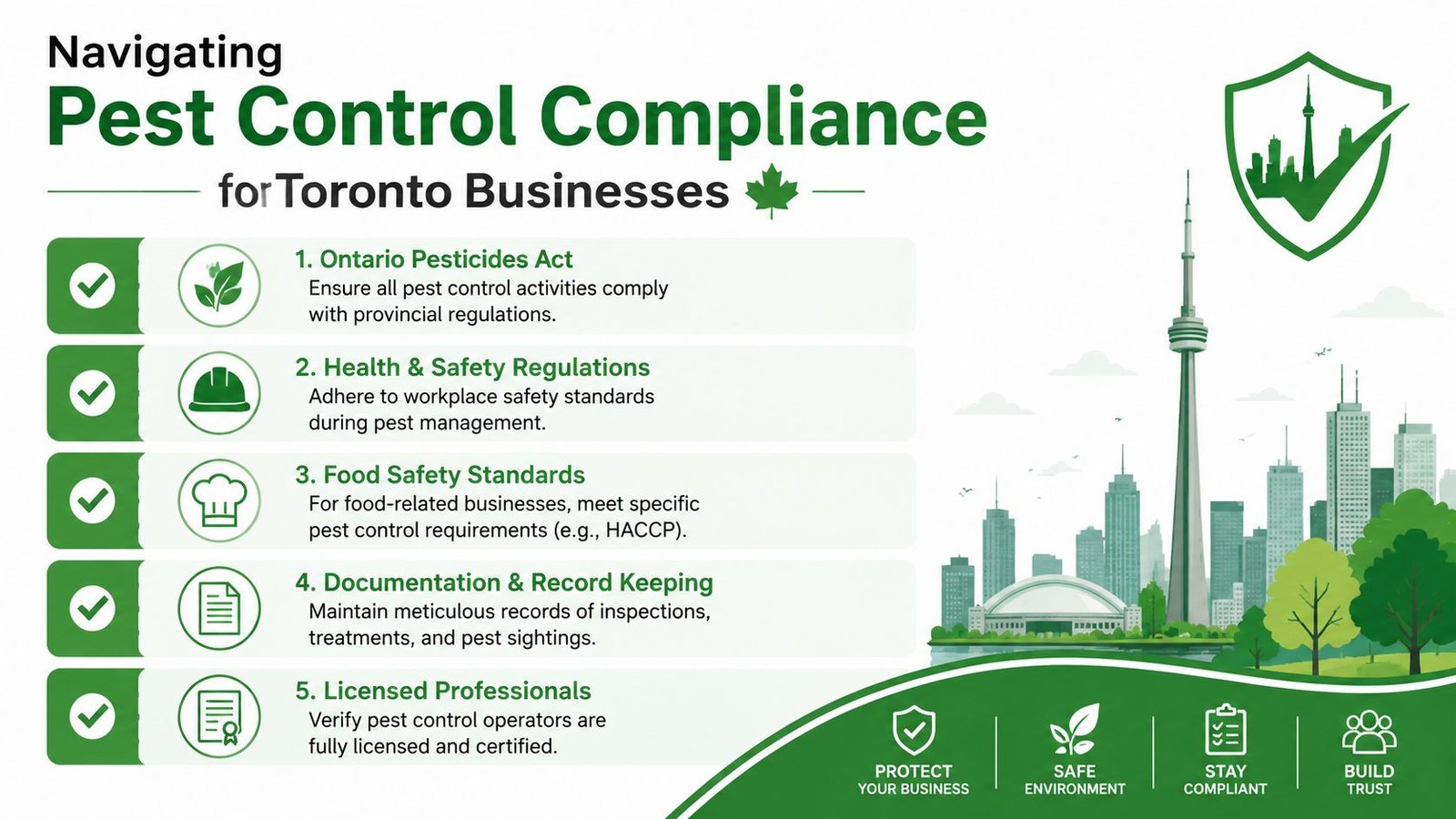
For food premises, Ontario Regulation 493/17 documentation expectations are about more than whether pests are present on the day of inspection. The expectation is proof of an active prevention program, including service logs, monitoring records, site maps, and written corrective actions taken.
What inspectors and auditors want to see
If a Toronto restaurant has no visible pests but can't produce records, the operator is in a weaker position than expected. A food business needs to show that management is actively monitoring risks and correcting conditions that allow infestations.
That usually means keeping:
- Service reports: dates, findings, treatment details, and technician notes.
- Monitoring records: trap checks, bait station reviews where used, and activity patterns.
- Site maps: clear locations for devices and monitoring points.
- Corrective action records: sealing work, sanitation fixes, storage changes, or maintenance requests.
- Internal sighting logs: staff-reported issues with date, location, and action taken.
A property manager should apply the same discipline even outside foodservice. In multi-unit and mixed-use buildings, records show whether recurring complaints are isolated tenant issues or part of a building-wide pattern. That matters when dealing with landlords, tenants, insurers, and maintenance teams.
Compliance insight: The record is part of the treatment. If a provider treats but leaves weak paperwork, the business is still exposed.
Operators managing food premises can also review practical guidance around restaurant pest control service expectations when comparing what their current provider documents versus what should be on file.
What a complete documentation system includes
Many Toronto businesses have some paperwork, but not a system. A stack of invoices in a drawer won't help much during an inspection or audit. The records need to tell a clear story: what was found, what was done, what still needs correction, and who is responsible.
A useful commercial pest control file should include three layers.
First, the service history.
This is the running log of inspections, findings, and treatments. It should be readable by someone who wasn't present on the visit.
Second, the physical map.
A site map shows trap locations, bait points where applicable, and recurring hot spots. In large Toronto buildings, that prevents missed devices and supports consistency across different technicians or shifts.
Third, the corrective action trail.
If the report says “gap under rear door,” there should be a follow-up note showing whether the door sweep was installed. If the report notes clutter in a storage room, there should be a record of cleanup or escalation to management.
That documentation does two jobs at once. It supports compliance, and it helps managers spend money where it reduces risk.
Choosing Your Commercial Pest Control Partner in Toronto
A commercial pest control provider should function like a risk-management contractor, not a spray-on-demand service. The difference shows up during the estimate. A serious provider asks about hours of operation, sanitation routines, waste flow, deliveries, structural vulnerabilities, previous pest history, and who is responsible for maintenance follow-up.
This matters more in occupied Toronto buildings, where lower-toxicity methods, exclusion, sealing, monitoring, and heat treatment can support continuity with less disruption than blanket chemical use, as outlined in this overview of low-toxicity commercial pest control approaches.
Questions that separate professionals from sprayers
Before signing a service agreement, a business owner or manager should ask direct questions.
- How is the site inspected before quoting? A proper quote usually needs a walkthrough. Phone-only pricing can miss major risk factors.
- What does the reporting include? If the answer is vague, documentation may be weak.
- How are corrective actions communicated? The provider should identify what building staff must fix.
- What is the approach in occupied spaces? Treatment choice should reflect customers, staff, food handling, and access restrictions.
- How is trend activity tracked over time? A commercial plan should show whether pressure is increasing, shifting, or stabilising.
For businesses that want a broader buyer's checklist, this guide on what to look for in a Toronto pest control company gives a useful starting point.
Some operators also look at how service companies communicate and present technical value online before making contact. That's where resources such as Transactional LLC's marketing insights can help explain how strong providers educate buyers instead of relying on fear-based sales.
Commercial Pest Control Service Models Compared
| Service Model | Best For | Cost Structure | Key Benefit |
|---|---|---|---|
| On-call only | Very low-risk sites with strong internal maintenance | Pay per visit | No routine commitment |
| Scheduled preventative service | Restaurants, offices, retail, clinics | Recurring monthly or periodic fee | Early detection and consistent records |
| Multi-site portfolio service | Property managers, franchises, mixed-use portfolios | Centralised contract with site-based scope | Consistency across locations |
| Exclusion plus monitoring program | Warehouses, industrial, recurring rodent pressure | Up-front corrective work plus ongoing checks | Reduces repeat access issues |
| Emergency response support with routine plan | Businesses with zero tolerance for visible pests | Recurring service plus callout terms | Faster stabilisation when issues appear |
Red flags during the quoting process
Some warning signs are easy to spot.
A provider who recommends heavy treatment before identifying the pest is guessing. A provider who doesn't discuss sanitation, maintenance, or entry points is treating symptoms only. A provider who can't explain how records are stored and shared may create compliance problems later.
Another red flag is overpromising speed without mentioning follow-up. In commercial pest control, fast response matters, but so does the quality of the plan after the first visit.
The ROI of Proactive Pest Management Real-World Examples
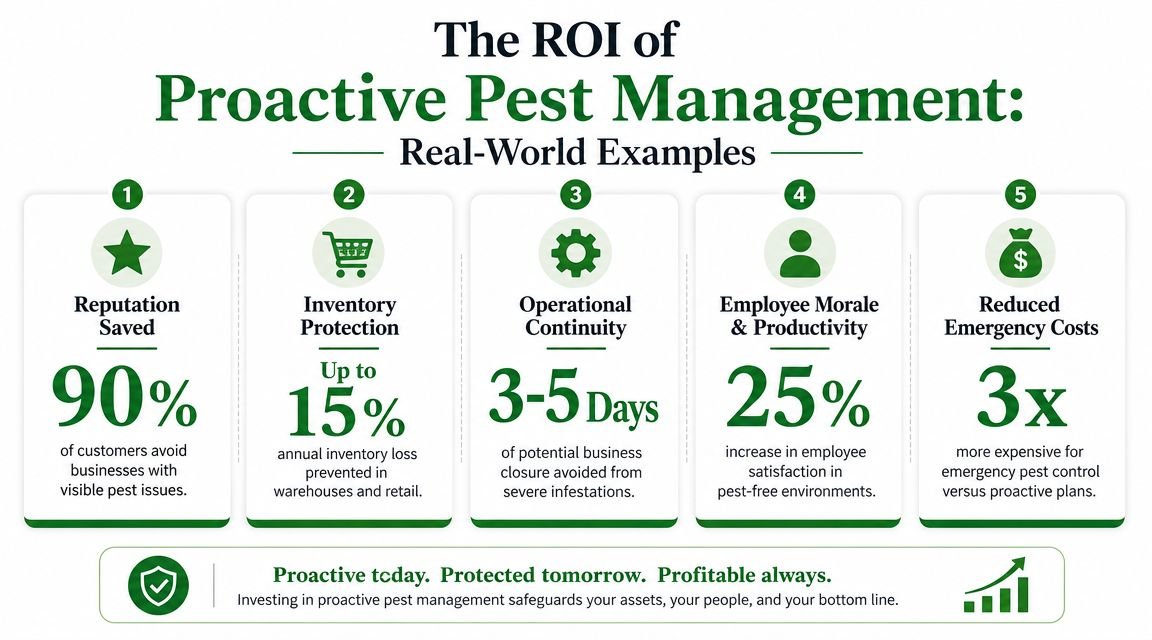
The return on commercial pest control doesn't sit in a single line item. It shows up in avoided disruption, fewer emergency calls, cleaner audits, protected stock, and fewer staff hours spent reacting to preventable issues. Toronto businesses usually feel the value most clearly when they compare two paths: controlled prevention versus repeated interruption.
Restaurant continuity depends on prevention
Consider a downtown Toronto restaurant with a clean dining room but weak back-end controls. The kitchen closes late, grease builds behind equipment, the rear delivery door doesn't seal tightly, and staff leave cardboard stacked near dry storage overnight. In that setting, a visible cockroach isn't the first problem. It is the first public sign of a deeper one.
A proactive program changes the outcome by tightening sanitation routines, inspecting harbourage zones, improving storage discipline, and documenting every correction. The operator gains more than pest reduction. The kitchen manager gains a record trail. Staff know how to report issues. Ownership avoids scrambling for emergency service during peak hours.
Businesses rarely regret prevention. They regret waiting until the pest becomes visible to customers.
Warehouses and multi-unit buildings need trend control
A warehouse in the Toronto area faces different pressure. Rodents don't care that inventory is shrink-wrapped. They look for shelter along walls, under pallets, in lunchrooms, and near dock doors that stay open too long. If the business relies only on occasional treatment, it can miss the reason activity keeps returning.
A stronger plan usually combines exclusion, monitoring, and maintenance coordination. The site seals gaps, tracks device activity, improves waste handling, and reviews receiving patterns. The result is steadier operations and fewer surprises around inventory handling.
The same logic applies to apartment and condo buildings. A property manager dealing with mice, cockroaches, ants, or wasps can't solve the issue suite by suite forever. Shared walls, risers, garbage rooms, and utility penetrations mean the building needs coordinated action. The return comes from reducing recurring complaints, limiting spread, and keeping a documented trail of due diligence.
Businesses comparing service cost against risk often benefit from reviewing a practical local breakdown of commercial and residential pest control pricing factors in Toronto. The useful question isn't “What's the cheapest visit?” It's “What does inaction cost when operations are interrupted?”
Frequently Asked Questions About Commercial Pest Control
How often should a Toronto business schedule commercial pest control service
It depends on the building type, past activity, sanitation pressure, and how much risk the operation can tolerate. Restaurants, food handling sites, and multi-unit properties usually need more frequent attention than low-traffic offices. The right schedule should come from inspection findings, not a generic package.
Are commercial pest control treatments safe for staff and customers
They should be planned around occupancy, access, and building use. In many Toronto commercial settings, lower-toxicity and non-chemical measures such as exclusion, monitoring, trapping, sanitation correction, and heat treatment are often part of the plan. A provider should explain where products are used, why they are used, and what precautions apply.
Can service be done after hours or discreetly
Yes, and many Toronto businesses prefer that. Restaurants, offices, clinics, and retail spaces often schedule inspections or treatment outside public hours to reduce disruption. Discreet service also helps when a business wants to avoid customer concern during active operations.
What pests are most common in Toronto commercial buildings
The list changes by use, but common issues include cockroaches, mice, rats, ants, carpenter ants, bed bugs in hospitality settings, wasps near entry points, and occasional wildlife around roofs, dumpsters, or service areas. Warehouses and food premises also need to watch for pests introduced through shipments and storage.
What should staff do after a pest sighting
They should log the sighting with the exact location, time, and conditions, then alert management immediately. Staff shouldn't rely on over-the-counter sprays or improvised fixes in commercial areas. One accurate report can reveal a pattern that prevents a larger issue.
What should a business keep on site for inspections or landlord audits
At minimum, keep service reports, monitoring records, site maps, internal sighting logs, and written corrective actions. The business should also know who is responsible for follow-up, such as sealing a gap, cleaning a drain, or changing storage practices.
Toronto businesses don't need generic extermination. They need a documented, prevention-first commercial pest control program that protects operations, supports compliance, and reduces repeat disruptions. Vanish Pest Control Inc. works with businesses across Toronto and the GTA on commercial pest control, rodent-proofing, inspections, and targeted treatment plans built around real property conditions.
